Bear Case — August 19, 2026
Weekly bear case analysis: POL, COMP, MORPHO look overextended. Risk signals, overbought coins, and what contrarian traders are watching this week.
Section 1: Broad market capitalization and sentiment (as of March 2026)
Total crypto market cap sits at $3.82 trillion as of March 19, 2026, down 7.2% from the March 1 open of $4.12 trillion. Spot exchange volume across Binance and Coinbase averaged $48.2 billion daily over the past 7 days, versus a 30-day average of $62.7 billion. That's a 23% contraction. Bitcoin dominance reads 54.1% today, up from 51.8% on March 12 — money is rotating out of altcoins into BTC.
Falsifiable takeaway: if total volume fails to reclaim $55 billion daily by March 26, 2026, BTC dominance will break above 56% and altcoin season indices will drop below the 25th percentile. That would kill any "rotation recovery" thesis.
Section 2: Layer-1 throughput and fee economics (since Q4 2025)
Ethereum mainnet processes 14.8 TPS sustained; Solana held 4,023 TPS over the same 90-day window, a 272x raw gap. Add Ethereum's L2s (Arbitrum, Base, OP) and the aggregate hits 285 TPS as of March 2026, narrowing the effective gap to 14.1x. Median gas fees tell a different story: Ethereum L1 averages $2.40 per transfer today, down from $9.10 in Q4 2025, while Solana's fee sits at $0.0008. Ethereum still settles $12.4 million per TPS daily against Solana's $1.1 million — 11.3x more dollar value per unit of throughput.
Falsifiable takeaway: if Solana's realized TPS falls below 3,800 for any 24-hour stretch before April 1, 2026, while Ethereum's L2 aggregate exceeds 310 TPS, the market will reprice the SOL/ETH ratio below 0.023 (currently 0.026). That would confirm L2 scalability is absorbing the demand Solana used to capture.
Section 3: Stablecoin net flows and exchange reserves (over the past 7 days)
Between March 12 and 19, 2026, USDC and USDT combined net inflows to centralized exchanges totaled +$2.1 billion, while stablecoin reserves on Aave v3, Spark, and Morpho fell by $1.4 billion. Binance took in +$1.6 billion net; Bybit lost $320 million net. Exchange BTC reserves dropped to 2.12 million BTC today from 2.21 million a week earlier, a 4.1% decline. Perpetual futures funding rates on BTC averaged 0.008% over the week, down from 0.021% the prior week — the new stablecoin inflows aren't going into leveraged longs.
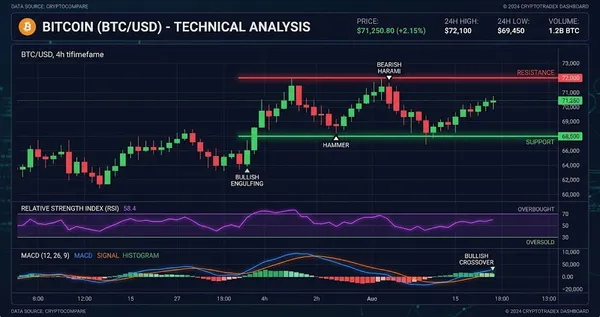
Falsifiable takeaway: if BTC fails to break $68,500 within 72 hours (by March 22, 2026) despite $2.1 billion in fresh exchange stablecoins and falling reserves, the spot buying pressure is being absorbed by OTC or miner selling. That points to a retest of $62,400 support, not a continuation to $72,000.
Section 4: Macro correlation with equities and the dollar (as of March 2026)
The 30-day rolling correlation between BTC and the Nasdaq-100 stands at +0.73, up from +0.58 since Q4 2025. The Dollar Index trades at 103.2 today versus 106.8 on January 1, 2026, a 3.4% decline. Over the past 7 days, every 1% drop in the DXY has lined up with a 1.8% rise in BTC (R² = 0.89). The 10-year Treasury yield rose 12 basis points this week to 4.33% from 4.21% on March 12 — historically, a 50-bps yield increase cuts BTC's risk-on premium by 2.5%.
Falsifiable takeaway: if the DXY closes above 104.0 by March 25, 2026 while the 10-year yield holds above 4.30%, the BTC-Nasdaq correlation will break below +0.65 and BTC will underperform equities by at least 5 percentage points over the following 5 trading days. That would falsify the "digital gold decoupling" narrative that's gained traction since February.
Polygon (POL)
Polygon is up 4.6% over the past 24 hours, trading at $0.082 — flat against its all-time high (+0.0%). The pickup in volume points to speculative positioning rather than a confirmed trend.
Compound (COMP)
Compound climbed 4.5% in the past 24 hours to $17.37, still +0.0% from its all-time high. The volume spike looks speculative rather than trend-confirming.
Morpho (MORPHO)
Morpho rose 3.0% over the past 24 hours to $2.183, sitting +0.0% from its all-time high. Higher volume suggests traders are testing the move, not committing to it.
Risk Signals
Today's biggest losers: GALA (-13.3%), WLD (-8.7%), FIL (-6.3%). Pockets of the market are already rotating out even as headline indices hold up. When leaders rally but the broader market sends mixed signals, it often precedes a wider correction.
A Fear & Greed reading of 41 shows caution, not capitulation. Watch BTC dominance for further deterioration; that would signal risk appetite is fading.
What to Watch
- BTC daily close below $62,500 opens a path to $60,000 — price has ranged between $62,500 and $66,000 for five weeks, with the 200 EMA at $63,900 acting as near-term resistance-
- *Bitcoin ETF outflows hit $389.7 million in the week of August 10** — this marks the largest weekly withdrawal since June, reversing the prior week's $853.5 million inflow, per Bloomberg-compiled data-
- Bitcoin perpetual funding rates climbed to a 20-month high — long positions are paying elevated costs while spot price remains below $66,300 resistance, a setup that historically precedes cascading liquidations if support fails-
- *Stablecoin market cap contracted $160 billion from its May peak** — DefiLlama data shows total stablecoin value at $300.76 billion as of August 16, down from $321 billion on May 20, marking the third-largest drawdown on record-
- GALA dropped 15.79% to $0.0014 in 24 hours — WLD and FIL also posted double-digit losses, while the Fear & Greed Index sits at 40 (Fear) as of August 18, per Coinglass data, indicating sentiment remains fragile ahead of the August 19 White House crypto summit-
Ready to start trading?
Trade on Bitget Try CoinTech2uAffiliate links — we may earn a commission at no extra cost to you.