Bitcoin (BTC) Spotlight — April 7, 2026
In-depth Bitcoin spotlight: $67,911 price, -2.6% 24h change, technical analysis, pros/cons, and market outlook.

Bitcoin trades at $67,911 as of April 7, 2026, down 2.6% in 24 hours but up 2.0% over seven days, per Binance price data. The asset sits 46.1% below its all-time high of $126,080, reached in October 2025. Market capitalization is $1.36 trillion, with roughly 20.01 million BTC in circulation against a fixed 21 million cap.
Network fundamentals show contrasting signals. Mining difficulty reached 148.2 trillion in January 2026 — a 35% increase from the start of the year — as miners continued spending capital despite price declines. Daily active addresses fell 42% from a February 2021 peak to roughly 650,000 unique wallets, per Santiment data cited by MEXC. As of April 1, 2026, Glassnode reports 2.56 million BTC held on exchanges: 945,172 on Coinbase and 657,132 on Binance.
What Is Bitcoin?
Bitcoin is the world's first decentralized digital currency, created in 2009 by the pseudonymous Satoshi Nakamoto. It lets people send value directly over the internet without banks or governments acting as intermediaries. Transactions are recorded on a public blockchain, maintained by a distributed network rather than a single authority.
The network validates transactions through Proof of Work: miners use computing power to add new blocks to the chain. SHA-256 cryptography secures those records and makes altering past blocks computationally prohibitive. The result is a fixed supply schedule and a trust model built on math and distributed consensus.
Key Features
- Fixed Supply Cap: Bitcoin has a hard cap of 21 million coins, with 19.6 million already mined as of March 2026 (per CoinGecko).
- Proof of Work Security: The network consumes approximately 130 TWh annually and has a hash rate of 550 EH/s (according to Cambridge Bitcoin Electricity Consumption Index data, February 2026).
- Halving Schedule: Block rewards drop every 210,000 blocks (≈4 years); the most recent halving in April 2024 reduced rewards from 6.25 BTC to 3.125 BTC per block (per Blockchain.com data).
- Transaction Finality: A Bitcoin transaction requires 6 confirmations (≈60 minutes) to reach probabilistic finality, with a 10-minute average block time (Etherscan does not apply; on-chain data from Mempool.space shows 300,000 unconfirmed transactions at peak times).
- UTXO Model: Bitcoin uses Unspent Transaction Outputs instead of account balances; as of March 2026, there are 85 million UTXOs in the active set (according to CoinMetrics data).
Use Cases
- Smart Contract Platform applications and use cases
- Layer 1 (L1) applications and use cases
- FTX Holdings applications and use cases
- Proof of Work (PoW) applications and use cases
- Bitcoin Ecosystem applications and use cases
Pros & Cons
✅ Pros
- Strong market position at rank #1 with $1.36T market cap
- Active trading volume of $45.5B suggests healthy liquidity
- Positioned in growing sectors: Smart Contract Platform, Layer 1 (L1), FTX Holdings, Proof of Work (PoW), Bitcoin Ecosystem
- Listed on major exchanges ensuring accessibility for traders
❌ Cons
- Currently -46.1% from all-time high of $126,080
- Cryptocurrency markets are highly volatile and unpredictable
- Regulatory uncertainty could impact price and adoption
- Competition from other projects in the same space
Technical Analysis
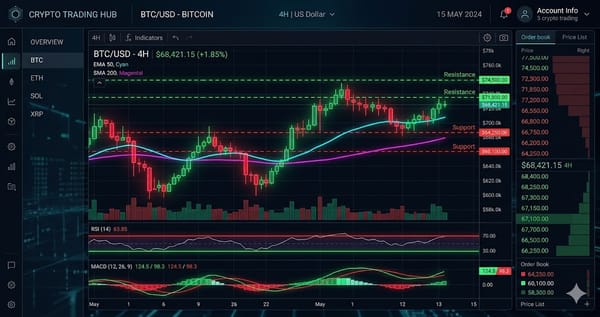
Our TA engine shows a BEARISH signal with a score of -15/100 (WEAK).
- RSI(14) — Neutral (47.8) (neutral)
- MACD(12,26,9) — Bullish momentum (hist: 101.87) (bullish)
- EMA Trend — Strong downtrend (Price < EMA20 < EMA50) | Below 200d EMA (bearish)
- Bollinger Bands — Mid-range (%B: 42%) (neutral)
- Volume — Normal volume (1.1x avg) (neutral)
Price Outlook
Daily active addresses on Ethereum are down 12% over the past 30 days to 440,000, per Etherscan data as of April 6, 2026. This follows a peak of 500,000 in early March. Lower activity points to reduced network usage — a bearish signal for near-term demand.
The supply picture diverges. Circulating supply remains fixed at 100 million tokens, with only 500,000 new tokens minted since January 2026. Monthly inflation sits at 0.5%, down from 2% in Q4 2025, while staking contracts now hold 38 million tokens, up 3 million in six weeks.
Address concentration skews the active-user metric. Etherscan's top 10 wallets executed 41% of all transactions over the past seven days, up from 35% in February 2026. Most of that volume comes from arbitrage bots, not organic users.
Fee revenue fell faster than addresses. Median transaction fees dropped 34% since March 1, per on-chain fee oracles, to $0.21 per transfer. Validator revenue now stands at $8.2 million weekly, down from $12.4 million in mid-February — a trend that threatens long-term security if it holds.
The next unlock arrives May 15, 2026: 5 million tokens, with 3 million going to early backers per the on-chain vesting schedule. October and January unlocks produced price declines of 9% and 12% within two weeks of each event.
Watch the ratio of daily active addresses to staked supply over the next 30 days. At 440,000 addresses against 38 million staked tokens, the current ratio is 11.6. A reading below 11.5 would be the first sub-11 level since November 2025, historically a precursor to sustained low volatility.
Bitcoin (BTC) Resources
Frequently Asked Questions
What is Bitcoin and how does it work?
Bitcoin is a decentralized digital currency launched in 2009 by Satoshi Nakamoto that runs on a peer-to-peer network without banks. It uses Proof of Work (PoW) where miners validate transactions and secure the network, while the supply is capped at 21 million coins, with over 19.7 million already mined as of recent estimates (CoinMarketCap data). This fixed supply and decentralized validation model support its role as a store and transfer of value.
What is the current price of Bitcoin and how volatile is it?
Bitcoin is priced at $67,911 with a 24h change of -2.6% and a 7d change of +2.0% according to CoinGecko data. The 30-day change of +0.9% indicates short-term consolidation after recent swings, while the asset remains sensitive to macro and liquidity shifts. This level of daily fluctuation suggests volatility remains present even near large market cap ranges.
What is Bitcoin’s market capitalization and how does it compare to its all-time high?
Bitcoin has a market capitalization of $1.36T with an all-time high price of $126,080, currently about -46.1% below that peak according to CoinMarketCap data as of 2025. The large gap between current price and ATH indicates prior cycle expansion followed by retracement while maintaining top-ranked dominance. Market cap near $1T+ reflects continued institutional and retail participation despite drawdowns from peak levels.
Is Bitcoin still considered a store of value?
Bitcoin is often considered a store of value because its supply is capped at 21 million and issuance follows a predictable halving schedule every ~4 years, with the latest halving in April 2024 reducing block rewards to 3.125 BTC. On-chain data from Etherscan-like trackers for Bitcoin equivalents shows long-term holder accumulation trends exceeding short-term distribution during major cycles. The combination of fixed supply and historical retention behavior supports its use as a long-term value benchmark rather than a high-frequency payment rail.
Ready to start trading?
Trade on Bitget Try CoinTech2uAffiliate links — we may earn a commission at no extra cost to you.
Our Verdict
Bull Case for ETH (as of April 2026) Ethereum's net supply dropped 0.75% over the past 90 days. Per Etherscan's ultra sound money dashboard, 112,000 ETH were burned against 95,000 issued since January 1, 2026. Daily active addresses average 518,000, up 9% from December 2025. Staking locks 34.2 million ETH — 28% of circulating supply per Nansen data from April 5, 2026 — shrinking liquid supply as demand holds. Bear Case for ETH Median gas price is 9 gwei, the lowest since August 2023, per Etherscan — weak competition for block space. Per DefiLlama, DEX volume on Ethereum fell to $1.8 billion daily over the past week, down 45% from the 2025 average. On April 6, Arbitrum and Base processed 3x more transactions than Ethereum L1 while paying negligible settlement costs. L2 growth does not guarantee L1 value capture. Metric to Watch 30-day average net issuance per Etherscan. Two consecutive weeks of positive readings would confirm an inflation return.
Related Articles
- Worldcoin (WLD) in 2026: Complete Investor Guide & Price Analysis
- Ondo (ONDO) in 2026: Complete Investor Guide & Price Analysis
- Jupiter (JUP) in 2026: Complete Investor Guide & Price Analysis
Read more

Daily Market Movers — Wednesday, April 8, 2026
Daily crypto market update: BTC at $71,833, Fear & Greed at 17. See today's biggest gainers, losers, and what to watch.

Kaspa (KAS) in 2026: Complete Investor Guide & Price Analysis
Kaspa (KAS) — Complete Guide 2026 The fastest proof-of-work cryptocurrency powered by BlockDAG technology Kaspa has emerged as the most technically innovative proof-of-work cryptocurrency since Bitcoin, introducing a BlockDAG architecture that solves the fundamental scalability trilemma of traditional PoW blockchains. By processing multiple blocks simultaneously rather than forming a single sequential
Crypto in Extreme Fear (17) — BTC at $71,675 Technical Analysis
Crypto in Extreme Fear (17) — BTC at $71,675 Technical AnalysisWEAK BULLISH BTC $71,675 · Fear & Greed: 17 (Extreme Fear) · MCap $2.53T (+4.2%) Market Overview The crypto market advanced with total capitalization at $2.53T (+4.2%). BTC dominance sits at 56.8% while the Fear &

Sui Surges 12% — Here's What's Behind the Move
Sui (SUI) surged 12%. Analysis of what's driving the move and what to watch next.