
Stacks Drops 9% — Here's What's Behind the Move
Stacks (STX) dropped 9%. Analysis of what's driving the move and what to watch next.
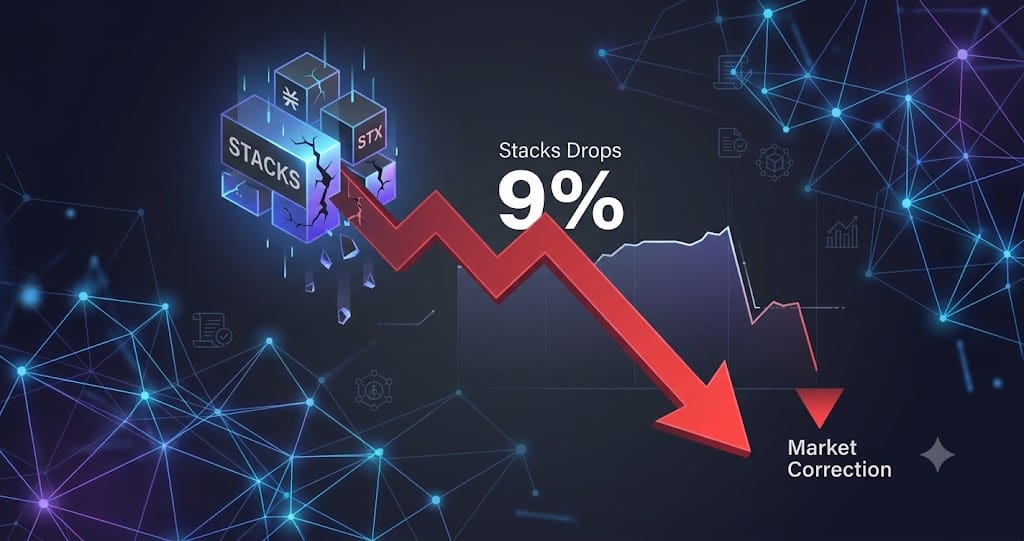
Stacks (STX) has just taken a brutal hit, shedding 8.5% in the last hour and a staggering 10.7% over the past 24 hours, with the token now trading at $0.1493. This is not a gradual bleed—it is a swift, aggressive flush that has caught many leveraged longs off guard. The move stands out as one of the sharpest single-hour drops across the top 200 assets today, and given the absence of a dedicated news catalyst for Stacks itself, we are looking at a textbook case of technical damage amplified by weak market structure and broader risk-off sentiment. With no specific protocol upgrade, security incident, or partnership announcement to pin this on, the most likely drivers are a combination of thinning liquidity, a cascading long liquidation cluster, and a macro rotation out of higher-beta Layer-1 assets as crypto sentiment continues to sour.
What’s driving the move
When an asset dumps 8.5% in sixty minutes without a direct headline, the first place to look is the derivatives book. While we do not have exact liquidation figures for STX, the velocity of the decline is highly suggestive of a long squeeze—traders who had built positions on the back of Stacks’ recent consolidation were likely levered between $0.160 and $0.165, and the break below that range triggered a cascade of stop-losses and forced liquidations. Compounding this is the fact that STX has been one of the more illiquid major altcoins, meaning a relatively moderate sell order can move the market disproportionately when bid support is thin. The 24-hour drop of 10.7% also coincides with a broader rotation away from risk assets, as evidenced by the top-ten mover list, where every single coin is in the red. There is no single "smoking gun" news event; instead, this appears to be a structural unwind where STX, having failed to hold recent support, became the focal point of aggressive selling as market makers pulled bids and high-frequency algorithms reacted to the breakdown. The lack of a fundamental catalyst actually increases the risk of further downside, as there is no "buy the news" floor to catch the fall—only technical levels and market sentiment stand in the way.
Market context
To understand STX’s plight, we have to place it side-by-side with the broader crypto landscape. Bitcoin, the anchor of the market, is down a relatively modest 0.5% at $65,330, while Ethereum has shed 2.3% to $1,879. That tells us this is not a systemic panic—it is an altcoin-led rout, with STX at the epicenter. The top-ten movers by percentage decline paint a clear picture of a risk-off rotation: DOGE falls 4.3% to $0.0694, AVAX drops 4.0% to $6.28, ADA slips 3.8% to $0.1677, and BCH declines 2.8% to $211.60. Even the more resilient names like SOL and SUI are down over 2%. STX’s hourly drop of 8.5% far outpaces the rest, making it a clear outlier, but the directional bias is unmistakable—capital is flowing out of speculative altcoins and into the safety of Bitcoin and stablecoins. The Fear & Greed Index stands at 28 (Fear), confirming that traders are skittish and unwilling to hold volatile positions into the weekend. With BTC hovering just above $65k, any further weakness in the king coin could accelerate the selling in STX, as the correlation between Bitcoin and high-beta alphas tends to increase during fearful market phases. The current environment is one of caution, where buyers are scarce and sellers are pricing in a potential retest of lower support zones.
What to Watch
- $0.140 psychological support: This is the next major round-number floor below current levels. A weekly close below $0.140 would confirm a breakdown from the multi-month range and likely open the door to a move toward the $0.120–$0.125 region. Watch for volume spikes—if selling accelerates on the break, it suggests panic liquidation rather than a healthy retest.
- Resistance at the 24-hour high ($0.167): Derived from the 10.7% drop, the pre-move level near $0.167 now serves as a critical overhead resistance. Any recovery attempt that fails below this zone will be viewed as a bearish retest, confirming that the prior support has turned into resistance. A reclaim of $0.167 on strong volume would be the first sign of a potential reversal.
- Bitcoin’s $65,330 pivot: STX’s fate is tightly linked to BTC’s reaction at $65,330. If Bitcoin breaks below this level and accelerates toward $64,500, expect STX to see another leg down, potentially testing $0.145 or lower. Conversely, a swift rebound in BTC above $66,000 could provide the risk-on tailwind needed to stabilise STX and trigger a short-squeeze bounce.
- Funding rates and open interest: While not provided in the raw data, traders should monitor perpetual swap funding rates for STX on major exchanges. A shift from positive to deeply negative funding would indicate that shorts are dominating, setting up a potential squeeze. Similarly, a sharp drop in open interest would confirm that the move is liquidation-driven and may exhaust itself quickly.
Related Articles
- Macro News & Crypto Impact — July 23, 2026
- Daily Market Movers — Thursday, July 23, 2026
- BTC at $65,680 — Daily Crypto Technical Analysis (July 23, 2026)