Breaking: Venezuela Opens Its Gold and Rare Earths to U.S. Mining
Breaking crypto market analysis: Venezuela Opens Its Gold and Rare Earths to U.S. Mining
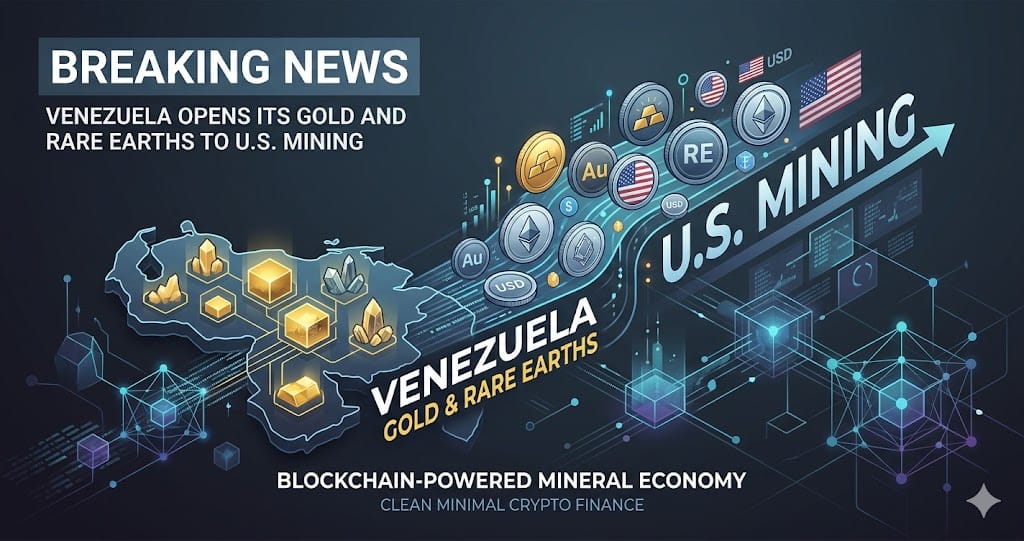
Up to 1,000 kilograms of Venezuelan gold—worth roughly $100–160 million—has begun flowing to U.S. refineries under a deal brokered with commodities trader Trafigura. Crypto traders care because large geopolitical resource deals signal shifting global power dynamics, capital flows, and macro risk—factors that often drive Bitcoin’s role as a hedge asset.
The agreement allows Venezuela’s state-owned miner Minerven to sell between 650 kg and 1,000 kg of gold doré bars (around 98% purity) to Trafigura, which will ship the metal to American refineries under U.S. government authorization. The transaction comes after Washington issued a license allowing Venezuelan gold exports to the United States and follows a broader effort to reopen Venezuela’s mining sector—including gold and rare earth elements—to foreign investment. Payments from the sales are routed through U.S.-controlled accounts before funds are released back to Venezuela under specific conditions. :contentReference[oaicite:0]{index=0}
For markets, the significance is not the gold volume itself—it is small relative to global supply—but the geopolitical implications. The deal reflects a major shift in resource alignment after years of sanctions and geopolitical tension between the United States and Venezuela. By redirecting mineral exports toward U.S. markets and away from other geopolitical partners, the agreement signals a restructuring of commodity supply chains and influence over strategic minerals.
These developments come as financial markets remain on edge. Despite Bitcoin trading at $72,348 (+3.1%) and Ethereum at $2,125 (+3.0%), the Fear & Greed Index sits at 15 (Extreme Fear), highlighting a disconnect between price rebounds and underlying investor sentiment. When crypto rises in an environment of extreme fear, it often indicates that capital is quietly rotating into alternative assets amid macro uncertainty.
The rare earth component of Venezuela’s mining reforms is particularly important. Rare earth metals are essential for advanced electronics, EV batteries, and military technologies, and the global supply chain is heavily concentrated in China. Opening Venezuela’s deposits to Western investment potentially creates a new geopolitical competition over critical minerals. For markets, such resource realignments historically coincide with increased volatility across commodities, currencies, and digital assets.
Crypto markets are especially sensitive to these shifts because they often act as a parallel macro hedge. When geopolitical resource competition intensifies, investors frequently diversify into assets perceived as politically neutral—Bitcoin being the most prominent example. That dynamic may help explain why BTC is rising alongside strong moves in high-beta altcoins like SUI (+6.6%), PEPE (+6.3%), and DOGE (+5.4%).
In the short term, the market reaction appears risk-on within crypto despite broader macro uncertainty. Altcoins are leading gains, with SUI, PEPE, and DOGE outperforming Bitcoin, suggesting speculative capital is returning after a period of heavy fear. Historically, this pattern emerges when traders believe the worst macro risks are already priced in.
However, medium-term risks remain. Resource nationalism, sanctions adjustments, and supply-chain geopolitics can quickly trigger volatility in commodities and currencies, which often spills over into crypto markets. If the Venezuela mining expansion becomes part of a broader global scramble for strategic minerals, it could amplify geopolitical tensions—an environment that typically benefits Bitcoin but creates instability across risk assets.
Bottom line: The Venezuela–U.S. gold and mining deal is less about bullion flows and more about control of strategic resources. In the current environment of extreme fear, any sign of geopolitical restructuring or commodity competition reinforces Bitcoin’s narrative as a macro hedge. That backdrop helps explain why crypto is rising even as global uncertainty remains elevated.
Related Articles
- Understanding Crypto Market Cycles: Where Are We in 2026?
- Daily Market Movers — Friday, March 13, 2026
- Daily Technical Analysis — March 13, 2026