Cardano (ADA) in 2026: Complete Investor Guide & Price Analysis

Cardano (ADA) — Complete Guide 2026
The research-driven, peer-reviewed blockchain platform built for sustainability and scalability
Cardano continues to distinguish itself in 2026 as the most academically rigorous blockchain project in the industry, trading around $0.75 and holding a top-ten market position. Founded by Ethereum co-founder Charles Hoskinson, the platform has steadily delivered on its multi-phase development roadmap, with the recent governance upgrades marking a significant milestone toward full community-driven decentralization.
For investors considering Cardano in 2026, the investment thesis centers on the platform's methodical approach to development and its growing ecosystem of DeFi protocols, real-world applications in developing nations, and a governance model that is truly novel in the blockchain space. While critics have long pointed to its slower development pace, proponents argue that peer-reviewed security is worth the wait.
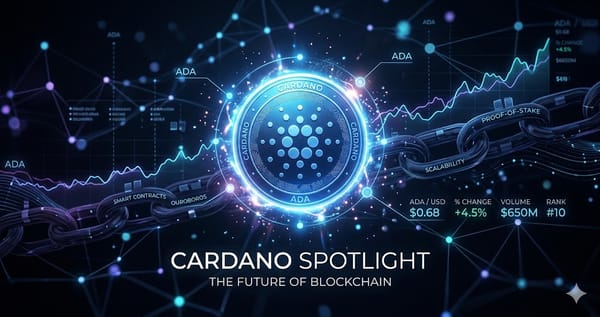
Price$0.75Market Cap$27BRank#8All-Time High$3.10Launched2017
In This Guide
What Is Cardano?
Cardano is a third-generation proof-of-stake blockchain platform founded in 2017 by Charles Hoskinson and developed by Input Output Global. What sets Cardano apart is its foundation in peer-reviewed academic research, where every protocol upgrade is formally specified, mathematically verified, and published in academic journals before implementation.
The platform uses the Ouroboros proof-of-stake consensus protocol, which was the first to be mathematically proven secure through peer review. Cardano's development has progressed through named eras including Byron, Shelley, Goguen, Basho, and Voltaire, each adding core capabilities from basic transactions to smart contracts, scaling solutions, and decentralized governance.
Key Features
- Ouroboros Consensus: Ouroboros is the first proof-of-stake protocol with mathematically proven security guarantees published in peer-reviewed academic conferences. It divides time into epochs and slots, randomly selecting stake pool operators to produce blocks in a way that is both energy-efficient and provably secure.
- Extended UTXO Model (eUTXO): Cardano uses an extended UTXO model instead of the account model used by Ethereum. This approach enables deterministic transaction outcomes, meaning users know the exact cost and result of a transaction before submitting it, eliminating failed transactions and wasted gas fees.
- Plutus Smart Contracts: Cardano's smart contract platform is built on Plutus, which uses the Haskell programming language known for its strong type safety and formal verification capabilities. This makes Cardano contracts particularly suitable for high-assurance applications in finance, identity, and governance.
- Hydra Layer 2 Scaling: Hydra is Cardano's Layer 2 scaling solution that creates isomorphic state channels called Hydra heads. Each head can process transactions independently at high speed while inheriting the security guarantees of the main chain, theoretically enabling millions of transactions per second across multiple heads.
- Voltaire Governance: The Voltaire era introduced on-chain governance that allows ADA holders to vote on treasury spending, protocol parameter changes, and constitutional amendments. This system transforms Cardano into a self-sustaining, community-governed platform with a decentralized treasury worth hundreds of millions of dollars.
Use Cases
- Decentralized identity and credential verification systems for developing nations, particularly in Africa through the Ethiopia education pilot
- DeFi protocols leveraging the eUTXO model for deterministic and predictable transaction outcomes on platforms like Minswap and SundaeSwap
- Supply chain tracking and agricultural certification using Cardano's native token standard for provenance verification
- Decentralized governance and treasury management for organizations seeking transparent, on-chain decision-making processes
- Real-world asset tokenization leveraging Cardano's formal verification capabilities for high-assurance financial applications
Pros & Cons
✅ Pros
- Peer-reviewed development methodology provides the highest level of academic rigor and security assurance of any blockchain platform
- Extremely low transaction fees, typically below $0.20, make the network accessible for everyday transactions and developing-world use cases
- Native liquid staking with no lock-up period allows ADA holders to earn rewards while retaining full access to their tokens at all times
- Voltaire governance creates a truly decentralized decision-making system backed by a substantial on-chain treasury for ecosystem funding
- Strong focus on real-world adoption in Africa and developing markets where blockchain can provide the most meaningful impact
❌ Cons
- Slower development pace compared to competitors means Cardano often delivers features months or years after rival platforms have shipped similar capabilities
- Haskell-based development using Plutus creates a steeper learning curve for developers, limiting ecosystem growth compared to Solidity-based chains
- DeFi ecosystem remains significantly smaller than Ethereum and Solana in terms of total value locked and daily active users
- Market perception as a "slow mover" has caused ADA to underperform many peers during bull markets, frustrating shorter-term investors
Price Outlook
Cardano trades around $0.75 in early 2026, well below its 2021 all-time high of $3.10, presenting a potential value opportunity if the ecosystem continues to mature. The successful launch of Voltaire governance and growing Hydra adoption for Layer 2 scaling are positive catalysts. Increasing DeFi activity on Cardano, particularly through platforms like Minswap and Liqwid, shows genuine ecosystem traction.
The primary risk for ADA is continued underperformance relative to faster-shipping competitors if developer adoption does not accelerate. Investors should watch total value locked growth, the number of active Plutus smart contracts, and Hydra head deployment as leading indicators. Cardano's methodical approach may ultimately prove its value, but patience is required as the ecosystem matures at its own deliberate pace.
Frequently Asked Questions
Is Cardano a good investment in 2026?
Cardano appeals to investors who value academic rigor and long-term sustainability over speed to market. Its low price relative to all-time highs offers potential upside, and the Voltaire governance launch marks a major milestone. However, its smaller DeFi ecosystem means growth depends on continued developer adoption.
How does Cardano staking work?
ADA staking is uniquely user-friendly because tokens are never locked and remain fully accessible in your wallet. You simply delegate to a stake pool, and rewards are distributed automatically every five days. There is no unbonding period, and you can switch pools or spend your ADA at any time.
Why is Cardano development so slow?
Cardano follows a peer-reviewed academic process where all protocol changes are formally specified, mathematically verified, and published before implementation. While this makes development slower, proponents argue it produces more secure and reliable code, reducing the risk of costly smart contract exploits.
Our Verdict
Cardano represents a unique bet in the blockchain space on the proposition that rigorous academic methodology and formal verification will win out over move-fast-and-break-things approaches in the long run. Its peer-reviewed security, liquid staking model, and Voltaire governance system are genuinely innovative. While ADA may not deliver the explosive short-term gains of higher-beta assets, it offers a compelling risk-adjusted position for investors who believe that sustainable, research-driven development will ultimately capture significant market share.
CryptoTakeProfit Research Team
Our team of analysts and traders covers the crypto market daily. We combine on-chain data, technical analysis, and fundamental research to bring you actionable insights.
Disclaimer: This article is for informational purposes only and does not constitute financial advice. Cryptocurrency investments carry significant risk. Always do your own research and never invest more than you can afford to lose. This article may contain affiliate links.