CEX vs DEX: Which Is Better for Your Trading Style in 2026?
CEX vs DEX: Which Is Better for Your Trading Style in 2026?
A practical comparison to help you choose the right exchange for every situation
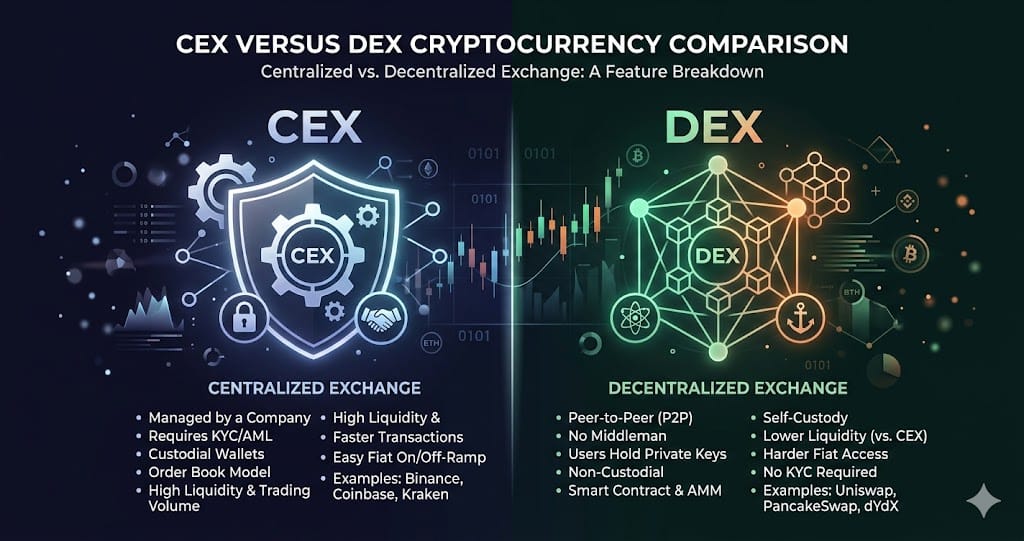
The CEX vs DEX debate has evolved beyond ideology. In 2026, both centralized and decentralized exchanges have clear strengths, and most active traders use both depending on the situation. Centralized exchanges offer speed, leverage, and fiat on-ramps. Decentralized exchanges offer self-custody, permissionless token access, and censorship resistance. The right choice depends on what you are trading, how much, and what risks you are comfortable with.
This comparison breaks down the practical differences across the factors that actually matter for day-to-day trading: execution speed, fees, token availability, security model, and user experience. By the end, you will know exactly when to use a CEX, when to use a DEX, and how to move between them efficiently.
In This Guide
- Step 1: Compare Execution Speed and Reliability
- Step 2: Compare Fees Honestly
- Step 3: Compare Token Availability
- Step 4: Compare Security Models
- Step 5: Compare Advanced Trading Features
- Step 6: Build a Practical Workflow Using Both
- Tips and Best Practices
- FAQ
What You'll Need
- An account on at least one centralized exchange (Coinbase, Binance, Kraken, etc.)
- A self-custody wallet like MetaMask, Rabby, or Phantom
- Basic understanding of how both CEX order books and DEX AMMs work
Step-by-Step Guide
Step 1
Compare Execution Speed and Reliability
Centralized exchanges execute orders in milliseconds. Their matching engines are traditional financial infrastructure that processes millions of trades per second with deterministic outcomes. You click buy, you get your tokens at the displayed price. This is critical for active traders, scalpers, and anyone using leverage where execution timing matters.
DEX execution depends on blockchain confirmation time. On Ethereum, your swap takes 12 seconds minimum. On Solana or L2s, it is 1-4 seconds. During congestion, transactions can be delayed further or fail entirely. DEX aggregators like 1inch and Jupiter optimize routing but cannot overcome blockchain latency. For time-sensitive trading, CEXs are definitively faster. For swing trades or DCA purchases, the DEX speed difference is irrelevant.
Step 2
Compare Fees Honestly
CEX fees are straightforward: a trading fee of 0.1-0.6% per trade, plus deposit and withdrawal fees that vary by network. Maker-taker models reward limit orders with lower fees. High-volume traders can get fees below 0.02% on major exchanges.
DEX fees look simple (0.05-1% pool fee) but have hidden costs. Gas fees on Ethereum can add $2-20 per swap. Slippage on large orders eats into your execution price. MEV attacks (sandwich attacks) extract additional value. On L2s and Solana, gas is negligible, making DEX total costs competitive with CEXs for most trade sizes. For trades under $10,000 on a supported L2, DEXs can actually be cheaper than CEXs after accounting for CEX withdrawal fees.
Step 3
Compare Token Availability
This is where DEXs have an unbeatable advantage. A centralized exchange lists maybe 200-500 tokens after a vetting process that takes weeks or months. A DEX has every token that exists on its chain the moment someone creates a liquidity pool, which can be within minutes of token launch. For new tokens, trending meme coins, and long-tail DeFi tokens, DEXs are the only option.
The flip side is that CEX listing is a quality filter. Tokens on Coinbase or Binance have passed some level of due diligence. DEXs list everything, including scam tokens, honeypots, and rug pulls. If you are trading blue-chip crypto like BTC and ETH, a CEX gives you better execution at lower risk. If you are hunting new opportunities in emerging tokens, DEXs are where the action is.
Step 4
Compare Security Models
When you trade on a CEX, you give the exchange custody of your funds. The exchange secures them and you trust that they will not be hacked, go bankrupt, or freeze your assets. The FTX collapse demonstrated the worst case of this trust model. Modern CEXs have improved with proof-of-reserves, regulatory oversight, and insurance funds, but counterparty risk remains real.
On a DEX, your tokens stay in your wallet until the moment of the swap, and the received tokens go directly back to your wallet. There is no counterparty holding your funds. The risk shifts to smart contract bugs and your own wallet security. If you get phished, approve a malicious contract, or lose your seed phrase, there is no customer support to help recover your funds. The CEX model is safer for less technical users; the DEX model is safer for security-conscious users who manage their own keys properly.
Step 5
Compare Advanced Trading Features
CEXs offer margin trading with up to 125x leverage, futures contracts, options, stop-loss and take-profit orders, and sophisticated order types. The trading interface resembles a professional terminal. For active traders who rely on these tools, CEXs are the only practical option. Decentralized perpetual platforms like dYdX and GMX offer leverage but with more limited order types and liquidity.
DEXs excel in DeFi composability. You can swap, provide liquidity, lend, borrow, and stake in a single transaction flow. Aggregators route across dozens of pools simultaneously. Smart contract wallets can automate multi-step strategies. For DeFi-native activities, DEXs offer capabilities that CEXs cannot replicate because the operations happen on-chain in a permissionless environment.
Step 6
Build a Practical Workflow Using Both
Most experienced traders use a hybrid approach. Fiat on-ramp and large purchases of major tokens happen on a CEX where liquidity is deepest and fees are lowest. Long-term holdings are withdrawn to self-custody. Trading on DEXs happens for new tokens, DeFi interactions, and situations where speed of access matters more than execution quality.
To move between them efficiently: buy stablecoins on a CEX, withdraw to your wallet on a cheap network like Arbitrum or Solana, then use DEXs for swaps and DeFi. When cashing out, reverse the flow: sell volatile tokens on a DEX for stablecoins, transfer stablecoins to a CEX, and withdraw fiat to your bank. This workflow minimizes fees while keeping the majority of your funds in self-custody.
Tips and Best Practices
- Use a CEX for your initial crypto purchase (fiat on-ramp), then transfer to self-custody and use DEXs for trading. This combines the strengths of both.
- For any token listed on both a CEX and DEX, compare the all-in cost (trading fee + spread + gas or withdrawal fee) before deciding where to trade.
- Keep only the funds you are actively trading on a CEX. Withdraw the rest to a hardware wallet. This limits your exposure to exchange risk.
- DEX aggregators like 1inch, Jupiter, and Paraswap often get you better prices than any single DEX by splitting your order across multiple pools.
- Enable two-factor authentication and withdrawal whitelists on every CEX account. These simple steps prevent most account compromise scenarios.
Important: Never keep more on a centralized exchange than you are willing to lose. History has shown that even large, regulated exchanges can fail. DEX token approval scams are common. Always verify the contract you are approving tokens for, and consider revoking approvals after swapping. CEX KYC data breaches have exposed user identities and addresses. Consider the privacy implications of extensive CEX usage. Switching between CEX and DEX involves withdrawal fees and bridge costs. Factor these into your trading costs to avoid hidden losses.
Ready to start trading?
Trade on Bitget Try CoinTech2u
Affiliate links — we may earn a commission at no extra cost to you.
Frequently Asked Questions
Which is safer, a CEX or DEX?
Neither is universally safer. CEXs have counterparty risk (exchange hack, bankruptcy). DEXs have smart contract risk and user error risk (phishing, lost keys). The safest approach uses both: CEX for fiat operations, DEX for DeFi, and self-custody for long-term storage.
Can I trade Bitcoin on a DEX?
Not native Bitcoin directly. You can trade wrapped Bitcoin (WBTC, tBTC) on Ethereum DEXs, or use cross-chain DEXs like THORChain that support native BTC swaps. For pure BTC trading, a CEX offers simpler execution.
Are DEX fees higher than CEX fees?
On Ethereum mainnet, yes — gas costs make small DEX trades expensive. On L2s and Solana, DEX fees are often comparable to or lower than CEX fees for trades under $10,000. Compare total cost including gas, trading fee, and slippage.
Should beginners start with a CEX or DEX?
Start with a CEX. The user experience is more forgiving, customer support exists, and the risk of irreversible mistakes is lower. Learn the basics of buying, selling, and managing crypto before graduating to DEXs and self-custody.
Alex Rivera
Crypto Educator
Alex breaks down complex crypto concepts into beginner-friendly step-by-step guides.
Disclaimer: This article is for informational purposes only and does not constitute financial advice. Cryptocurrency investments carry significant risk. Always do your own research and never invest more than you can afford to lose. This article may contain affiliate links.