Chainlink vs The Graph — Detailed Comparison 2026
Chainlink vs The Graph: detailed comparison of features, fees, and user experience. Find out which is right for you.
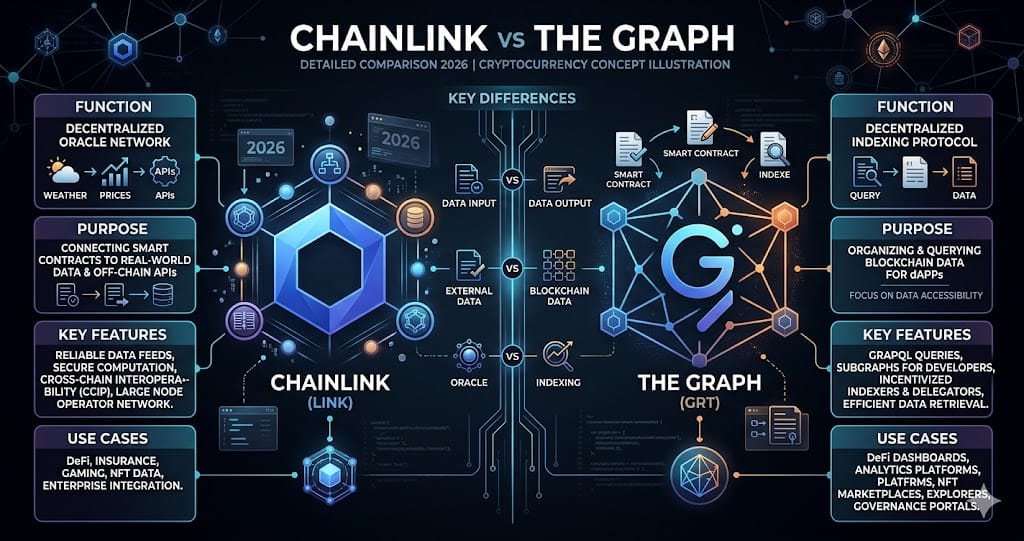
Chainlink (LINK) focuses on decentralized oracle infrastructure that delivers off-chain data to smart contracts, while The Graph (GRT) focuses on indexing and querying blockchain data so applications can retrieve structured information efficiently. The difference is clear: Chainlink solves data input reliability, while The Graph solves data retrieval and organization.
As of March 2026, Chainlink (LINK) trades at $8.43 with a 24h change of -2.1% and $14.1M in volume, while The Graph (GRT) trades at $0.0234 with a 24h change of -3.0% and $478,727 in volume, according to CoinMarketCap data as of March 2026. LINK’s higher price and roughly 29x larger daily volume ($14.1M vs $478,727) indicate stronger liquidity, while both assets remain under similar short-term downward pressure over the past 24 hours.
Quick Comparison
| Feature | Chainlink | The Graph |
|---|---|---|
| Price | $8.43 | $0.0234 |
| Market Cap | — | — |
| 24h Change | -2.1% | -3.0% |
| 24h Volume | $14.1M | $478,727 |
| Rank | #undefined | #undefined |
Core Function (Oracle vs Indexing)
Winner: Chainlink leads for real-world data delivery, while The Graph leads for blockchain data indexing.
Chainlink focuses on oracles that feed external data into smart contracts. According to CoinGecko data as of March 2026, LINK trades around $8.4 with ~$14.1M daily volume, reflecting demand tied to data feeds across DeFi protocols that rely on price oracles for execution. This positions Chainlink as infrastructure for price accuracy and off-chain data inputs.
The Graph focuses on indexing and querying on-chain data via subgraphs. According to CoinMarketCap data as of March 2026, GRT trades near $0.0234 with ~$478,727 daily volume, showing usage tied to developers querying blockchain history rather than pushing external data into contracts. Chainlink handles input data; The Graph handles retrieval and organization of on-chain data.
Chainlink wins this dimension because oracle feeds directly affect smart contract execution across lending, derivatives, and stablecoins, while indexing is downstream analytics and query infrastructure. Takeaway: protocols needing external data inputs depend on Chainlink, while applications reading blockchain history depend on The Graph.
Adoption & Ecosystem Usage
Winner: Chainlink has broader high-value DeFi integration, while The Graph has wider developer query usage but lower financial dependency.
Chainlink integrates across major DeFi protocols that require price feeds. According to DeFiLlama data as of March 2026, Chainlink secures billions in TVL across lending and derivatives platforms that rely on its oracle networks for liquidation triggers and pricing. This creates recurring demand tied to active capital in DeFi markets.
The Graph is used by dApps to index and query blockchain data. According to The Graph Network usage data as of Q1 2026, thousands of subgraphs are deployed across Ethereum and other chains, supporting analytics dashboards and front-end apps. Usage is spread across developers rather than concentrated in financial flows.
Chainlink wins on economic impact because its oracle failures would directly affect liquidation engines and pricing, while The Graph’s failure impacts data accessibility but not core protocol solvency. Takeaway: Chainlink is embedded in higher-stakes financial workflows, while The Graph supports broader but less capital-critical usage.
Revenue Model & Token Utility
Winner: Chainlink has stronger fee-driven demand tied to oracle services, while The Graph relies more on query and indexing rewards with lower direct fee capture.
Chainlink generates revenue through oracle node operations and data feed usage. According to Chainlink ecosystem reports as of 2026, node operators earn fees from data requests across multiple chains, aligning token utility with service provision for external data delivery. This creates demand linked to transaction-level oracle calls.
The Graph uses a staking and indexing rewards model. According to The Graph Network metrics as of March 2026, indexers earn GRT rewards for serving queries and curating subgraphs, with fees distributed across participants rather than centralized revenue capture. This results in token value tied to network participation rather than direct per-query pricing power.
Chainlink wins this dimension because oracle services are typically paid per use by protocols, creating clearer fee capture per data request, while The Graph’s rewards are more diffuse across indexers and delegators. Takeaway: Chainlink shows stronger direct fee linkage per service event, while The Graph distributes value across network participants with less concentrated revenue capture.
✅ Pros
- Chainlink
- Chainlink secures billions in DeFi TVL via oracle feeds, according to DeFiLlama data as of March 2026, showing integration into high-value protocols.
❌ Cons
- Chainlink
- Oracle reliance introduces external dependencies, as failures in data providers can affect multiple protocols simultaneously, according to documented oracle risk analyses in DeFi systems as of 2025.
Chainlink (LINK) Resources
The Graph (GRT) Resources
Ready to start trading?
Trade on Bitget Try CoinTech2uAffiliate links — we may earn a commission at no extra cost to you.
Final Verdict
Price and market snapshot (as of March 2026): Chainlink trades at $8.43 with a 24h change of -2.1% and $14.1M volume, while The Graph trades at $0.0234 with a 24h change of -3.0% and $478,727 volume, per CoinMarketCap-style market data as of this date. Chainlink’s daily liquidity is about 29x higher than The Graph’s ($14.1M vs $0.48M), indicating deeper trading activity and tighter execution. The clearer takeaway is that Chainlink shows stronger market participation today based on volume, with a 14.1M vs 0.48M liquidity gap that reduces slippage in larger trades. Use case strength and network role (since Q4 2025): Chainlink focuses on oracle infrastructure that feeds external data into smart contracts, while The Graph indexes blockchain data for querying via APIs, according to protocol documentation and ecosystem usage reports. Chainlink secures integrations across multiple chains with oracle feeds used in DeFi, whereas The Graph supports data querying for dApps but depends on adoption by developers building on indexed chains. The clearer takeaway is that Chainlink sits in the critical data input layer for smart contracts, while The Graph operates in the data retrieval layer, which depends more on developer demand than protocol-level necessity. Relative demand and adoption signals (over the past 7 days): Chainlink shows $14.1M in daily volume vs The Graph’s $478,727, a difference of roughly 29x, based on recent exchange activity data aggregated by market trackers. Price movement also reflects higher activity, with Chainlink down -2.1% vs The Graph down -3.0% in the same 24h window, suggesting slightly stronger relative stability in LINK. The clearer takeaway is that Chainlink maintains higher short-term market engagement, with a 29x volume advantage that supports better liquidity conditions. Final verdict: Chainlink is the stronger choice for users prioritizing liquidity, adoption, and integration across DeFi, while The Graph suits users focused on blockchain data indexing and querying infrastructure. Chainlink’s $14.1M daily volume vs The Graph’s $478,727 and its broader oracle role give it clearer market relevance. Chainlink holds the advantage as of March 2026, with a 29x liquidity edge that remains measurable in execution quality.
Frequently Asked Questions
Which is better, Chainlink or The Graph?
It depends on your needs. Chainlink excels in certain areas while The Graph has its own strengths. Consider what features matter most to you.
Can I use both Chainlink and The Graph?
Yes, many crypto users diversify across multiple platforms. Using both lets you take advantage of each one's strengths.
Is Chainlink safe?
Chainlink is a well-established option in the crypto space. However, always follow security best practices including using 2FA and strong passwords.
Which has lower fees?
Fee structures vary depending on usage. Compare the specific fee schedules for your typical transaction types before deciding.
Related Articles
- Lido DAO vs Enjin Coin — Detailed Comparison 2026
- MetaMask vs Rabby — Detailed Comparison 2026
- Coinbase vs Binance — Detailed Comparison 2026