Crypto Jargon Explained: 50 Terms Every Trader Needs to Know
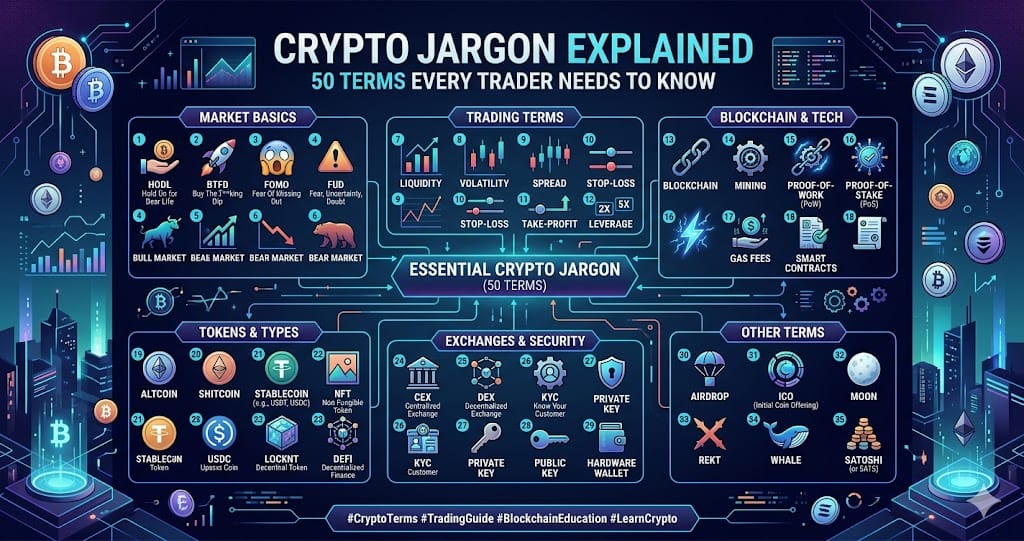
Crypto Jargon Explained: 50 Terms Every Trader Needs to Know
No-nonsense definitions for the terminology that confuses every new crypto trader
Crypto has a language problem. Every industry has its jargon, but crypto manages to combine financial terminology, computer science concepts, internet culture, and outright slang into a dialect that makes newcomers feel like they walked into a conversation in a foreign language. DYOR, gas, slippage, TVL, MEV, impermanent loss — these terms get thrown around in every Discord, every Twitter thread, and every article, usually without explanation.
This glossary covers 50 essential terms organized by category. Each definition is written in plain language with a practical example showing how the term applies to real trading decisions. Bookmark this page and come back whenever you encounter a term that does not make sense.
In This Guide
- Step 1: Blockchain and Network Terms
- Step 2: Trading and Market Terms
- Step 3: DeFi Terms
- Step 4: Wallet and Security Terms
- Step 5: Community and Culture Terms
- Step 6: Advanced and Emerging Terms
- Tips and Best Practices
- FAQ
What You'll Need
Step-by-Step Guide
Step 1
Blockchain and Network Terms
Gas — The fee you pay to process a transaction on a blockchain. On Ethereum, gas is priced in gwei (a tiny fraction of ETH). High network congestion means higher gas prices. Example: a simple ETH transfer costs about 21,000 gas units. Block — A batch of transactions processed together on the blockchain. Bitcoin creates a new block roughly every 10 minutes, Ethereum roughly every 12 seconds. Confirmation — When your transaction gets included in a block, that is one confirmation. More confirmations mean more security. Exchanges typically require 12-30 confirmations before crediting your deposit.
Layer 1 (L1) — The main blockchain: Ethereum, Bitcoin, Solana. Layer 2 (L2) — A network built on top of L1 that processes transactions faster and cheaper, then settles back to L1 for security. Arbitrum, Optimism, and Base are Ethereum L2s. Bridge — A protocol that moves tokens between different blockchains. You lock tokens on one chain and receive equivalent tokens on another. Node — A computer running blockchain software that validates and relays transactions. Consensus — The process by which nodes agree on the state of the blockchain. Proof-of-work (mining) and proof-of-stake (staking) are the two main consensus mechanisms.
Step 2
Trading and Market Terms
Slippage — The difference between the expected price of a trade and the actual execution price. Caused by low liquidity or price movement between submission and confirmation. Market Cap — Token price multiplied by circulating supply. Tells you the total value of all existing tokens. Volume — The total value of tokens traded in a given period. High volume means active trading and tighter spreads. Liquidity — How easily a token can be bought or sold without significantly moving the price. High liquidity means large orders execute smoothly.
Order Book — A list of buy and sell orders at different prices on centralized exchanges. Limit Order — An order to buy or sell at a specific price or better. Only executes if the market reaches your price. Market Order — An order that executes immediately at the best available price. Faster but you may get worse pricing. Stop-Loss — An order that automatically sells your position if the price drops to a specified level, limiting your downside. Take Profit — An order that automatically sells when the price reaches your target, locking in gains.
Step 3
DeFi Terms
DEX (Decentralized Exchange) — A trading platform that runs on smart contracts with no central authority. Uniswap, Jupiter, PancakeSwap. AMM (Automated Market Maker) — The algorithm that sets prices on DEXs using liquidity pools instead of order books. Liquidity Pool (LP) — A smart contract holding pairs of tokens that traders can swap between. LPs earn fees from trades. TVL (Total Value Locked) — The total value of crypto deposited in a DeFi protocol. Higher TVL generally means more trust and deeper liquidity.
Impermanent Loss — The loss LPs experience when the price ratio of their pooled tokens changes. Called impermanent because it reverses if prices return to the entry ratio. Yield Farming — Depositing tokens in DeFi protocols to earn rewards, often by providing liquidity or staking. Staking — Locking tokens to help secure a proof-of-stake network in exchange for rewards. APY (Annual Percentage Yield) — Your estimated annual return including compound interest. APR (Annual Percentage Rate) — Annual return without compounding. MEV (Maximal Extractable Value) — Profit that validators or bots extract by reordering transactions in a block, often at the expense of regular users through sandwich attacks or front-running.
Step 4
Wallet and Security Terms
Seed Phrase (Recovery Phrase) — The 12 or 24 words that back up your entire wallet. Anyone with these words can access all your funds. Never share them. Private Key — The cryptographic key that controls your wallet. Your seed phrase generates your private keys. Hot Wallet — A wallet connected to the internet. Convenient but more vulnerable to hacks. MetaMask, Phantom, Rabby. Cold Wallet (Hardware Wallet) — A physical device that stores your private keys offline. Ledger, Trezor. Safer for long-term storage.
Token Approval — Permission you grant a smart contract to spend your tokens. Required before swapping on a DEX. Unlimited approvals are convenient but risky if the contract is exploited. Revoke — Removing a previously granted token approval. Use tools like Revoke.cash to manage approvals. Multisig — A wallet that requires multiple signatures (keys) to authorize a transaction. Used by DAOs and teams for shared treasury management. Rugpull — When a project team drains the liquidity pool or abandons the project, taking investor funds. Honeypot — A scam token that lets you buy but blocks you from selling.
Step 5
Community and Culture Terms
DYOR (Do Your Own Research) — A reminder to investigate a project yourself before investing. Often used as a disclaimer. HODL — Holding a token long-term regardless of price drops. Originated from a misspelled Bitcoin forum post. FUD (Fear, Uncertainty, Doubt) — Negative information or sentiment, sometimes manufactured, designed to drive prices down. FOMO (Fear of Missing Out) — The anxiety that drives people to buy at the top because the price is pumping.
Whale — An entity or person holding a large amount of a token, enough to move the market when they trade. Diamond Hands — Someone who holds their position through extreme volatility without selling. Paper Hands — Someone who sells at the first sign of a price drop. Ape In — Buying a token impulsively without much research, usually driven by FOMO. NFA (Not Financial Advice) — Legal disclaimer used by crypto commentators. Bag — Your holding of a particular token. Being left holding the bag means you bought and the price collapsed.
Step 6
Advanced and Emerging Terms
Oracle — A service that feeds external data (like real-world prices) to smart contracts. Chainlink is the most widely used oracle network. Governance — The process by which token holders vote on protocol changes, fee structures, or treasury allocations. DAO (Decentralized Autonomous Organization) — An organization governed by smart contracts and token holder votes instead of a traditional management structure.
Restaking — Reusing staked tokens to secure additional protocols simultaneously, pioneered by EigenLayer. Liquid Staking — Staking tokens and receiving a liquid receipt token that represents your staked position plus rewards. RWA (Real World Assets) — Traditional assets like treasury bills, real estate, or commodities represented as tokens on a blockchain. Account Abstraction — A wallet upgrade that enables features like gas sponsorship, social recovery, and multi-signature security at the protocol level. Intent-Based Trading — A transaction model where you declare what you want to happen, and a network of solvers competes to execute it optimally. Airdrop — Free tokens distributed by a project to early users, testers, or community members as a reward or marketing strategy.
Tips and Best Practices
- When you encounter an unknown term in a Discord or Twitter thread, search for it with "crypto" and "meaning" to find relevant definitions quickly.
- Understanding gas, slippage, and token approvals will save you money immediately. These three concepts account for most costly beginner mistakes.
- Follow crypto educators on Twitter who explain concepts without shilling tokens. Good explainers make complex ideas accessible without an agenda.
- Bookmark this glossary and come back as your knowledge grows. Terms that seem abstract now will click once you have hands-on experience.
Ready to start trading?
Trade on Bitget Try CoinTech2u
Affiliate links — we may earn a commission at no extra cost to you.
Frequently Asked Questions
What is the most important term for new crypto traders to understand?
Gas fees and slippage. These directly affect how much every trade costs you. Understanding them prevents the most common beginner mistake of losing money to failed or poorly priced transactions.
Why does crypto have so much slang?
Crypto grew out of internet-native communities on forums, Reddit, and Twitter. The slang (HODL, ape in, diamond hands) emerged organically as shorthand for common experiences and became part of the culture.
What is the difference between APY and APR?
APR is the simple annual rate without compounding. APY includes the effect of compounding your returns. A 10% APR compounded monthly becomes about 10.47% APY. DeFi protocols often show APY because the number looks higher.
Alex Rivera
Crypto Educator
Alex breaks down complex crypto concepts into beginner-friendly step-by-step guides.
Disclaimer: This article is for informational purposes only and does not constitute financial advice. Cryptocurrency investments carry significant risk. Always do your own research and never invest more than you can afford to lose. This article may contain affiliate links.