Crypto Liquidation Cycles and Funding Rate Signals in 2026: How Market Stress Builds and Breaks
Learn how BTC liquidation events, funding rates, and sentiment indicators in 2026 signal market stress, short squeezes, and structural trading
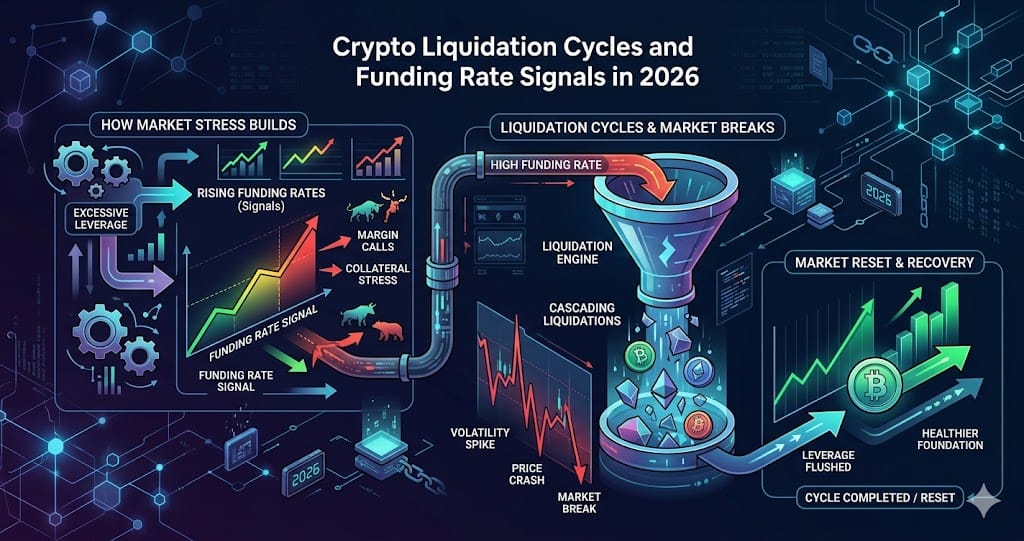
Crypto liquidation cycles in 2026 are driven by derivatives positioning rather than spot selling pressure. BTC moved above $75,000 while Fear & Greed dropped to 11 on April 8, 2026, then rebounded to 54 by April 14 before stabilizing near 45, showing extreme sentiment volatility within days. At the same time, funding rates stayed negative for over 46 days, BTC dominance reached 56.5%, and over $527M in liquidations occurred when price broke key leverage zones. This creates a structure where crowded shorts, compressed volatility, and ETF-driven inflows define market behavior rather than traditional macro signals.
In This Guide
Step-by-Step Guide
Identify Liquidation Zones in Price Structure
Liquidation events in 2026 are concentrated around specific price levels, not random volatility spikes. The most important trigger zone was BTC breaking above $75,000, which activated roughly $527M in total liquidations with over 80% from shorts. These zones form where leverage clusters accumulate across Binance, Bybit, and OKX. When price crosses these levels, cascading margin calls occur due to forced deleveraging rather than fundamental news shifts.
Track Funding Rate Duration Across Exchanges
Funding rates staying negative for extended periods is one of the strongest signals of crowded positioning. BTC funding remained negative for 46 consecutive days in April 2026, the longest streak since the 2022 post-FTX bottom. When Binance, OKX, and Hyperliquid all show synchronized negative funding, it confirms system-wide short exposure rather than isolated exchange behavior. This often precedes volatility expansion.
Combine Funding Rates with Open Interest
Open interest reached 767,000 BTC while funding stayed negative, creating a rare imbalance where traders are heavily positioned short but still paying carry costs. This is historically associated with squeeze risk conditions. High OI means leverage is already built into the system. When combined with negative funding, it indicates shorts are crowded rather than unwinding, increasing sensitivity to upside moves.
Monitor Sentiment and Volatility Compression
Fear & Greed Index moved from 11 to 54 within six days in April 2026, while VIX dropped from 31.05 to 18.92. BTC volatility also compressed to 38% annualized, one of the lowest levels in a decade. This combination signals market compression, where both emotional and volatility indicators converge into a narrow range. Such conditions typically precede directional expansion phases.
Watch ETF Flows and Institutional Positioning
ETF inflows of $257M in a single day and BlackRock IBIT accumulating $430M weekly show directional institutional demand replacing hedged arbitrage structures. At the same time, CME futures activity declined, indicating institutions are increasingly taking unhedged long exposure via ETFs. This increases directional market sensitivity.
Tips and Best Practices
- Always test with small amounts before committing significant funds.
- Bookmark the official websites of tools mentioned in this guide to avoid phishing.
- Keep detailed records of your transactions for tax reporting purposes.
Ready to start trading?
Trade on Bitget Try CoinTech2uAffiliate links — we may earn a commission at no extra cost to you.
Frequently Asked Questions
Why do liquidation events cluster around specific BTC price levels?
Because leverage is concentrated at predictable support and resistance zones where margin requirements trigger forced closures.
Does negative funding always mean a price reversal is coming?
No, but prolonged negative funding combined with high open interest increases the probability of short squeezes.
Why is BTC dominance important during liquidation cycles?
High dominance shows capital concentration in BTC, meaning altcoins are not absorbing liquidity during stress phases.
Related Articles
- DATCO Asset Class 2026: Digital Asset Treasury Companies Explained
- How to Trade Crypto in 2026: A Step-by-Step Guide for Beginners
- How to Trade Crypto Capital Flows Under Sanctions and Blackouts (2026 Guide)