Crypto Narratives June 2026: Stablecoins, ETFs, and Agentic Payments
BTC dominance at 58.7%, Altcoin Season Index at 49, GENIUS Act deadlines June 9 and July 18: where crypto capital is flowing in June 2026.
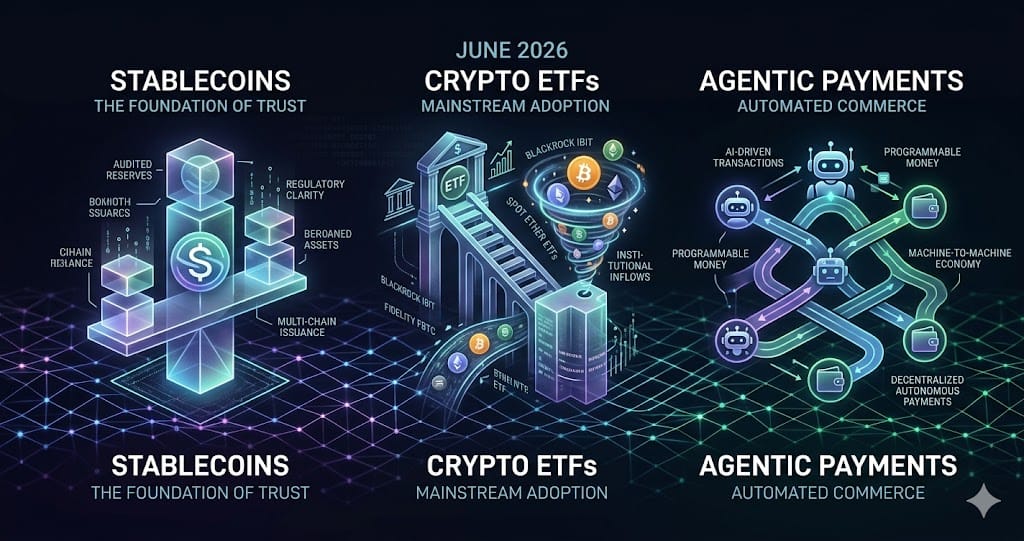
Six specific narratives are absorbing capital in June 2026 while the broader altcoin market stalls: stablecoin compliance, agentic payments, ETF supply expansion, RWA, DePIN, and AI agents. BTC dominance sits at 58.0-58.7% and the Altcoin Season Index reads 49 out of 100, well below the 75-point threshold that signals a broad rotation. Capital is not retreating; it is concentrating.
The pattern is selective allocation driven by narratives with verifiable on-chain revenue or binding regulatory timelines. On the institutional side, the GENIUS Act creates two hard deadlines in June and July 2026. On the speculative side, AI agent protocols and DePIN networks with real settlement volume are absorbing retail rotation. Memecoins and launchpad tokens are present but secondary to positions backed by transaction data.
GENIUS Act Deadlines Are the Dominant Institutional Catalyst
The GENIUS Act has two deadlines concentrating attention right now: the FinCEN-OFAC public comment period closes June 9, and the full implementing regulations under a Treasury proposal dated April 1 are scheduled to take effect July 18, 2026. These are not speculative milestones. They represent a binding legislative timeline that gives institutional stablecoin operators a defined compliance window to plan around.
Circle is the most cited beneficiary. The company reported H1 2026 revenue of approximately USD 1.25 billion, with 95.5% of that figure derived from interest on Treasury reserve holdings. In December 2025, the OCC issued national trust bank charters to five crypto institutions, including Circle operating under the entity name First National Digital Currency Bank, and Paxos. That regulatory footprint is providing the compliance foundation that underpins the broader RWA and institutional DeFi narrative.
The stablecoin total market cap has crossed USD 300 billion. Visa disclosed in Q1 2026 earnings that its annualized stablecoin settlement volume has reached USD 4.6 billion. Mastercard has opened card settlement to regulated stablecoins including USDC, RLUSD, and PYUSD across eight blockchains. These data points shift the stablecoin narrative from DeFi-native usage toward mainstream payment infrastructure.
Agentic Payments: x402 and Machine-to-Machine Settlements
The x402 protocol, developed jointly by Coinbase and Cloudflare, revives the HTTP 402 status code to allow AI agents to pay for API access in USDC on a per-request basis. As of March 2026, the protocol had processed 119 million transactions on Base and 35 million on Solana, with annualized settlement volume of approximately USD 600 million. The protocol charges zero fees at the protocol layer.
This is a structurally distinct branch of the AI narrative, separate from decentralized training projects like Bittensor or proof-of-humanity protocols. The core use case is machine-to-machine payment: an AI agent autonomously authorizing micropayments to access data, compute, or API services without human intermediation. A competing standard called AP2 has also emerged, suggesting the sector is entering a standards competition phase that typically precedes broader market recognition.
Multiple research sources now classify agentic payments as an independently investable category rather than a sub-theme of existing AI infrastructure. The combination of verifiable transaction volume, backing from regulated entities like Coinbase and Cloudflare, and USDC settlement linked to the GENIUS Act compliance narrative makes it one of the more data-grounded new categories in the current cycle.
ETF Supply Pipeline and Near-Term Market Structure
Bitwise has projected that more than 100 new crypto ETFs will launch in the US in 2026. As of this week, at least 126 ETP applications are pending with the SEC, covering assets including staked Ethereum, Dogecoin, and Chainlink. This extends the ETF narrative well beyond the BTC and ETH spot products that drove inflows through 2024 and 2025.
The near-term data creates a tension worth noting. Spot Bitcoin ETFs have seen consecutive net outflows in the current week even as the application pipeline expands. BTC dominance rising from approximately 56% to 58.0-58.7% reflects altcoins declining faster than Bitcoin rather than Bitcoin actively appreciating. The Altcoin Season Index at 49 confirms no broad rotation has started; the widely cited trigger level for wider alt performance is BTC dominance falling below 55%.
The implication for positioning is that the ETF supply expansion is a medium-term structural catalyst, not a current-week price driver. Narratives with existing on-chain revenue, including Perp DEXs such as Hyperliquid and RWA protocols such as Ondo Finance, continue to attract the selective institutional flows that define this market phase. The long tail of assets covered by pending ETF applications has not yet seen corresponding capital movement.
DePIN, RWA, and Prediction Markets: Sector Metrics That Matter
DePIN has surpassed the oracle sector in total market capitalization in 2026, with more than 650 active networks, 264 tracked tokens, and a combined market cap of USD 9.0 to 10.0 billion. The sector generated approximately USD 150 million in revenue in January 2026 alone, with a recent 30-day price increase of 24.95% across the tracked token set. These are the kinds of concrete revenue figures that the current selective market environment rewards.
RWA has grown from approximately USD 5.5 billion in on-chain value at the start of 2025 to USD 29.2 billion as of April 2026, representing more than a fivefold increase in under 18 months. Prediction markets show a larger growth curve: 2025 total volume was approximately USD 51 billion, with forward estimates of USD 240 billion in 2026 and USD 1 trillion by 2030. The 2026 and 2030 figures are analyst projections and carry uncertainty; the 2025 baseline is verifiable on-chain.
CoinGecko's published list of nine major narratives for 2026 provides a useful taxonomy: Meme Launchpads, ICO Launchpads, Prediction Markets, Privacy and ZK, Perp DEXs, Stablecoins and Stablechains, ETFs and DATcos, RWA, and Crypto Cards. Of these, Crypto Cards, ICO Launchpads, and Stablechains are the categories with the least prior-cycle precedent. The Fetch.ai token FET is identified across multiple sources as the most liquid and institutionally recognized position in the AI agent application layer, complementing Bittensor's decentralized training focus with an agent deployment and coordination angle.
What to Watch
- June 9, 2026: FinCEN-OFAC public comment deadline under the GENIUS Act, after which stablecoin implementing rules move toward the July 18 effective date
- BTC dominance at 58.0-58.7%: a sustained move below 55% is the widely cited trigger for broader altcoin rotation; the current reading reflects altcoins falling faster than Bitcoin, not Bitcoin strengthening
- x402 protocol transaction volume on Base and Solana as a leading indicator for the agentic payments sector, currently at 119 million and 35 million transactions respectively with annualized settlement near USD 600 million
- Altcoin Season Index at 49 out of 100: the 75-point level is required for confirmation of a generalized alt season; current conditions support only selective, narrative-driven short rotations
Ready to start trading?
Trade on Bitget Try CoinTech2uAffiliate links — we may earn a commission at no extra cost to you.
Frequently Asked Questions
What are the GENIUS Act deadlines in June and July 2026?
The FinCEN-OFAC public comment period on GENIUS Act implementing rules closes June 9, 2026. The full set of regulations under a Treasury proposal published April 1, 2026 is scheduled to take effect July 18, 2026. These deadlines define the compliance window that stablecoin operators including Circle and Paxos, both of which received OCC national trust bank charters in December 2025, are currently planning around.
What is the x402 protocol and why does it matter for crypto markets?
x402 is an open protocol built by Coinbase and Cloudflare that uses the HTTP 402 status code to let AI agents pay for API access in USDC on a per-request basis with no protocol fee. By March 2026, it had processed 119 million transactions on Base and 35 million on Solana, with annualized settlement volume of approximately USD 600 million. It represents a machine-to-machine payment category that is distinct from existing AI infrastructure tokens like Bittensor and is being classified by multiple analysts as an independently investable sector.
Does BTC dominance at 58.7% mean altcoins will underperform?
Not necessarily, but it does mean a broad alt season has not started. The Altcoin Season Index reads 49 out of 100 as of early June 2026, and most analysts cite 55% BTC dominance as the threshold below which broader rotation becomes likely. The current elevated dominance largely reflects altcoins declining faster than Bitcoin rather than Bitcoin actively appreciating, a condition described by market observers as passive dominance rather than active Bitcoin strength. Selective, narrative-driven rotation into categories like DePIN, RWA, and stablecoins is occurring within this environment.