Crypto Swing Trading Strategies That Actually Work in 2026
Crypto Swing Trading Strategies That Actually Work in 2026
Practical swing trading setups designed for the post-halving market cycle
Swing trading sits in the sweet spot between the stress of day trading and the patience required for long-term holding. A swing trader holds positions for days to weeks, capturing medium-term price moves without needing to monitor charts every minute. In the 2026 crypto market, where Bitcoin is navigating its post-halving price discovery phase and altcoins are cycling through sector rotations, swing trading offers some of the best risk-adjusted return opportunities available.
This guide breaks down the swing trading strategies that are producing consistent results in the current market environment. These are not theoretical setups from a textbook but practical approaches refined by traders actively navigating the 2026 bull cycle. Each strategy includes specific entry triggers, stop loss placement, target setting, and the market conditions where it works best.
Average Swing Trade Duration5-15 daysTypical Risk-Reward Ratio1:2 to 1:4Recommended Capital Allocation20-40% of trading portfolioWin Rate for Trend-Following Swings45-55% with larger winners than losers
The Pullback-to-Support Strategy
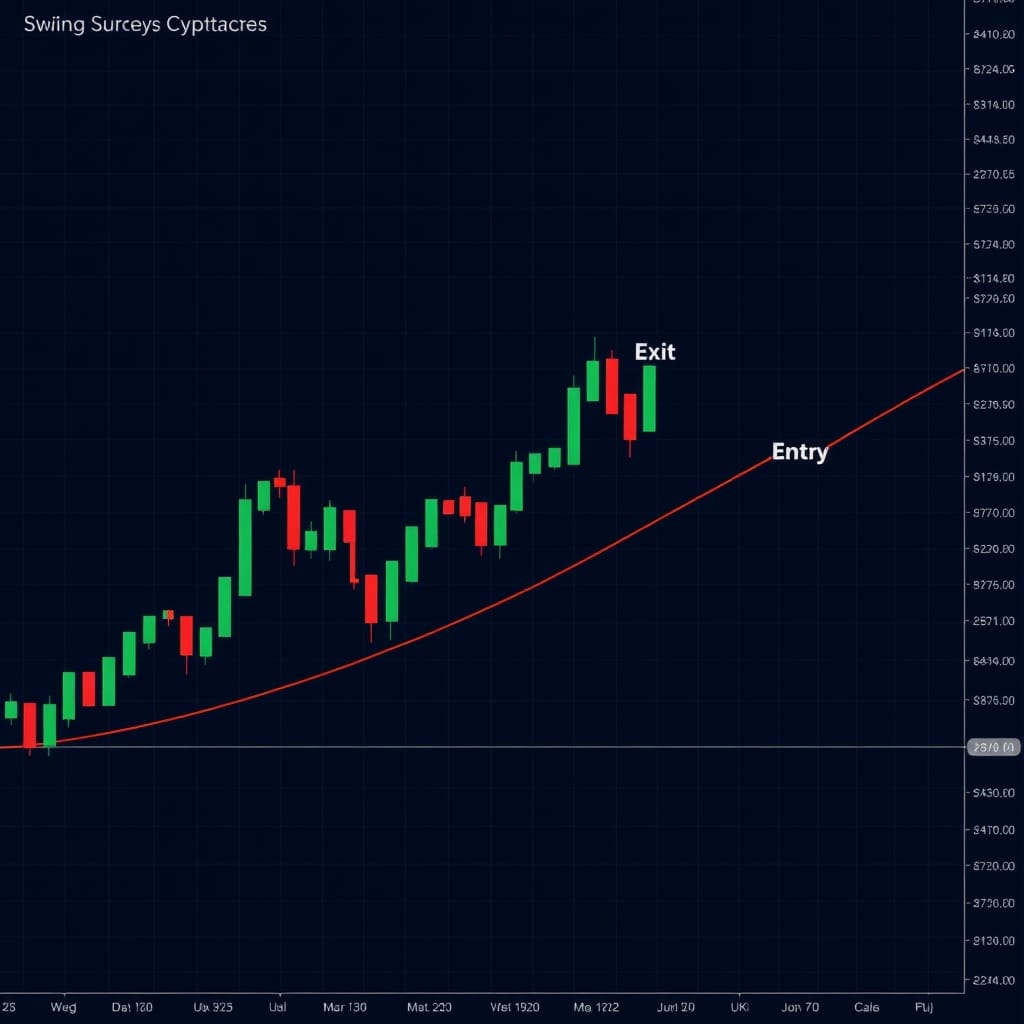
The most reliable swing trading setup in any market, including crypto, is buying pullbacks to support within an established uptrend. The concept is straightforward: identify an asset in a clear uptrend on the daily chart, wait for price to pull back to a known support level such as a previous breakout zone, a moving average, or a Fibonacci retracement level, and then enter when buying pressure returns. This strategy works because strong trends tend to continue, and pullbacks provide lower-risk entry opportunities.
In the 2026 market, the 21-day and 50-day exponential moving averages have been acting as reliable dynamic support for Bitcoin and major altcoins during the bull phase. When BTC pulls back to the 21 EMA on the daily chart and forms a bullish reversal candle like a hammer or engulfing pattern, this has consistently offered swing entries with tight stops just below the EMA and upside targets at the previous high or higher. The key is patience, waiting for the pullback to actually reach support rather than chasing the first green candle after a dip.
The Breakout and Retest Strategy
When a crypto asset breaks above a significant resistance level that it has tested multiple times, the breakout itself is often too risky to chase because many breakouts fail and reverse. The higher-probability play is to wait for the price to retest the broken resistance level as new support. This retest entry gives you confirmation that the breakout is genuine and provides a logical stop loss placement just below the retested level.
Look for assets that have been consolidating in a range for at least two to four weeks and then break above the upper boundary on above-average volume. After the breakout, price typically retests the breakout zone within one to five days. Enter when price touches or comes close to the old resistance level and shows a bullish reaction such as a bounce candle or a bullish divergence on the 4-hour RSI. Set your stop just below the retest level and target a move equal to the height of the prior consolidation range.
Mean Reversion Swings on Oversold Bounces
During the 2026 bull market, sharp corrections of 15% to 25% on major altcoins create oversold conditions that frequently snap back aggressively. Mean reversion swing trades capitalize on these overextended moves by buying when indicators reach extreme oversold readings and targeting a return to the average or mean price level. This strategy works best on high-quality assets with strong fundamentals that are unlikely to enter a sustained downtrend.
The setup requires RSI below 30 on the daily chart combined with price touching or piercing the lower Bollinger Band on default settings. For entry timing, drop to the 4-hour chart and wait for RSI to turn back above 30 or for a bullish divergence where price makes a lower low but RSI makes a higher low. Target the 20-day moving average as your initial take profit level, which typically represents a 10% to 20% recovery from the oversold extreme. This strategy has a high win rate in bull markets but should be used sparingly in bearish or uncertain conditions.
Sector Rotation Swing Trades
One of the defining characteristics of the 2026 crypto market is the rapid rotation of capital between sectors. AI tokens rally for two weeks, then capital flows into DeFi, then into layer-2 scaling solutions, then into gaming. Identifying which sector is entering a new rotation early gives swing traders an edge. Track sector performance using tools like CoinGecko categories or Messari sector indexes to spot which groups are beginning to outperform.
When a sector has been flat or declining for several weeks while the broader market trends higher, it becomes a candidate for the next rotation. Enter positions in the two or three strongest projects within that sector just as relative performance begins to improve. Hold for one to three weeks until the sector rotation matures and momentum peaks, typically signaled by excessive social media hype about the sector and late-money flooding in. Exit into strength rather than waiting for the rotation to reverse.
Risk Management for Swing Traders
Position sizing is the most critical aspect of swing trading risk management. Never risk more than 1% to 2% of your total portfolio on a single swing trade. This means that if your trading portfolio is 50,000 dollars and your stop loss is 8% below your entry, your maximum position size should be approximately 6,250 to 12,500 dollars. This ensures that a string of losing trades cannot materially damage your account.
Manage multiple open swing positions by tracking your total portfolio exposure. Having five open long swing trades means you are significantly exposed to a broad market selloff even if each individual position is properly sized. Cap your total long exposure at 40% to 60% of your portfolio during normal market conditions and reduce to 20% to 30% when macro uncertainty is elevated. Keep the remainder in stablecoins or short-term yield positions, ready to deploy when new high-quality setups appear.
Timing Entries and Exits in the Current Cycle
The 2026 market presents a unique swing trading environment because we are in the historically most bullish phase of the four-year Bitcoin cycle, approximately 18 to 24 months after the April 2024 halving. During this phase, corrections tend to be shorter and shallower than during bear markets, which means swing entries on pullbacks have a higher probability of success and faster recovery times.
Pay attention to macro catalysts that can override technical setups. Federal Reserve monetary policy decisions, US regulatory developments, and large-scale token unlock events can all trigger rapid price moves that invalidate even the best-looking chart patterns. Check the economic calendar weekly and reduce position sizes or take profits ahead of major known events. The best swing traders in 2026 are those who combine strong technical setups with awareness of the fundamental and macro backdrop.
What to Watch
- Bitcoin pullbacks to the 21-day EMA with bullish daily candle confirmation as the primary swing setup
- Ethereum relative strength versus Bitcoin as a leading indicator for altcoin rotation timing
- AI sector tokens showing accumulation patterns after multi-week consolidation phases
- Layer-2 tokens with increasing on-chain activity metrics that have not yet reflected in token price
- DeFi blue chips trading near support with daily RSI approaching oversold territory below 35
- Bitcoin dominance chart for signals of capital rotation from BTC into altcoins when dominance falls below 50%
CryptoTakeProfit Research Team
Our team of analysts and traders covers the crypto market daily. We combine on-chain data, technical analysis, and fundamental research to bring you actionable insights.
Disclaimer: This article is for informational purposes only and does not constitute financial advice. Cryptocurrency investments carry significant risk. Always do your own research and never invest more than you can afford to lose. This article may contain affiliate links.