
DePIN Crypto Sector Surges to $18.92 Billion in 2026, Overtakes Oracles
DePIN hit $18.92B across 265 tokens in 2026, doubling in two months to overtake Oracle tokens, as DePAI, Agentic Finance, and privacy data emerge.
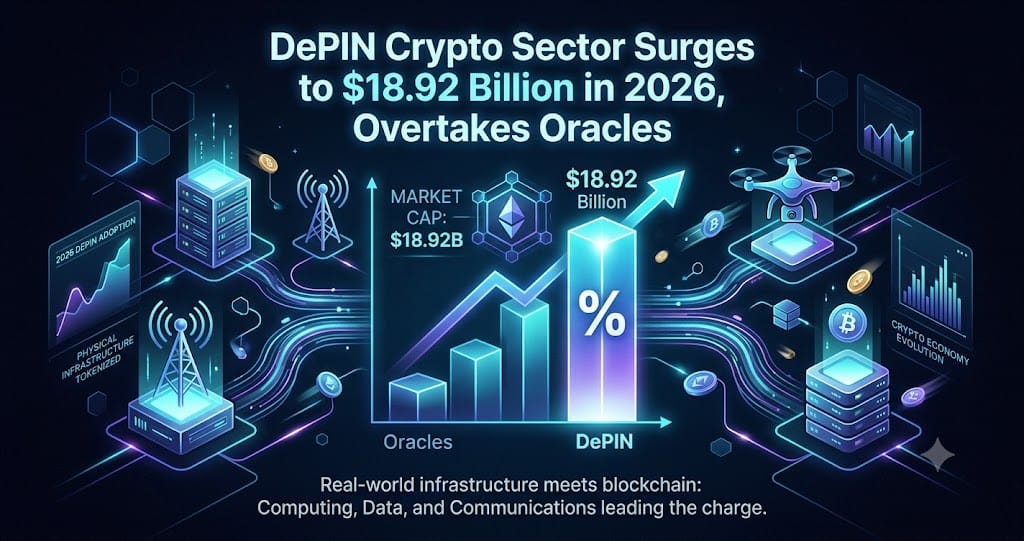
DePIN (Decentralized Physical Infrastructure Networks) tokens reached a combined market capitalization of USD 18.92 billion across 265 projects by May 2026, with USD 2.74 billion in 24-hour trading volume, according to KuCoin's sector tracking. That is roughly double the USD 9.423 billion DefiLlama recorded for the same category at the end of March 2026, a two-month climb that pushed DePIN past the Oracle category to become one of crypto's largest sectors.
The growth is not purely speculative. Aggregated revenue from paying DePIN customers, spanning storage orders, GPU compute jobs, wireless data credits, and map API calls, totaled roughly USD 150 million in January 2026 alone. Combined with the emerging DePAI (Decentralized Physical AI) subsector and the first on-chain data supporting the Agentic Finance narrative, DePIN's rise is one of the more concrete sector shifts of the current cycle.
DePIN's Two-Month Doubling and Its Real-Revenue Case
DefiLlama's Narrative Tracker put DePIN market cap at USD 9.423 billion at the end of March 2026, ranking it below Meme (USD 37.6 billion across 5,701 projects) and AI (USD 22.625 billion) but ahead of GameFi (USD 4.628 billion) and Data Availability (USD 2.062 billion) in the same snapshot. By May, KuCoin's figures show the 265-token DePIN basket at USD 18.92 billion, a move that both crosses the Oracle category and roughly doubles the March baseline in about two months.
Part of that gap likely reflects classification differences rather than pure growth, since which of the 265 tokens count as DePIN varies between trackers. Even accounting for that, the January 2026 revenue figure of about USD 150 million from paying customers, tied to storage, compute, wireless, and mapping services, gives DePIN a real-usage anchor that most narrative-driven sectors this cycle have lacked.
DePAI: Where DePIN Meets Robotics and AI Agents
DePAI, or Decentralized Physical AI, sits at the intersection of DePIN, robotics, and AI agents, built around a mechanism called Proof-of-Physical-Work (PoPW) that verifies real-world sensor and robotic activity on-chain. Named projects in the space include Helium (wireless), Hivemapper (mapping), Render (compute), BitRobot, peaq, and the robotics-focused XMAQUINA DAO.
The timing argument for DePAI centers on a 2026-to-2027 deployment window: humanoid robots are expected to enter warehouse, retail, and healthcare settings in 2026, with mass production targeted for 2027. Liquidity in DePAI-linked tokens remains thin compared with established AI names like TAO or PHALA, and the field is fragmented across a small number of named projects rather than concentrated in one leader.
Agentic Finance Gets Its First On-Chain Proof
Agentic Finance moved from narrative to data this cycle: on the Gnosis chain, AI-initiated transactions now account for more than 39 percent of Safe multisig transactions, and AI agents are contributing roughly 340,000 prediction market trades per month. That is a direct counterpoint to earlier skepticism, voiced around the x402 payment protocol, that agent-driven demand was running ahead of actual usage.
The sector also had a headline-grabbing structural event: OpenClaw was acquired by OpenAI and subsequently by Meta, cementing it as a marker project for AI-agent finance. The overlap with prediction markets is notable in itself, since AI agents' largest current use case and the Gnosis Safe data are effectively the same underlying trend viewed from two angles.
Five More Categories Reshaping the Sector Map
Several smaller but distinct categories emerged alongside DePIN and Agentic Finance. Next-generation wallets and neo-banking apps, including MetaMask, Phantom, Revolut, and X, are converging custody, payments, yield, tax, and compliance into single interfaces. A parallel category, described as Spec is Law security governance, uses deterministic, verifiable rules to block risks such as reentrancy, flash-loan attacks, oracle manipulation, and pool draining before execution, paired with AI-assisted real-time code scanning.
On-chain sovereign bonds are also expanding RWA beyond private credit and real estate, with central banks in Hong Kong, Thailand, and Brazil running tokenized government bond pilots. Privacy tokens gained harder data too: Zcash's shielded pool has tripled and fully shielded transactions now make up 20 percent of network volume, Railgun has processed USD 1.6 billion in cumulative shielded transactions, HoudiniSwap averages USD 95 million monthly, and Paxos partnered with Aleo on a compliant privacy stablecoin following the lifting of Tornado Cash sanctions. Separately, an ICO revival is forming around platforms like Legion, MetaDAO, and Coinlist, with community ICOs raising USD 341 million in the final 62 days of 2025 using bonding curves, anti-sniping mechanisms, and milestone-based unlocks.
What to Watch
- Whether DefiLlama, KuCoin, and other trackers converge on which of the 265 tokens qualify as DePIN, since classification differences explain part of the jump from USD 9.423 billion to USD 18.92 billion.
- DePAI names such as Helium, Hivemapper, Render, BitRobot, peaq, and XMAQUINA against the 2026 robotics deployment and 2027 mass-production timeline, given their thinner liquidity relative to TAO or PHALA.
- Gnosis Safe's AI-initiated transaction share, currently above 39 percent, and the roughly 340,000 monthly AI-driven prediction market trades, as a live check on whether Agentic Finance demand is real or narrative-led.
- Privacy-sector data points including Zcash's tripled shielded pool, Railgun's USD 1.6 billion cumulative shielded volume, and the Paxos-Aleo compliant privacy stablecoin following the Tornado Cash sanctions lift.
Ready to start trading?
Trade on Bitget Try CoinTech2uAffiliate links — we may earn a commission at no extra cost to you.
Frequently Asked Questions
Why did DePIN overtake the Oracle sector in 2026?
DePIN's 265-token market capitalization rose from USD 9.423 billion at the end of March 2026 to USD 18.92 billion by May, according to DefiLlama and KuCoin data. That roughly two-month doubling, combined with about USD 150 million in monthly revenue from paying customers in January 2026, pushed the sector's valuation past the Oracle category.
What is DePAI and how does it differ from DePIN?
DePAI, or Decentralized Physical AI, is a subsector at the intersection of DePIN, robotics, and AI agents, using a Proof-of-Physical-Work mechanism to verify real-world activity on-chain. Named projects include Helium, Hivemapper, Render, BitRobot, peaq, and XMAQUINA, positioned ahead of expected 2026 robotics deployments and 2027 mass production.
Is the Agentic Finance narrative backed by real usage data?
Yes, at least on Gnosis: AI-initiated transactions account for more than 39 percent of Safe multisig transactions, and AI agents generate about 340,000 prediction market trades per month. That data offers a partial counter to earlier concerns that agent-driven demand, such as around the x402 protocol, was ahead of actual need.