How to Use Grid Trading Bots for Passive Income
Automate your trading with systematic buy-low sell-high strategies Grid trading bots are automated trading systems that place a series of buy and sell orders at predetermined price intervals within a defined range, profiting from natural market oscillations without requiring you…

How to Use Grid Trading Bots for Passive Income
Automate your trading with systematic buy-low sell-high strategies
Grid trading bots are automated trading systems that place a series of buy and sell orders at predetermined price intervals within a defined range, profiting from natural market oscillations without requiring you to predict direction. In sideways or range-bound markets that crypto frequently experiences, grid bots can generate consistent returns by systematically buying dips and selling rallies around the clock.
This guide explains how grid trading works, walks you through setting up your first bot on popular platforms like 3Commas, Pionex, and Bitget, and teaches you how to choose optimal parameters including grid spacing, price range, and investment amount. You will also learn which market conditions are ideal for grid trading and how to manage the risks that can turn a profitable bot into a losing one.
What You'll Need
- A funded account on an exchange that supports grid trading bots
- Capital allocated specifically for bot trading that you can lock up for weeks or months
- Basic understanding of limit orders and how crypto trading works
- Patience to let the bot run through market cycles without interfering
Step-by-Step Guide
Step 1
Understand How Grid Trading Works
A grid trading bot divides a price range into equal intervals and places buy orders at each lower level and sell orders at each upper level. When the price drops and fills a buy order, the bot immediately places a corresponding sell order one grid level above. When the price rises and fills a sell order, it places a buy order one grid level below. Each completed buy-sell cycle captures the profit of one grid spacing.
For example, if you set a grid bot on BTC/USDT with a range of $60,000 to $70,000 and 10 grids, the bot places orders every $1,000. When Bitcoin drops from $65,000 to $64,000, the bot buys. When it bounces back to $65,000, the bot sells for a $1,000 gross profit on that grid level. This process repeats across all grid levels simultaneously, generating income from every price oscillation within the range.
Step 2
Choose the Right Market and Trading Pair
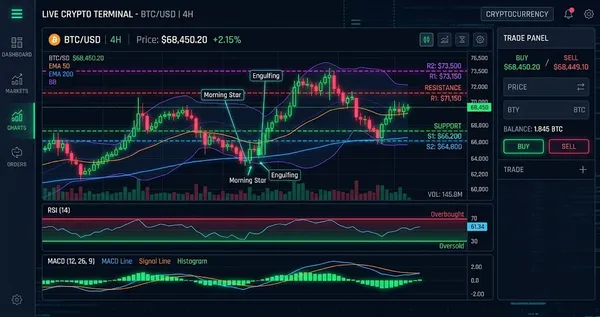
Grid bots perform best in range-bound markets where prices oscillate within a defined channel. Look for pairs with high trading volume, tight spreads, and historical price action showing clear support and resistance boundaries. Major pairs like BTC/USDT and ETH/USDT are popular choices because they have deep liquidity and frequently consolidate in ranges between major trend moves.
Avoid using grid bots on highly trending markets or low-liquidity altcoins. In a strong uptrend, you sell too early and miss the larger move. In a strong downtrend, the bot keeps buying as the price falls, leaving you holding a bag of tokens at progressively lower prices. Altcoins with thin order books can also cause poor fill prices that erode your grid profits. Stick to high-volume pairs in clearly range-bound conditions.
Step 3
Set Your Grid Parameters
The three critical parameters are the price range upper and lower bounds, the number of grids, and the total investment amount. The price range should encompass the area where you expect the price to oscillate. Study the recent price chart to identify strong support and resistance levels. Setting the range too narrow means the price frequently exits your range, while too wide spreads your capital too thin across too many levels.
The number of grids determines your profit per trade and trade frequency. More grids mean smaller profits per trade but more frequent trades, while fewer grids mean larger profits per trade but less frequent execution. A common starting point is 20 to 50 grids for major pairs. Your total investment is divided equally across all grid levels, so larger investments allow for more grids and wider ranges. Most platforms provide a recommended setup that you can adjust.
Step 4
Configure and Launch Your Bot
On your chosen platform, navigate to the trading bot section and select Grid Trading Bot. Enter your pair, price range, number of grids, and investment amount. The platform will show you the estimated profit per grid, the total number of open orders, and the amount allocated per grid level. Review these carefully to ensure they match your strategy and risk tolerance.
Many platforms offer both arithmetic grids where each level has equal spacing in absolute price terms and geometric grids where spacing is equal in percentage terms. Geometric grids are generally better for volatile assets because they maintain consistent percentage returns at each level. Launch the bot and monitor it for the first few hours to ensure orders are filling as expected. Resist the urge to shut it down during the first minor drawdown.
Step 5
Monitor Performance and Adjust Settings
Check your bot dashboard daily to review total grid profits earned, unrealized profit or loss on held tokens, and whether the current price is still within your grid range. Most platforms show both the realized grid income, which represents completed buy-sell cycles, and the total PnL which includes the floating value of tokens held at current prices.
If the price consistently sits near the top or bottom of your range, consider closing the bot and relaunching with an adjusted range centered on the current price. Some platforms offer trailing grid bots that automatically adjust the range as the price trends, reducing the need for manual intervention. Track your annualized returns by dividing total grid profits by your invested capital and the time elapsed.
Step 6
Manage the Risks of Grid Trading
The primary risk of grid trading is a sustained directional move outside your range. If the price crashes below your lower bound, the bot stops trading and you are left holding tokens bought at higher prices, effectively creating a loss. Conversely, if the price surges above your upper bound, you have sold all your tokens and hold only cash, missing the remainder of the rally.
Mitigate downside risk by setting a stop loss that closes the bot and sells all holdings if the price drops below a certain threshold beyond your range. You can also reduce risk by using only a portion of your portfolio for grid trading and by selecting pairs where you are comfortable holding the base asset long-term. Never invest your entire portfolio in a single grid bot, as one bad trend can wipe out months of accumulated grid profits.
Step 7
Scale Up and Optimize Over Time
After running a grid bot successfully for several weeks, analyze which parameter settings produced the best risk-adjusted returns. Experiment with different grid counts, range widths, and pairs. You might find that running multiple bots on different pairs with different parameters provides smoother overall returns through diversification across market conditions.
Consider reinvesting a portion of your grid profits to compound your returns. As your capital grows, you can run more bots or increase the investment per bot. Advanced strategies include running inverse grid bots that accumulate a target token during downtrends, or combining grid bots with futures hedging to create market-neutral strategies. Start simple and add complexity only as you gain experience and confidence in the mechanics.
Tips & Best Practices
- Back-test your grid parameters using historical price data before committing real capital. Many platforms offer back-testing tools that show how a grid would have performed over the past weeks or months.
- Use geometric grid spacing for volatile pairs and arithmetic spacing for stablecoins or pairs with tighter ranges.
- Set your grid range slightly wider than you think necessary to account for unexpected price wicks and short-term volatility.
- Run grid bots during periods of confirmed sideways consolidation, which you can identify by declining Bollinger Band width or ADX indicator readings below 25.
- Withdraw grid profits regularly to your main account to lock in gains rather than letting all profits sit inside the bot.
Important: Grid trading is not a risk-free passive income strategy. A sharp market downturn can erase all accumulated grid profits if you do not use a stop loss. The bot will continue buying as the price falls, increasing your exposure to a declining asset. Always size your grid bot investment as a portion of your total portfolio and accept that some grids will end in a net loss when market conditions are unfavorable.
Frequently Asked Questions
How much money do I need to start grid trading?
Most platforms allow grid bots with as little as $100 to $500, though $1,000 or more provides better diversification across grid levels. The minimum depends on the number of grids and the minimum order size on the exchange. More capital allows more grids, which captures more price oscillations and generates more consistent returns.
What returns can I expect from grid trading bots?
Returns vary widely based on market conditions. In favorable sideways markets with high volatility, grid bots can generate 1 to 5 percent monthly in grid profits. In trending markets, returns can be flat or negative. Annualized returns of 10 to 30 percent are achievable in good conditions but are not guaranteed. Always factor in the risk of holding the base asset through a downturn.
Should I use a grid bot on a centralized exchange or a DeFi protocol?
Centralized exchanges like Pionex, Bitget, and KuCoin offer the simplest grid bot setup with built-in tools, back-testing, and lower latency. DeFi grid strategies on platforms like Maverick Protocol offer non-custodial alternatives but are more complex to set up. Beginners should start with centralized exchange bots and migrate to DeFi options as they gain experience.
CryptoTakeProfit Research Team
Our team of analysts and traders covers the crypto market daily. We combine on-chain data, technical analysis, and fundamental research to bring you actionable insights.
Disclaimer: This article is for informational purposes only and does not constitute financial advice. Cryptocurrency investments carry significant risk. Always do your own research and never invest more than you can afford to lose. This article may contain affiliate links.
Try AI auto-trading on your exchange
CoinTech2U runs take-profit and grid strategies on Binance, Bybit, Bitget, and OKX. No-code setup. Performance-based pricing — you only pay when the bot generates profit.
Get Started → Learn more