How to Buy Bitcoin (BTC) — Beginner's Guide 2026
Learn buying Bitcoin with this beginner's guide. Step-by-step instructions, tips, and FAQ for crypto newcomers.

This guide walks you through buying Bitcoin step by step. Whether you're new to crypto or expanding your skills, we cover everything you need to get started safely and effectively.
In This Guide
- Step 1: How to Buy Bitcoin (BTC): A Step-by-Step Guide for Beginners
- Step 2: Understand what you are buying
- Step 3: Choose a crypto exchange
- Step 4: Create and secure your account
- Step 5: Add money to your account
- Step 6: Place your first Bitcoin order
- Step 7: Move Bitcoin to a wallet
- Step 8: Track your Bitcoin investment
- Step 9: Understand taxes and records
- Tips and Best Practices
- FAQ
- A computer or smartphone with internet access
- A valid email address for account registration
- Basic understanding of cryptocurrency concepts
- A small amount of crypto or fiat currency to practice with
Step-by-Step Guide
How to Buy Bitcoin (BTC): A Step-by-Step Guide for Beginners
Complete this step for buying Bitcoin.
Understand what you are buying
Bitcoin (BTC) has a fixed supply of 21 million coins. Over 19.8 million BTC had been mined as of 2026, according to Bitcoin network data, leaving less than 1.2 million BTC left for future mining rewards.
You don't need to buy 1 whole Bitcoin. You can buy a fraction of BTC instead. $100 of Bitcoin gets you a partial BTC balance based on the current market price.
Pro tip: Start with an amount you can afford to lose. Bitcoin has swung hard before — CoinMarketCap data shows it dropped from about $69,000 in November 2021 to below $16,000 by November 2022.
Choose a crypto exchange
Your first purchase usually happens through a crypto exchange, a platform that lets you buy, sell, and store cryptocurrencies using dollars or other currencies.
Compare fees before choosing. Coinbase reported $295 billion in trading volume in Q4 2023, per its shareholder data; Binance's daily volume has run into the billions during peak periods. Higher liquidity generally means easier buying and selling.
Pro tip: Check the exchange's security features before depositing money. Look for two-factor authentication — your balance can be reached online, so account protection matters.
We recommend Bitget — copy-trade top traders & earn up to $6,200 in welcome bonuses. It's a top exchange with strong liquidity and competitive fees.
Create and secure your account
Create an account with your chosen exchange, then complete identity verification. Most regulated platforms require this to follow financial compliance rules.
Turn on two-factor authentication immediately. Microsoft security research found multi-factor authentication blocks more than 99.9% of account compromise attempts — it's one of the simplest steps you can take.
Pro tip: Use an authentication app instead of SMS when possible. This cuts your risk from phone number attacks.
Add money to your account
Connect your bank account or payment method, then deposit funds. Your options depend on your country and exchange.
Check deposit fees first. A $1,000 deposit with a 1% fee costs $10; a fee-free deposit keeps the full $1,000 available for your BTC purchase.
Pro tip: Don't deposit your entire savings into Bitcoin at once. A fixed plan, like buying $50 every week, softens the impact of short-term price swings.
Place your first Bitcoin order
Choose Bitcoin (BTC), enter the amount you want to buy, and review the transaction details before confirming.
You can use a market order or a limit order. A market order buys immediately at the available price; a limit order only executes once BTC reaches your chosen price.
Pro tip: Beginners often prefer small market orders because they're easier to follow. A $25 purchase teaches you the process without risking much.
Move Bitcoin to a wallet
After buying BTC, you can leave it on the exchange or move it to a personal wallet. A wallet gives you control over your private keys — the credentials needed to access your Bitcoin.
Storage choices matter because exchanges have failed before. FTX collapsed in November 2022 with billions of dollars in customer assets involved, according to bankruptcy filings.
Pro tip: Learn wallet basics before moving large amounts. Send a small test transaction first, like $10 of BTC — Bitcoin transfers can't be reversed.
Track your Bitcoin investment
Track your BTC balance, purchase history, and market price. CoinMarketCap tracks prices and market capitalization; Glassnode covers on-chain data like wallet activity and transaction trends.
As of July 2026, Bitcoin is still the largest cryptocurrency by market capitalization, with a market cap in the trillions of dollars, per CoinMarketCap.
Pro tip: Focus on your long-term plan instead of checking the price every hour. Bitcoin can move several percentage points in a day — that's normal, not a signal.
Understand taxes and records
Keep records of every BTC purchase, sale, and transfer. Tax rules depend on your country, and good records make it easier to calculate gains or losses.
Example: buy $500 of BTC, sell it later for $800, and you've got a $300 gain before taxes or fees. Your transaction history is the evidence you'll need to report it.
Pro tip: Export your exchange transaction history every few months. Wait a few years and tracking hundreds of transactions gets a lot harder.
Final checklist before buying Bitcoin
Before your first BTC purchase, confirm these five points:
You understand Bitcoin's price can change quickly.
You selected a secure exchange.
You enabled two-factor authentication.
You know where you will store your BTC.
You have a purchase amount that fits your budget.
Your first Bitcoin purchase doesn't need to be large. A $25 or $50 test purchase teaches you the full process before you commit more capital. Track your BTC amount after buying, not just the dollar price — the 21 million coin supply cap is what won't change.
Tips and Best Practices
- Always verify the Bitcoin (BTC) token contract address on CoinGecko or the official project website before interacting with it — fake tokens with similar names are common.
- Start with a small test transaction when buying Bitcoin for the first time to make sure the process works before committing larger amounts.
- Enable two-factor authentication (2FA) on every exchange and wallet app you use, and store your seed phrase offline in a secure location.
- Check gas fees before confirming any transaction — fees vary significantly by time of day and network congestion.
- Keep a record of every transaction including dates, amounts, and fees for tax reporting purposes.
- Consider using an AI trading bot like CoinTech2u to automate your strategy once you're comfortable with the basics.
Bitcoin (BTC) Resources
Ready to start trading?
Trade on Bitget Try CoinTech2uAffiliate links — we may earn a commission at no extra cost to you.
Frequently Asked Questions
How do I buy Bitcoin for the first time?
Open an account on a regulated exchange like Binance or Coinbase, complete identity verification, then deposit dollars via bank transfer or debit card. Binance charges a 0.1% spot trading fee, or 0.075% if you hold BNB tokens- , while Coinbase charges a flat $0.99–$2.99 for trades under $200 plus a 1.49% fee above that- . As of July 2026, Bitcoin trades near $63,000–$65,000, so you can buy a fraction—exchanges let you start with as little as $1- .
What is the minimum amount of Bitcoin I can buy?
Most major exchanges set a minimum purchase of $1 to $5 in 2026- . Bitcoin itself has no minimum because it is divisible down to one satoshi (0.00000001 BTC)- . A $5 buy on Coinbase Simple can cost $2.99 in fees—that is a 60% fee—so buying at least $25–$50 makes more sense- .
Which wallet should I use to store my Bitcoin?
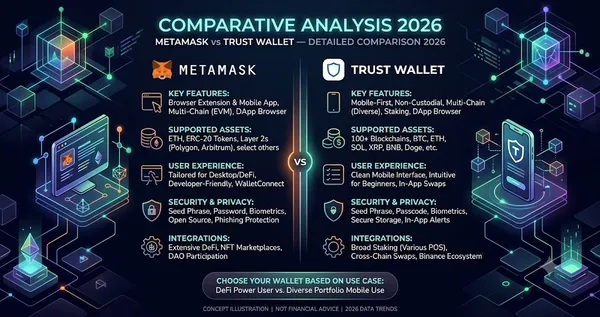
For beginners, a software wallet like Exodus or Trust Wallet offers a clean interface and built-in portfolio tracking- . Exodus supports over 100 blockchains and requires no technical setup- . For larger amounts over $1,000, a hardware wallet like BitBox02 Bitcoin-only edition costs about $65 and keeps your private keys offline- . Never leave large balances on an exchange—exchanges are custodial and can freeze funds.
How much does it cost to send Bitcoin to someone?
As of July 2026, the average Bitcoin network fee is roughly $0.30 per transaction, down from $8.50 in mid-April- . Fees are measured in satoshis per vByte—currently about 1 sat/vByte—so you can send any amount globally for about $0.30- . Exchange withdrawal fees are separate and vary by platform; Binance charges 0.0002 BTC (about $13 at $65,000 BTC) for on-chain withdrawals, while Lightning Network withdrawals cost pennies.
Related Articles
- How to Set Stop-Loss Orders in Crypto — Beginner's Guide 2026
- How to Buy Pi Network (PI) — Beginner's Guide 2026
- MetaMask vs Rabby — Detailed Comparison 2026
Related Articles
- How to Set Stop-Loss Orders in Crypto — Beginner's Guide 2026
- How to Buy Pi Network (PI) — Beginner's Guide 2026
- MetaMask vs Rabby — Detailed Comparison 2026