How to Stake Bitcoin in 2026: Babylon, Wrapped BTC, and Liquid Staking
How to Stake Bitcoin in 2026: Babylon, Wrapped BTC, and Liquid Staking
Yes, you can earn yield on BTC — here are the real options and their trade-offs
Bitcoin was never designed for staking. Its proof-of-work consensus mechanism rewards miners, not stakers, and for years the only way to earn yield on BTC was through centralized lending platforms that eventually collapsed. But the landscape has changed dramatically since 2024, and there are now multiple legitimate ways to put your Bitcoin to work without giving up custody to a centralized counterparty.
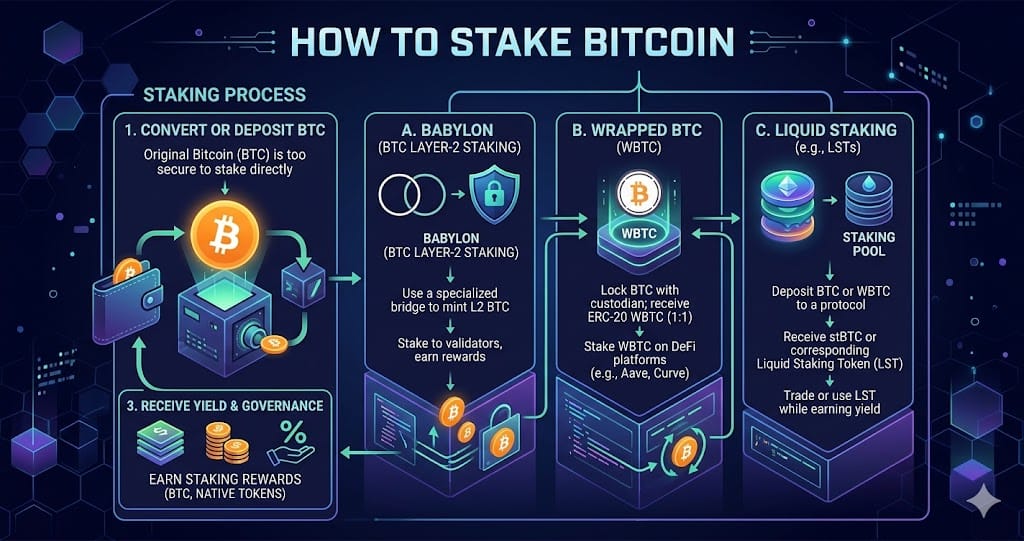
This guide covers the three main approaches to Bitcoin staking in 2026: native BTC staking through the Babylon protocol, wrapping your Bitcoin to use in Ethereum DeFi, and liquid staking tokens that let you earn yield while maintaining liquidity. Each option carries different trade-offs in terms of risk, complexity, and expected returns.
In This Guide
- Step 1: Understand Why Bitcoin Staking Is Different
- Step 2: Explore Babylon Protocol for Native BTC Staking
- Step 3: Use Wrapped Bitcoin in Ethereum DeFi
- Step 4: Try Liquid Staking for BTC
- Step 5: Compare Yields and Risks Across Options
- Step 6: Monitor Your Positions and Manage Risk
- Tips and Best Practices
- FAQ
What You'll Need
- Bitcoin in a self-custody wallet (hardware wallet recommended for large amounts)
- Basic understanding of blockchain transactions and gas fees
- An Ethereum wallet like MetaMask if using wrapped BTC options
- Willingness to accept smart contract risk in exchange for yield
- Enough BTC to justify the transaction fees (at least 0.01 BTC recommended)
Step-by-Step Guide
Step 1
Understand Why Bitcoin Staking Is Different
Traditional staking works on proof-of-stake chains where validators lock tokens to secure the network and earn rewards. Bitcoin uses proof-of-work, so there is no native staking mechanism built into the protocol. Every Bitcoin staking option involves either a separate protocol built on top of Bitcoin, or moving your BTC to another chain where staking is possible.
This means all Bitcoin staking carries additional risk beyond just holding BTC. You are trusting a bridge, a wrapper, or a new protocol with your funds. The yield you earn is compensation for that extra risk. Understanding this fundamental difference helps you evaluate whether the returns justify the exposure for your situation.
Step 2
Explore Babylon Protocol for Native BTC Staking
Babylon is the first protocol that enables native Bitcoin staking without wrapping or bridging. It uses Bitcoin script to create time-locked staking transactions directly on the Bitcoin blockchain, then provides cryptographic security to proof-of-stake chains in exchange for staking rewards. Your BTC never leaves the Bitcoin network during the staking process.
To stake through Babylon, visit the official Babylon staking dashboard and connect a compatible Bitcoin wallet. Choose a finality provider to delegate your stake to, select the amount and lock-up period, then sign the staking transaction. Your BTC will be locked on-chain for the chosen duration, and rewards accrue based on the security you provide to partner chains. Check the current APY and minimum stake requirements on the dashboard before committing.
Step 3
Use Wrapped Bitcoin in Ethereum DeFi
Wrapped Bitcoin (WBTC) and its alternatives like tBTC and cbBTC allow you to represent your Bitcoin as an ERC-20 token on Ethereum. Once wrapped, you can deposit your WBTC into lending protocols like Aave or Compound to earn interest, or provide it as liquidity on decentralized exchanges. This approach has the longest track record and deepest liquidity of any Bitcoin yield option.
To wrap your Bitcoin, use a decentralized bridge like tBTC through the Threshold Network, or a centralized custodian like BitGo for WBTC. Send your BTC to the bridge address, wait for confirmations, and receive your wrapped tokens on Ethereum. From there, connect your Ethereum wallet to a DeFi protocol and deposit your wrapped BTC. Current lending rates for WBTC on major platforms range from 0.5% to 3% APY depending on market conditions.
Step 4
Try Liquid Staking for BTC
Liquid staking protocols issue a receipt token when you deposit your BTC, allowing you to earn staking yield while still using that token elsewhere in DeFi. Protocols like Lombard (LBTC) and SolvBTC let you stake Bitcoin through Babylon or other mechanisms and receive a liquid token that represents your staked position plus accrued rewards.
The advantage of liquid staking is capital efficiency. Instead of locking your BTC for a fixed period with no access, you hold a liquid token that can be traded, used as collateral, or deposited into additional yield strategies. The trade-off is an extra layer of smart contract risk and the possibility that the liquid token depegs from BTC value during market stress.
Step 5
Compare Yields and Risks Across Options
Before committing your BTC, compare the available options side by side. Babylon native staking typically offers 3-8% APY with the lowest bridge risk but requires a lock-up period. Wrapped BTC in DeFi lending earns 0.5-3% APY with no lock-up but carries wrapping and smart contract risk. Liquid staking yields vary between 2-6% APY and offer the most flexibility but add an extra protocol layer.
Consider the size of your BTC position and your risk tolerance. For large holdings, splitting across multiple approaches reduces single-protocol exposure. For smaller amounts, the transaction fees on Ethereum may eat into your returns, making Babylon or a Solana-based option more cost-effective. Never stake more than you can afford to lose to a smart contract exploit.
Step 6
Monitor Your Positions and Manage Risk
After staking, track your positions using a portfolio tracker like DeBank or Zapper that supports the protocols you are using. Set alerts for any depegging events on liquid staking tokens, governance changes to the protocols, or security incidents that might require immediate action. Review your positions monthly to ensure the yields still justify the risk.
Have an exit plan before you stake. Know the unbonding period for Babylon staking, the unwrapping process for WBTC, and the redemption mechanism for any liquid staking tokens you hold. If a security concern arises, acting quickly with a pre-planned exit strategy can mean the difference between preserving your Bitcoin and losing it.
Tips and Best Practices
- Start with a small test amount before committing significant BTC to any staking protocol. Verify the full deposit and withdrawal process works before scaling up.
- Avoid any Bitcoin staking platform that promises fixed returns above 10% APY. Sustainable BTC yields in 2026 are in the low single digits, and anything significantly higher likely involves undisclosed risks.
- Keep your staking keys and wallet recovery phrases backed up separately from your main Bitcoin holdings. If you lose access to the wallet used for staking, recovering your position may be impossible.
- Check the audit history of any protocol before depositing. Reputable staking platforms have multiple independent audits from firms like Trail of Bits, OpenZeppelin, or Halborn.
- Consider the tax implications. In most jurisdictions, staking rewards are taxable income at the time they are received, regardless of whether you sell them.
Important: Bitcoin staking is fundamentally different from ETH staking. There is no protocol-level guarantee of returns, and every option involves trusting additional infrastructure beyond the Bitcoin network itself. Wrapped Bitcoin carries bridge risk. If the bridge or custodian is compromised, your wrapped tokens may become worthless even if your original BTC still exists. Liquid staking tokens can depeg from BTC value during market panics, meaning you could receive less BTC back than you deposited if you exit at the wrong time. Never share your private keys or seed phrase with any staking platform. Legitimate protocols interact with your wallet through standard transaction signing, never by requesting your keys directly.
Ready to start trading?
Trade on Bitget Try CoinTech2u
Affiliate links — we may earn a commission at no extra cost to you.
Frequently Asked Questions
Can I stake Bitcoin directly on the Bitcoin network?
Not through Bitcoin's own consensus mechanism, but Babylon protocol enables a form of native BTC staking where your coins remain on the Bitcoin blockchain in a time-locked transaction. This is the closest option to true native staking.
What are the risks of staking Bitcoin?
The main risks are smart contract bugs, bridge exploits for wrapped BTC, protocol insolvency, and lock-up periods that prevent you from selling during a downturn. Each staking method has different risk profiles, so research each option individually.
How much can I earn staking Bitcoin in 2026?
Realistic yields range from 0.5% to 8% APY depending on the method, market conditions, and the specific protocol. Be skeptical of any platform advertising significantly higher returns.
Is Bitcoin staking safe?
No yield opportunity is risk-free. Babylon native staking has the lowest additional risk since BTC stays on the Bitcoin chain. Wrapped BTC and liquid staking add smart contract and bridge risk. Only stake amounts you can afford to lose.
Alex Rivera
Crypto Educator
Alex breaks down complex crypto concepts into beginner-friendly step-by-step guides.
Disclaimer: This article is for informational purposes only and does not constitute financial advice. Cryptocurrency investments carry significant risk. Always do your own research and never invest more than you can afford to lose. This article may contain affiliate links.