How to Trade Crypto: A Step-by-Step Guide for Beginners (2026 Edition)
Learn about How to Trade Crypto: A Step-by-Step Guide for Beginners (2026 Edition). Practical guide with tips and FAQ.

The world of cryptocurrency trading is exciting, fast-paced, and potentially lucrative. However, it’s also a domain where the unprepared can lose money quickly. Unlike traditional stock markets, the crypto market operates 24/7, is highly volatile, and is constantly shaped by shifting global regulations.
This guide is designed to take you from a complete beginner to a confident trader. We’ll cover the essential steps, from understanding what crypto actually is to executing your first trade and, most importantly, managing your risk. We’ve also updated this edition to reflect major regulatory changes that took effect on March 23, 2026, which are reshaping how and where we trade.
In This Guide
- Step 1: Understand What You’re Trading
- Step 2: Choose Your Trading Style
- Step 3: Select a Secure Exchange (With a New Regulatory Lens)
- Step 4: Fund Your Account and Secure Your Assets
- Step 5: Master the Basics of Technical Analysis (TA)
- Step 6: Learn Risk Management (Your #1 Priority)
- Step 7: Place Your First Trade
- Step 8: Maintain a Trading Journal
- Tips and Best Practices
Step-by-Step Guide
Understand What You’re Trading
Before you spend a single dollar, you need to understand the asset class. Cryptocurrency is a digital or virtual currency secured by cryptography, making it nearly impossible to counterfeit or double-spend. Most cryptocurrencies operate on a technology called blockchain, a decentralized ledger spread across many computers that records all transactions.
Don’t just buy a coin because you saw a meme or a celebrity tweet about it. Learn the difference between:
Bitcoin (BTC): The original cryptocurrency, viewed by many as "digital gold" and a store of value.
Choose Your Trading Style
Your trading style will dictate your strategy, time commitment, and risk level. As a beginner, it’s best to start with one style and master it.
Trading Style Timeframe Effort Required Risk Level HODLing / Long-term Investing Months to Years Low Low to Medium Swing Trading Days to Weeks Medium Medium Day Trading Minutes to Hours High High Scalping Seconds to Minutes Very High Very High
For most beginners, starting with a mix of HODLing (for 70-80% of your portfolio) and swing trading (for 20-30%) is a prudent way to learn without being glued to a screen.
Select a Secure Exchange (With a New Regulatory Lens)
A cryptocurrency exchange is the platform where you’ll buy, sell, and trade your assets. As of March 23, 2026, the US regulatory landscape has fundamentally shifted. The SEC and CFTC have implemented a joint token classification framework. This means that exchanges handling assets like Bitcoin, Ethereum, Solana, and XRP are now under CFTC jurisdiction, not the SEC.
Jurisdiction & Classification: Does the exchange separate "Digital Commodities" (BTC, ETH, etc.) from "Digital Securities"? Your trading strategy may require different compliance routing.
Security: Look for exchanges with a strong track record, proof of reserves, and features like 2-Factor Authentication (2FA).
Fund Your Account and Secure Your Assets
Once your account is verified, you’ll need to deposit funds.
Deposit Fiat: Most exchanges allow you to deposit USD, EUR, or other fiat currencies via bank transfer, debit card, or credit card (credit cards often have higher fees).
Your First Purchase: Start with a major coin like Bitcoin or Ethereum. Navigate to the "Buy" section, select the coin, enter the amount, and execute the trade.
Master the Basics of Technical Analysis (TA)
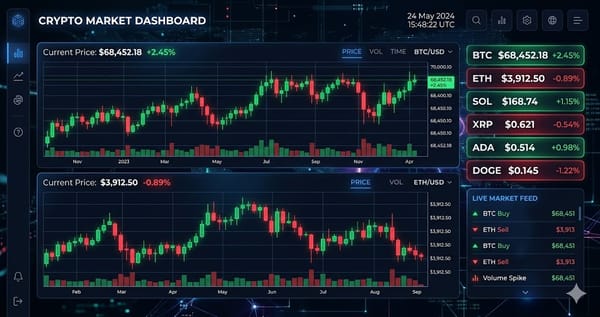
You don’t need a PhD in finance, but you do need to understand the basics of how to read a price chart. Technical analysis is the practice of evaluating an asset based on its past price and volume data to predict future movement.
Support: A price level where a downtrend tends to pause due to a concentration of buying interest. Think of it as a "floor."
Resistance: A price level where an uptrend tends to pause due to a concentration of selling interest. Think of it as a "ceiling."
Learn Risk Management (Your #1 Priority)
This is the most important step. You can be right 40% of the time and still be profitable if you manage your risk effectively.
The 1% Rule: Never risk more than 1-2% of your total trading capital on a single trade. If you have a $10,000 account, your risk per trade should be $100-$200.
Stop-Loss Orders: This is a non-negotiable tool. A stop-loss is an automatic order to sell an asset if it drops to a specific price. Before entering any trade, decide where you’ll cut your losses. “Plan the trade, and trade the plan.”
Place Your First Trade
Let’s put it all together with a simple swing trade scenario.
Scenario: You believe Bitcoin (BTC) is currently trading at a strong support level of $60,000 and will bounce up to $65,000.
Stop-Loss: Set at $59,500 (a logical point just below the support level). Your risk per coin is $500.
Maintain a Trading Journal
This is a practice that separates amateurs from professionals. Keep a record of every single trade you make, including:
Reason for the trade (e.g., “bounced off support with high volume”)
Emotions felt (e.g., “FOMO,” “Confident,” “Fearful”)
Tips and Best Practices
- Always test with small amounts before committing significant funds.
- Bookmark the official websites of tools mentioned in this guide to avoid phishing.
- Keep detailed records of your transactions for tax reporting purposes.
Ready to start trading?
Trade on Bitget Try CoinTech2uAffiliate links — we may earn a commission at no extra cost to you.
Related Articles
- Synthesia vs AI Studios 2026: Best AI Video Tool for Crypto Content Creation
- Best AI Video Tools for Crypto & Finance Creators (2026 Guide)
- Crypto vs Gaming Revenue in 2026: Step-by-Step Guide to Higher Income Channels