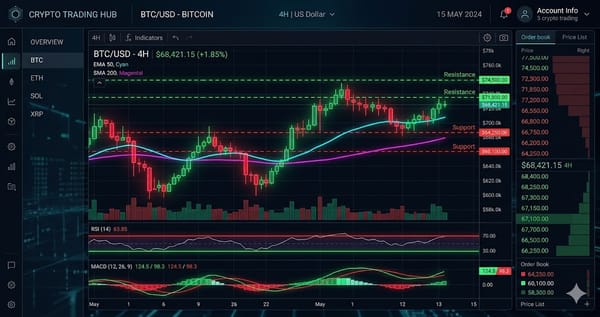
Kaspa (KAS) in 2026: Complete Investor Guide & Price Analysis
Kaspa (KAS) — Complete Guide 2026
The fastest proof-of-work cryptocurrency powered by BlockDAG technology
Kaspa has emerged as the most technically innovative proof-of-work cryptocurrency since Bitcoin, introducing a BlockDAG architecture that solves the fundamental scalability trilemma of traditional PoW blockchains. By processing multiple blocks simultaneously rather than forming a single sequential chain, Kaspa achieves one-second block times while maintaining the security and decentralization properties that make proof-of-work valuable.
Launched with a fair mining launch in November 2022 with no premine, no ICO, and no venture capital funding, Kaspa has attracted a dedicated community of miners and holders who value its grassroots ethos. For investors, KAS represents a rare opportunity to invest in genuine proof-of-work innovation that extends the Bitcoin vision of decentralized, censorship-resistant money.
Price$0.10Market Cap$2.6BRank#30All-Time High$0.20Launched2022
In This Guide
What Is Kaspa?
Kaspa is a proof-of-work cryptocurrency that uses a BlockDAG (Directed Acyclic Graph) structure instead of a traditional blockchain. Created by Yonatan Sompolinsky, the researcher who authored the PHANTOM and GHOSTDAG protocols, Kaspa allows multiple blocks to be mined and confirmed in parallel, dramatically increasing throughput without sacrificing the security properties of proof-of-work consensus.
The GHOSTDAG protocol orders all blocks in the DAG and ensures consensus even when blocks are mined simultaneously by different miners. This means blocks mined at the same time are not orphaned as wasted work, making Kaspa mining significantly more efficient than traditional PoW blockchains while enabling block rates of one per second or faster.
Key Features
- BlockDAG Architecture: Unlike traditional blockchains where simultaneous blocks create orphans and wasted work, Kaspa's BlockDAG includes all blocks mined in parallel into the ledger. The GHOSTDAG protocol orders them deterministically, enabling much higher block rates without security compromises.
- One-Second Block Times: Kaspa produces blocks approximately every second, providing rapid transaction confirmation that is unprecedented for a proof-of-work network. This speed, combined with the BlockDAG structure, delivers a user experience approaching that of proof-of-stake chains while maintaining PoW security.
- Fair Launch: Kaspa launched with no premine, no ICO, no developer allocation, and no venture capital investment. Every KAS token has been mined through proof-of-work, creating one of the fairest token distributions in the cryptocurrency industry since Bitcoin itself.
- kHeavyHash Mining Algorithm: Kaspa uses the kHeavyHash algorithm optimized for GPU and increasingly ASIC mining. The growing ASIC ecosystem for Kaspa strengthens network security through increased hashrate while improving mining efficiency and reducing the energy cost per transaction.
- Chromatic DAG: Kaspa plans to implement smart contract support through its Chromatic DAG upgrade, which would enable programmable transactions while preserving the BlockDAG's parallel processing advantages. This upgrade would expand Kaspa's use cases beyond simple value transfer.
Use Cases
- Fast proof-of-work value transfer with one-second confirmation times and strong security guarantees
- Store of value with a fair distribution model and decreasing emission schedule similar to Bitcoin's halving
- Decentralized mining accessible to GPU miners and a growing ecosystem of dedicated ASIC hardware
- Censorship-resistant payments that inherit the permissionless properties of proof-of-work consensus
- Future programmable applications through the planned Chromatic DAG smart contract implementation
Pros & Cons
✅ Pros
- Genuine technical innovation in proof-of-work consensus that solves the blockchain scalability trilemma for PoW networks
- One of the fairest launches in crypto history with zero insider allocation, matching Bitcoin's grassroots mining distribution
- One-second block times provide a dramatically better user experience than Bitcoin's ten-minute confirmations
- Growing ASIC mining ecosystem strengthens network security and demonstrates long-term infrastructure investment
- Created by a leading academic researcher whose GHOST and GHOSTDAG papers are cited in the Ethereum whitepaper
❌ Cons
- Proof-of-work faces ongoing environmental criticism and regulatory headwinds in some jurisdictions
- No smart contract support yet limits use cases to value transfer and basic transactions
- Relatively small market cap and community compared to established PoW chains like Bitcoin and Litecoin
- ASIC development concentration could lead to mining centralization similar to concerns in other PoW networks
Price Outlook
KAS trades at approximately $0.10 in early 2026, having grown from near-zero at launch to a multi-billion dollar market cap purely through mining and organic community growth. The primary price catalysts include smart contract deployment through Chromatic DAG, growing mining hashrate, potential exchange listings, and the broader narrative around PoW fairness and decentralization in contrast to VC-funded proof-of-stake tokens.
Investors should monitor mining hashrate growth, daily transaction volume, developer progress on smart contracts, and community growth metrics. The key risk is that proof-of-work faces structural headwinds from environmental regulation and that the crypto market increasingly favors proof-of-stake ecosystems. However, for believers in proof-of-work's security properties and fair distribution model, Kaspa represents the most significant innovation in the PoW space since Bitcoin.
Frequently Asked Questions
How is Kaspa different from Bitcoin?
Both are proof-of-work cryptocurrencies, but Kaspa uses a BlockDAG structure instead of a blockchain. This allows multiple blocks to coexist in parallel, enabling one-second block times versus Bitcoin's ten minutes. Kaspa processes transactions much faster while maintaining PoW security. However, Bitcoin has vastly greater adoption, liquidity, and network effects.
What is a BlockDAG?
A BlockDAG is a Directed Acyclic Graph of blocks where multiple blocks can be mined simultaneously without conflicting. In a traditional blockchain, only one block can be valid at each height, and competing blocks are orphaned. In a BlockDAG, all valid blocks are included and ordered by the consensus protocol, eliminating wasted miner work and enabling much higher throughput.
Is Kaspa a good long-term investment?
Kaspa offers exposure to genuine proof-of-work innovation with a fair launch distribution. The BlockDAG technology solves real limitations of traditional PoW blockchains. Long-term value depends on smart contract delivery, continued community growth, and whether the market values PoW fairness. It is higher risk than Bitcoin but offers correspondingly higher growth potential from its smaller base.
Our Verdict
Kaspa is the most significant proof-of-work innovation since Bitcoin, with its BlockDAG architecture solving fundamental limitations that have constrained PoW scalability for over a decade. The fair launch with zero insider allocation, combined with growing ASIC mining infrastructure, creates a strong foundation for long-term value. While the lack of smart contracts currently limits use cases and proof-of-work faces headwinds, Kaspa deserves attention from any investor who values decentralization, fair distribution, and genuine technical innovation.
CryptoTakeProfit Research Team
Our team of analysts and traders covers the crypto market daily. We combine on-chain data, technical analysis, and fundamental research to bring you actionable insights.
Disclaimer: This article is for informational purposes only and does not constitute financial advice. Cryptocurrency investments carry significant risk. Always do your own research and never invest more than you can afford to lose. This article may contain affiliate links.