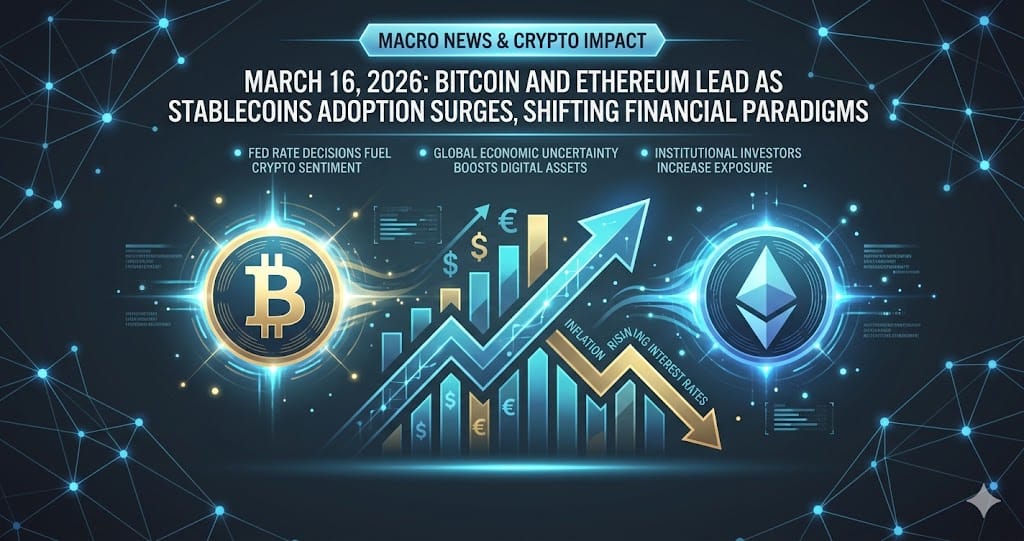
Macro News & Crypto Impact — March 16, 2026
Daily macro news digest: how today's global events affect Bitcoin and crypto markets. BTC at $74,251.
This is a seismic shift in the narrative. Here is today's column for Crypto Take Profit.
The Petrodollar Apocalypse: Why the Strait of Hormuz Is Now Crypto’s Only Lifeboat
For months, we have been trading the macro. We have been staring at Fed dots, parsing CPI prints, and obsessing over the slope of the yield curve. We thought the biggest risk to our portfolios was Jay Powell’s next press conference. We were wrong.
The last 24 hours have delivered a reality check so profound that it threatens to render our entire analytical framework obsolete. While we were busy debating the probability of a 25-basis-point cut in September, the geopolitical tectonic plates have shifted beneath our feet. We are no longer looking at a recession trade. We are looking at a reserve currency extinction event.
Let’s connect the dots that the mainstream financial press is too timid to draw.
It starts, as it always does, with oil. The United States is now engaged in a hot war with Iran. The immediate market impact was obvious: a supply shock. But the second and third-order effects are where the crypto thesis transforms from speculative bet to existential hedge.
The Liquidity Loop
Look at the twisted genius—or madness—of the current dynamic. According to the reports surfacing this morning, the US has lifted sanctions on Russian oil to feed its war machine, spending an estimated $150 million per day. That cash is flowing directly to Moscow. Moscow, in turn, is using those petrodollars to fund its drone and military support for Iran. Iran, armed and financed by this circular flow of American cash, is using that help to continue disrupting the very oil supply the US needs to secure.
It is a perfect, self-licking ice cream cone of destruction. And who is left holding the bag? Every holder of US dollars.
This is the petrodollar's death by a thousand cuts, executed at knifepoint. The dollar’s reserve status has long been underpinned by a simple bargain: the world’s oil is priced in dollars, and the world’s navies—chiefly the US Navy—keep the sea lanes open. But that bargain is now broken.
The Alliance Cascade Failure
Enter the diplomatic comedy of errors playing out in the Strait of Hormuz. President Trump is demanding that NATO allies and Asian partners send warships to secure the strait. The response from Japan and Australia? A flat "no." The response from Europe? Deafening silence, punctuated by reminders that the US just spent the last four years threatening to annex Greenland and declaring NATO "obsolete."
The Strait of Hormuz is the most important energy choke point on the planet. 20% of the world's oil passes through it. And right now, the United States is essentially begging for help at a gunfight while holding the gun backwards.
Iran, sensing the weakness, is threatening escalation. And they are right to sense it. When the President of the United States has to invent "many countries" that are supposedly sending warships—when he has to fabricate a coalition because the real one refused to show up—the message to adversaries is clear: the imperial guard is asleep.
The Malaysia Bombshell
Then, there is the signal from Kuala Lumpur. Malaysia has officially declared its US trade deal "null and void" following a Supreme Court tariff ruling. On its own, Malaysia is not a systemic threat to the dollar. But as a symbol? It is a wildfire spark.
Malaysia is the first domino to explicitly tip. It is the first ASEAN nation to look at the chaos in the Middle East, the weaponization of the dollar, the tariffs, and the unilateralism, and say, "We're out." They are de-risking from a hegemon that is simultaneously at war and incapable of securing its own strategic interests without begging.
The Crypto Synthesis
So, where does this leave the digital asset market?
For the last year, the crypto macro trade has been about the "digital gold" narrative—a hedge against domestic monetary debasement. That thesis remains intact, but it is no longer the primary driver.
We are now witnessing the birth of the "petrodollar hedge" trade.
If the Strait of Hormuz remains contested, if the US cannot guarantee the free flow of oil, and if major trading partners begin following Malaysia's lead in questioning dollar-denominated trade, then the entire house of cards begins to tremble.
Consider the alternatives. If you are a sovereign wealth fund in Asia or the Middle East right now, what do you do with your dollar reserves? Do you buy more Treasuries to fund the war machine of a chaotic ally? Or do you look for neutral, non-sovereign, transportable stores of value?
Bitcoin is not a warship. It cannot secure a strait. But it also doesn't ask permission to cross a checkpoint. It doesn't get sanctioned. It doesn't get caught in the crossfire of a US-Iranian drone strike.
We have spent years arguing about Bitcoin's correlation to equities. We have debated its status as a risk-on or risk-off asset. That debate is now provincial. In a world where the global oil trade is being held hostage by a circular flow of cash funding both sides of a war, and where the US-led global order is fragmenting in real-time, the question is no longer about beta. It is about survival.
The Fed will cut rates eventually. That is a known event. But a challenge to the petrodollar? That is a black swan with teeth. And for the first time, the crypto market is the only asset class priced for that possibility.
Watch the Strait. Watch Kuala Lumpur. And for God's sake, don't let go of your coins.
This is the view from the desk at CryptoTakeProfit.com. When the world burns, we find the assets that don't.
Related Articles
- Understanding Crypto Market Cycles: Where Are We in 2026?
- Daily Market Movers — Monday, March 16, 2026
- Daily Technical Analysis — March 16, 2026