Macro News & Crypto Impact — March 19, 2026
Daily macro news digest: how today's global events affect Bitcoin and crypto markets. BTC at $69,952.
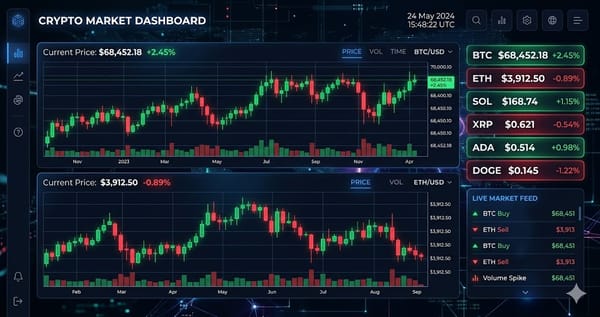
Crypto fell as BTC dropped 3.0% to $69,952 and ETH slid 4.2% to $2,139, with extreme fear at 23 reinforcing a risk-off shift tied to escalating geopolitical tensions and tighter macro conditions that immediately suppress liquidity and weigh on digital assets.
Geopolitical escalation and energy risk
Rhetoric around potential strikes on Iran’s energy infrastructure, combined with broader regional alignment signals, introduces direct supply risk to global oil and gas flows. Threats to large-scale facilities like South Pars raise the probability of supply shocks, which feed into higher energy prices and sustained inflation. That keeps central banks restrictive, delaying any meaningful easing cycle. For crypto, this means the cost of capital stays elevated, suppressing speculative flows and reinforcing downward pressure on high-beta assets.
Higher energy-driven inflation also strengthens the dollar and real yields, which historically pressures BTC as a non-yielding asset. ETH and altcoins like UNI (-5.2%), TON (-4.4%), and LINK (-4.1%) amplify this move due to their higher sensitivity to liquidity conditions. In this environment, capital rotates out of DeFi and ecosystem tokens first, as seen in UNI leading losses, while BTC and ETH act as relative anchors rather than outperformers.
Fragmentation of global blocs

Europe distancing itself from U.S. escalation narratives signals a breakdown in coordinated Western policy. At the same time, continued Russian energy flows to sanctioned or pressured regions like Cuba highlight the emergence of parallel economic channels. This fragmentation reduces the efficiency of global markets and increases transaction friction across energy, trade, and capital flows.
For crypto, this creates a paradox. On one hand, fragmentation strengthens the long-term narrative for neutral settlement rails. On the other, it introduces short-term volatility as capital reacts to shifting alliances and trade routes. Markets respond by reducing exposure to risk assets first, which explains the broad declines across LINK, SUI, HBAR, DOT, AVAX, and ADA, all down between roughly 3.2% and 4.1%, as traders prioritize liquidity preservation over positioning.
Rates, inflation, and liquidity constraint

Equities are reacting to a combination of inflation fears and steady rates, with repeated swings reflecting uncertainty rather than direction. This aligns with crypto’s behavior: BTC at $69,952 (-3.0%) is holding a key psychological level but lacks momentum, while ETH at $2,139 (-4.2%) continues to underperform. The broader market cap contraction to $2.48T confirms that capital is not rotating in at scale.
When rates remain unchanged amid rising inflation expectations, real liquidity tightens. That directly impacts leveraged crypto markets, where funding rates, derivatives positioning, and margin activity are highly sensitive to macro shifts. The result is sharper downside in altcoins and weaker follow-through on rallies. PEPE at $0.000003 (-3.1%) and AVAX at $9.47 (-3.3%) reflect how even speculative and infrastructure assets are being de-risked simultaneously.
Where Markets Stand
BTC’s decline to $69,952 (-3.0%) keeps it in a consolidation zone but reinforces that upside is constrained under extreme fear at 23, while ETH’s sharper 4.2% drop to $2,139 shows persistent underperformance as liquidity tightens. The uniform weakness across UNI, TON, LINK, and other top assets signals broad risk reduction rather than isolated selling, with no sector acting as a defensive rotation. Market structure is fragile, with sentiment, rates, and geopolitical risk all aligned to suppress capital inflows.
What to Watch
- BTC holding or breaking the $69,500–$70,000 zone over the next 24–72 hours
- ETH reaction to the $2,100–$2,200 range as a short-term sentiment anchor
- Fear & Greed index remaining below 30 or pushing further into extreme fear
- Any confirmed escalation or de-escalation involving Middle East energy infrastructure
- Movements in oil prices, as sustained increases will directly impact inflation expectations and risk assets
Related Articles
- Understanding Crypto Market Cycles: Where Are We in 2026?
- Bitcoin Drops 5% — Here's What's Behind the Move
- Daily Technical Analysis — March 19, 2026