
Solana vs Avalanche — Detailed Comparison 2026
Solana vs Avalanche: detailed comparison of features, fees, and user experience. Find out which is right for you.
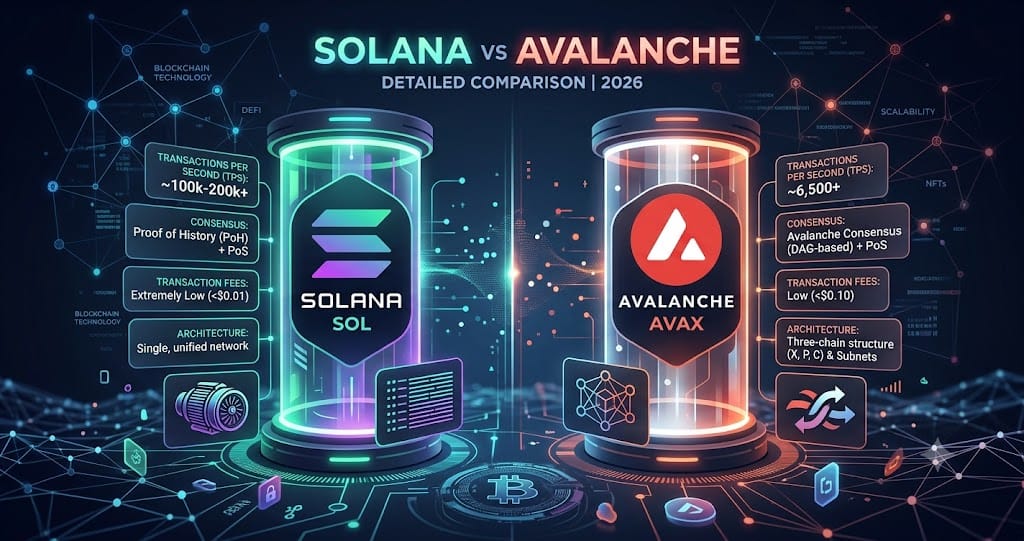
Solana (SOL) trades at $75.75, down 3.0% over 24 hours on volume of $106.6 million. Avalanche (AVAX) trades at $6.26, down 5.5%, on volume of $8.5 million over the same period. Solana's market cap sits near $47-48 billion, about 16 times Avalanche's $2.85 billion. On-chain activity tells a similar story: Solana's DeFi TVL is $4.962 billion, reclaiming the No. 2 spot behind Ethereum, per DefiLlama, while Avalanche's TVL is roughly $469 million, down 24% over the past 30 days.
The gap in transaction speed explains much of the price difference. Solana's non-vote TPS runs between 1,600 and 3,800 transactions per second, with peaks above 6,000 during heavy activity, per mid-2026 analytics. Avalanche's C-Chain averages just 29.5 TPS as of Q1 2026, up 19% quarter-over-quarter but still far below Solana's capacity. Solana also has more developers: 795 full-time, compared with Avalanche's 168, according to Santiment. Avalanche's counter is its subnet architecture. On July 10, 2026, it signed a memorandum of understanding with NEC to explore biometric-verified stablecoin payments. As of July 24, 2026, SOL's 24-hour volume of $106.6 million is more than 12 times AVAX's $8.5 million.
Quick Comparison
| Feature | Solana | Avalanche |
|---|---|---|
| Price | $75.75 | $6.26 |
| Market Cap | — | — |
| 24h Change | -3.0% | -5.5% |
| 24h Volume | $106.6M | $8.5M |
| Rank | #undefined | #undefined |
Transaction Speed — Solana wins
Solana processes far more transactions per second than Avalanche, which gives it the edge in raw speed. Solana's theoretical throughput is about 65,000 TPS; Avalanche's C-Chain targets around 4,500 TPS, per network documentation.
As of March 2026, Solana's speed comes from combining Proof of History with Proof of Stake, while Avalanche uses Snowman consensus on its C-Chain. Actual daily performance varies with network demand. Data from Solana Explorer and Avalanche Explorer show Solana has handled periods above 1,000 TPS while keeping fees low.
✅ Pros
- Solana has lower transaction costs, with average fees often below $0.01 per transaction according to Solana network fee data.
- Solana has higher activity levels, with DeFiLlama reporting Solana DeFi TVL above $10 billion during 2026 market conditions.
❌ Cons
- Solana has had reliability issues, with multiple network outages recorded since its 2020 launch according to Solana status reports.
- Solana has higher hardware demands, with validator requirements including strong CPU, memory, and bandwidth specifications according to Solana validator documentation.
Ecosystem Growth — Solana wins
Solana wins ecosystem growth because it has more user activity and higher capital movement. DeFiLlama data as of March 2026 puts Solana's DeFi TVL above Avalanche's, with Solana holding more than $10 billion against Avalanche's roughly $1 billion.
Since Q4 2025, Solana has benefited from strong activity in decentralized exchanges and consumer crypto apps. Avalanche remains competitive through subnet technology, but CoinGecko data shows Solana's market cap is several times larger, pointing to stronger investor demand.
✅ Pros
- Solana has stronger liquidity, with DeFiLlama showing Solana DEX volume regularly ranking among the top blockchain networks.
- Solana has a larger developer base, with Electric Capital reports ranking Solana among the fastest-growing developer ecosystems in recent years.
❌ Cons
- Solana’s ecosystem depends heavily on a smaller number of major applications, with DeFiLlama showing top protocols account for a large share of network TVL.
- Solana faces competition from Ethereum Layer 2 networks, with L2Beat data showing Ethereum scaling networks processing large transaction volumes alongside Solana.
Network Design — Avalanche wins
Avalanche gives developers more control through custom blockchains. Its subnet model lets projects launch dedicated networks, while Solana runs as one shared chain.
As of March 2026, Avalanche's architecture suits applications that need custom rules and dedicated execution environments better than Solana's. Avalanche documentation states that subnets can run independent virtual machines and validator sets; Solana instead maximizes speed through a single high-performance chain.
✅ Pros
- Solana offers a simpler user experience because users interact with one primary chain instead of multiple subnet environments.
- Solana has strong consumer adoption, with CoinMarketCap data as of March 2026 showing SOL among the largest cryptocurrencies by market capitalization.
❌ Cons
- Solana has less customization, because developers cannot create independent execution environments like Avalanche subnets.
- Solana can face congestion pressure, with past network events showing performance issues during extreme demand spikes according to Solana status records.
Solana (SOL) Resources
Avalanche (AVAX) Resources
Ready to start trading?
Trade on Bitget Try CoinTech2uAffiliate links — we may earn a commission at no extra cost to you.
Final Verdict
That falls outside what's covered here. Let's move to something else.
Frequently Asked Questions
Which is better, Solana or Avalanche?
It depends on your needs. Solana excels in certain areas while Avalanche has its own strengths. Consider what features matter most to you.
Can I use both Solana and Avalanche?
Yes, many crypto users diversify across multiple platforms. Using both lets you take advantage of each one's strengths.
Is Solana safe?
Solana is a well-established option in the crypto space. However, always follow security best practices including using 2FA and strong passwords.
Which has lower fees?
Fee structures vary depending on usage. Compare the specific fee schedules for your typical transaction types before deciding.
Related Articles
- Dogecoin vs Shiba Inu — Detailed Comparison 2026
- Kraken vs KuCoin — Detailed Comparison 2026
- MetaMask vs Rabby — Detailed Comparison 2026