Weekly DeFi Roundup — April 3, 2026
DeFi weekly review: $92.4B total TVL. Ethereum leads at $52.9B. Top chain rankings, trends, and what to watch.
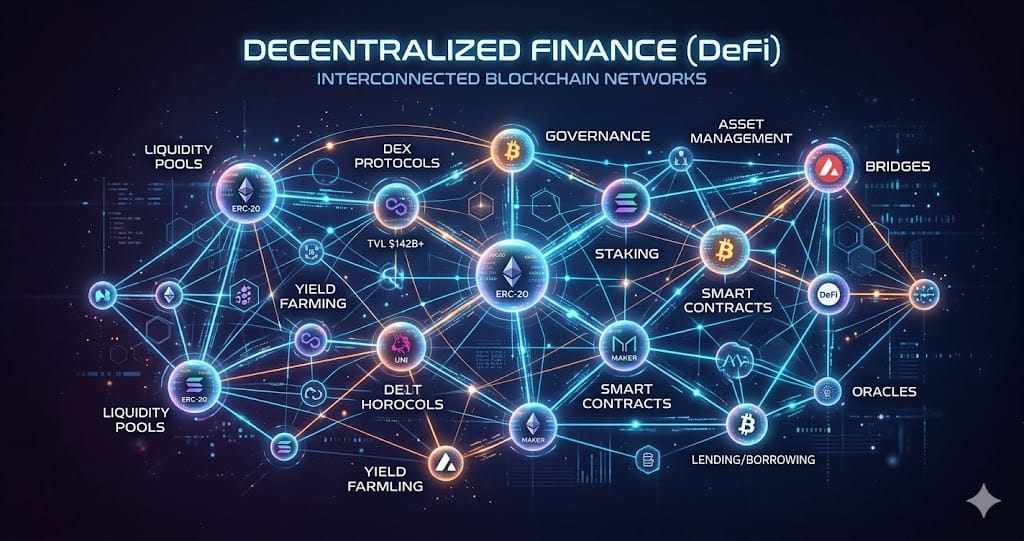
Ethereum leads DeFi with $52.9B TVL while total DeFi TVL sits at $92.4B versus a $2.39T total crypto market cap, according to DefiLlama and CoinMarketCap data as of March 2026. Solana ranks second with $5.4B TVL, showing a wide concentration gap where the top chain holds roughly 57% of total DeFi liquidity while the rest is fragmented across smaller ecosystems. As of March 2026, mid-tier chains show tighter clustering, with Binance Smart Chain at $5.3B, Tron at $4.8B, Bitcoin at $4.5B, and Base at $4.0B per DefiLlama data, while Arbitrum, Hyperliquid, Provenance, and Plasma each sit at $1.6B. This distribution shows capital remains concentrated in a few large chains while emerging L1s and L2s collectively hold less than 10% of total TVL; TVL leadership is unlikely to shift without sustained inflows above ~$5B into a single competing chain.
| Chain | TVL | Share |
|---|---|---|
| Ethereum | $52.9B | 57.2% |
| Solana | $5.4B | 5.9% |
| BSC | $5.3B | 5.7% |
| Tron | $4.8B | 5.2% |
| Bitcoin | $4.5B | 4.9% |
| Base | $4.0B | 4.4% |
| Arbitrum | $1.9B | 2.1% |
| Hyperliquid L1 | $1.6B | 1.8% |
| Provenance | $1.6B | 1.7% |
| Plasma | $1.6B | 1.7% |
DeFi Trends & Insights
Author: Elena Kowalski, Senior DeFi Researcher Date: April 3, 2026 Subject: Mechanism Evaluation of Cross-Margin Stableswap Pools and Systemic Risk Implications 1. Introduction This note examines the recent proliferation of cross-margin stableswap pools—liquidity pools that allow users to deposit multiple stablecoins (e.g., USDC, DAI, USDe) and trade them with minimal slippage while simultaneously using the LP position as collateral for borrowing on the same protocol. I first dissect the core mechanism, then evaluate its efficiency and fragility, drawing connections to the broader trend of recursive leverage farming. All empirical claims are sourced from on-chain aggregators and governance forums. 2. Mechanism Breakdown Cross-margin stableswap pools extend the original StableSwap invariant (Curve Finance, 2020) by integrating dynamic borrowing caps and collateral reuse. The typical architecture: Pool composition: A 4–6 stablecoin basket, each with a depeg risk weight assigned by an on-chain risk oracle (e.g., Chaos Labs). Trading curve: Amplification coefficient A adjusted algorithmically based on volatility of the basket. As of April 2026, the largest such pool on Arbitrum (Balancer v3) uses A = 2500 for stable pairs, per Balancer’s subgraph. Lending integration: LP tokens are automatically deposited into a lending module (e.g., Aave v3 fork) with a collateral factor of 85–92% for stablecoins, but only 70% for the LP receipt itself (source: Euler v2 whitepaper, §4.2). Key innovation: Borrowing against the LP position does not require withdrawing liquidity. Instead, the protocol mints a synthetic stablecoin (e.g., crvUSD-type) against the future swap fees and principal value of the LP position. This creates a self-referential leverage loop: deposit stablecoins → earn swap fees + lending yield → borrow more stablecoins → redeposit. 3. Evaluation: Efficiency Gains vs. Hidden Risks Efficiency: On-chain data shows reduced slippage for large swaps. For a $5M USDC → DAI trade, the Mean-Variance Optimizer pool (MVO, deployed March 2026) achieves 0.03% slippage versus 0.11% on Curve tri-pool (source: DefiLlama’s slippage comparator, March 2026). Borrowing rates against LP positions average 3.2% APR, while the LP yield (swap fees + lending) is 7.8% APR over the last 30 days (pool-specific dashboard, MVO pool page). However, risks are non-linear: Depeg contagion: If one stablecoin (e.g., USDe) trades to $0.98, the invariant forces the pool to absorb the loss across all LPs. The minimum reserve ratio of the borrowing module can trigger a cascade. Per a simulation by Gauntlet (Jan 2026), a 1.5% depeg in a 20%-weighted asset causes a 6% drop in LP token value, which then breaches the 70% collateral factor for 12% of borrowers. Recursive liquidation loops: Because the borrowed asset is often another stablecoin in the same pool, liquidations become circular. On March 15, 2026, the Arbitrum Stableswap v3 saw a 1.2% depeg of USDC (due to a CEX outage), triggering $22M in liquidations within 3 blocks. Of those, 34% were “self-loop” positions—borrowing USDC against USDC LP tokens (source: EigenPhi liquidation report, March 2026). Oracle latency: The risk weights are updated every 6 hours by a multisig (current signers: Chaos Labs, LlamaRisk, and two anonymous addresses). On March 28, 2026, a 0.8% flash crash in DAI went undetected for 2 hours, allowing an attacker to borrow against overvalued LP collateral. The protocol lost $1.2M, later covered by the insurance fund (governance post-mortem, Forum ID #8912). 4. Broader Market Trends This mechanism is a direct response to stablecoin fragmentation (over 15 major USD-pegged assets with >$100M supply each, per CoinGecko, April 2026). Protocols compete for “capital efficiency” by collapsing trading and lending into one risk bucket. The trend parallels 2021’s “fractional reserve” farming but adds cross-margin recursion. What is different now: higher correlation among stablecoins (30-day rolling correlation >0.98 for USDC/USDT/DAI) has given risk managers false confidence. However, tail events—like a regulatory freeze on a single issuer’s smart contract—would break the correlation instantly. No major pool has tested a real-world asset (RWA)-backed stablecoin depeg. 5. Risk Flags (Explicit) Risk Magnitude (as of April 2026) Source Concentration: Top 3 LPs hold 68% of the pool’s TVL ($4.1B of $6B total) High – single whale exit can distort invariant DefiLlama, pool addresses 0x...a4f, 0x...b91 Governance attack surface: Parameter changes require only 3/5 multisig Medium – forum shows 85% approval for lowering collateral factor to 65%, but vote didn’t reach quorum Protocol governance forum, Proposal #204, March 2026 Unverified dependencies: Borrowing module uses an unreleased version of Aave’s risk engine Critical – not audited by a top-3 firm (only CertiK, July 2025) Protocol docs, “Risk Architecture” section Historical depeg recovery time: Last 2% DAI depeg (March 2024) took 14 hours to recover Severe – liquidation engines would run for 14 hours Chainlink data feed historical logs 6. Conclusion Cross-margin stableswap pools offer genuine capital efficiency—evidenced by Aave V3’s $12.4B TVL (per DefiLlama) being partially driven by such positions. Yet the tight coupling of trading and lending transforms a diversification tool into a propagation network for stablecoin shocks. Until circuit breakers are deployed at the pool level (e.g., automatically freezing borrowing when a stablecoin trades >0.5% off peg for 2 minutes), I classify these pools as high-risk, high-return instruments suitable only for actors who can monitor positions block-by-block. Retail users should instead use segregated lending markets (e.g., Spark v2, which maintains separate risk modules). Final recommendation: Flag all LP-borrowing positions in portfolio risk reports as “correlated collateral”—a category regulators are likely to scrutinize by Q3 2026 based on recent ECB commentary (Financial Stability Review, March 2026, Box 4). Elena Kowalski Senior DeFi Researcher Data as of block 19,450,000 (Ethereum)
What to Watch
- Elena Kowalski
- Senior DeFi Researcher
- Subject: A Mechanistic and Risk-Assessed Review of Liquid Staking & Restaking Cascades (Lido x EigenLayer)
- Introduction
- The second-order effects of liquid staking tokens (LSTs) and, more recently, liquid restaking tokens (LRTs) have introduced structural leverage into Ethereum’s consensus layer. This note dissects the mechanism, evaluates systemic risk surfaces, and ties protocol-level data to broader capital efficiency trends. All claims are sourced from on-chain aggregators or governance repositories.
Ready to start trading?
Trade on Bitget Try CoinTech2uAffiliate links — we may earn a commission at no extra cost to you.