Bitcoin Liquidation Whiplash 2026: Geopolitics, Saylor Sales, Funding Rate Extremes
BTC liquidations hit $289M on July 14, 2026 as geopolitics, Strategy's BTC sales, ETF outflows, and a 46-day negative funding streak collide.
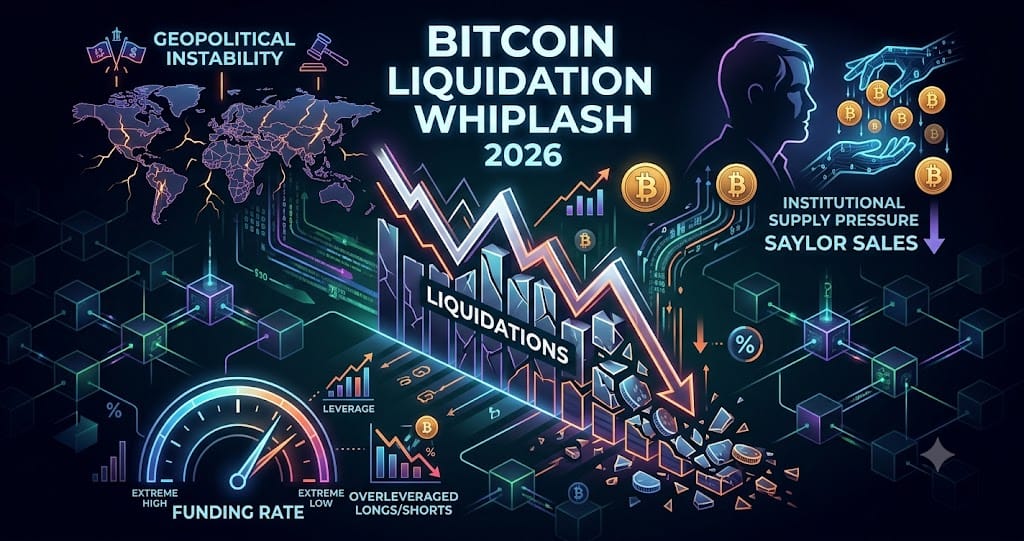
Bitcoin briefly broke below USD 62,000 on July 14, 2026 after the collapse of a US-Iran ceasefire triggered roughly USD 289 million in 24-hour liquidations, with long positions bearing the brunt before BTC recovered to about USD 62,650. It was the third reversal in liquidation direction within a single week, following a June long-squeeze and an early-July short-squeeze.
The event capped a month in which Bitcoin's liquidation triggers multiplied beyond the usual macro-data calendar. Geopolitical headlines, a change in behavior from Strategy (formerly MicroStrategy) under Michael Saylor, persistent US spot ETF outflows, and a historic 46-day stretch of negative funding rates each played a distinct role in keeping leveraged traders on both sides exposed.
The July Liquidation Whiplash
Two of July's sharpest drawdowns were triggered by the same geopolitical fault line. On July 8, 2026, Bitcoin fell from an intraday level of USD 63,345 to USD 61,663 between 05:00 and 06:00 EDT after the same US-Iran ceasefire tensions resurfaced, according to Bitcoin News Digest. Six days later, the July 14 selloff repeated the pattern, pushing BTC under USD 62,000 and generating an estimated USD 289 million in liquidations, as reported by The Crypto Times.
The direction of liquidations has flipped three times in roughly two weeks: shorts were squeezed for an estimated USD 450 to 500 million in early July, shorts still made up about 62 percent of liquidations around July 6 and 7, and then the market swung back to predominantly long liquidations by July 14. The Fear and Greed Index tracked the same volatility, falling from a neutral 45 on July 12 to a fear reading of 29 just two days later.
Strategy's Pivot From Perpetual Buyer to Net Seller
Strategy's shift from its long-standing accumulation strategy became a market-moving signal in its own right. A relatively small sale of 32 BTC in late May coincided with Bitcoin's slide from near USD 74,000 to below USD 58,000, according to Forbes. In early July, Strategy sold 3,588 BTC for roughly USD 216 million at an average price near USD 60,000, its largest single sale on record, cutting its holdings to 843,775 BTC per Fortune and CoinDesk.
JPMorgan formally flagged the shift as a new systemic risk to the Bitcoin market in a July 2 report, noting that Strategy's Q2 holdings carried an USD 8.32 billion unrealized loss as BTC fell from about USD 68,000 on April 1 to roughly USD 60,000 by the end of June, according to Bloomberg. The USD 216 million sale represented under 1 percent of Bitcoin's roughly USD 25 billion daily volume, and the market recovered its 1 percent dip within an hour, suggesting the impact was driven more by broken sentiment around a company once seen as a permanent buyer than by the size of the sale itself.
ETF Outflows as a Chronic Sell-Pressure Backdrop
US spot Bitcoin ETFs recorded roughly USD 4.5 billion in net outflows during June 2026, with BlackRock's IBIT accounting for about 75 percent of that total, according to Tapbit. The outflows continued into July, with a single-day net redemption of USD 84.86 million recorded on July 8, per Intellectia.
The sustained ETF selling removed what had been the market's largest marginal spot buyer, thinning the order book that would otherwise absorb leveraged liquidation cascades. Combined with Strategy's reduced buying, the spot side of the market entered July with less structural demand than it had during the 2025 accumulation phase.
Funding Rates: From a 46-Day Negative Streak to Exchange-Level Extremes
Bitcoin's 30-day average perpetual funding rate stayed negative for 46 consecutive days through April 15, 2026, the longest negative funding stretch since the FTX collapse in November 2022, according to CoinDesk. Analysts estimated the prolonged negative funding eroded short-side margin by 30 to 40 percent before Strategy's purchase of 34,164 BTC (USD 2.54 billion) and easing geopolitical risk triggered a squeeze that liquidated more than USD 427 million in short positions, per crypto.news.
Individual exchanges showed even sharper distortions. On June 7, 2026, OKX's BTC perpetual funding rate reached an annualized -453 percent, meaning short holders were paying roughly 1.3 percent of their position daily, according to Pluang. Separately, a BitMEX Q2 report found that Hyperliquid's BTC perpetual carried a structural +7.17 percent annualized funding premium over Binance from 2023 through 2026, with ETH averaging a +5.31 percent premium, reflecting differences in user base and institutional custody constraints that keep the spread from being fully arbitraged away.
What to Watch
- The Federal Reserve's end-of-month rate decision, widely viewed as July's largest calendar-based catalyst for Bitcoin volatility
- Strategy's remaining 843,775 BTC position and whether further sales follow the pattern set by the May and July disposals
- US spot Bitcoin ETF flow data, particularly whether BlackRock's IBIT returns to net inflows after June's USD 4.5 billion outflow
- Fresh developments in US-Iran relations, which have now triggered two separate BTC drawdowns on July 8 and July 14
- Whether funding rates across major exchanges normalize or repeat the extreme negative readings seen on OKX in June
Ready to start trading?
Trade on Bitget Try CoinTech2uAffiliate links — we may earn a commission at no extra cost to you.
Related Articles
- Crypto Liquidations in 2026: How $1.8B Long Wipeouts Flipped Into a Short Squeeze
- Privacy Coins Roar Back as Zcash Rallies 13% Ahead of Ironwood Upgrade
- Bitcoin's 2026 Volatility Cycle: DVOL Compression Before the Liquidation Cascades
Frequently Asked Questions
What caused the Bitcoin liquidation event on July 14, 2026?
A breakdown in the US-Iran ceasefire triggered a geopolitical risk-off move that briefly pushed BTC below USD 62,000, generating an estimated USD 289 million in 24-hour liquidations, mostly on long positions, before price recovered to about USD 62,650.
Why does Strategy's Bitcoin selling move the market if the amounts are small relative to daily volume?
Strategy's USD 216 million July sale was under 1 percent of Bitcoin's roughly USD 25 billion daily volume, so the price impact was mainly a signal effect: it broke the market's assumption that Strategy would only ever buy, which JPMorgan flagged as a new systemic risk on July 2, 2026.
What does a 46-day negative Bitcoin funding rate streak indicate?
A prolonged negative funding rate means short positions are paying long positions to stay open, gradually eroding short-side margin. The 46-day streak through April 15, 2026 was the longest since the November 2022 FTX collapse, and both prior instances preceded sharp short-covering rallies.
How much did US spot Bitcoin ETFs see in outflows during June 2026?
US spot Bitcoin ETFs recorded roughly USD 4.5 billion in net outflows in June 2026, with BlackRock's IBIT responsible for about 75 percent of the total, removing a major source of spot-side demand that had previously cushioned leveraged sell-offs.