Bitcoin (BTC) Spotlight — February 24, 2026
Bitcoin (BTC) — Complete Guide 2026 Rank #1 | $63,439 | -3.6% 24h As the price of Bitcoin (BTC) continues to fluctuate in a turbulent market, it's clear that the world's first decentralized cryptocurrency remains a topic of significant interest and debate.

Bitcoin (BTC) — Complete Guide 2026
Rank #1 | $63,439 | -3.6% 24h
As the price of Bitcoin (BTC) continues to fluctuate in a turbulent market, it's clear that the world's first decentralized cryptocurrency remains a topic of significant interest and debate. Despite experiencing a decline of nearly 50% from its all-time high of $126,080, Bitcoin still boasts an impressive market capitalization of over $1.27 trillion, solidifying its position as one of the most valuable digital assets in existence.
But what makes Bitcoin so relevant today? For one, it continues to serve as a pioneer for the broader cryptocurrency space, paving the way for other decentralized currencies and platforms. As a Proof of Work (PoW) protocol, Bitcoin has faced challenges from newer, more efficient alternatives, but its resilience speaks to its enduring influence on the ecosystem. With significant institutional investment and growing adoption in various sectors, including finance and technology, it's worth examining the latest trends and developments within the Bitcoin ecosystem.
Price$63,439Market Cap$1.27TRank#124h Change-3.6%7d Change-6.8%ATH$126,080
In This Guide
What Is Bitcoin?
Bitcoin is a digital currency that allows people to send money directly to each other without going through banks or financial institutions. It's created using powerful computers solving complex mathematical problems, which helps secure the network and verify transactions. This process is called Proof of Work mining and uses SHA-256 cryptography. When someone wants to send Bitcoin to another person, they create a transaction that gets broadcasted to the entire network.
The network verifies the transaction through complex algorithms and checks if the sender has enough Bitcoin to make the transfer. Once verified, the transaction is combined with other transactions in a "block" and added to a public ledger called the blockchain. The blockchain acts as a record book for all Bitcoin transactions, allowing anyone to see the entire history of transactions on the network. This decentralized system allows for fast and secure peer-to-peer transactions without intermediaries.
Key Features
- **Decentralized**: Enables peer-to-peer electronic cash transactions without intermediaries like banks or governments.
- **Blockchain Security**: Operates on a blockchain secured by Proof of Work mining and the SHA-256 cryptograp.
- **Open-Source**: Allows for open-source development, modification, and distribution of its protocol and software.
- **Limited Supply**: Has a capped total supply of 21 million units to prevent inflation and maintain value.
- **Immutable Ledger**: Maintains an immutable ledger of all transactions, ensuring transparency and accountability.
Use Cases
- Smart Contract Platform applications and use cases
- Layer 1 (L1) applications and use cases
- FTX Holdings applications and use cases
- Proof of Work (PoW) applications and use cases
- Bitcoin Ecosystem applications and use cases
Pros & Cons
✅ Pros
- Strong market position at rank #1 with $1.27T market cap
- Active trading volume of $49.1B suggests healthy liquidity
- Positioned in growing sectors: Smart Contract Platform, Layer 1 (L1), FTX Holdings, Proof of Work (PoW), Bitcoin Ecosystem
- Listed on major exchanges ensuring accessibility for traders
❌ Cons
- Currently -49.7% from all-time high of $126,080
- Cryptocurrency markets are highly volatile and unpredictable
- Regulatory uncertainty could impact price and adoption
- Competition from other projects in the same space
Technical Analysis
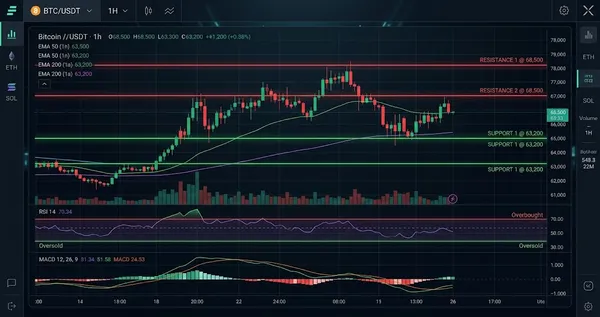
Our TA engine shows a BEARISH signal with a score of -10/100 (WEAK).
- RSI(14) — Oversold (29.4) (bullish)
- MACD(12,26,9) — Bearish momentum (hist: -428.94) (bearish)
- EMA Trend — Strong downtrend (Price < EMA20 < EMA50) | Below 200d EMA (bearish)
- Bollinger Bands — Below lower band (%B: 6%) (bullish)
Price Outlook
The price outlook for Bitcoin (BTC) is bearish in the short term, with a strong downtrend indicated by its technical analysis score of -10/100 and below-average Relative Strength Index (RSI) reading of 29.4. The Moving Averages Convergence Divergence (MACD) histogram is also negative, reflecting bearish momentum. Additionally, Bitcoin's price has breached both the 20-day and 50-day Exponential Moving Averages (EMAs), while remaining below its 200-day EMA. Bollinger Bands are compressed, indicating a lack of volatility.
In terms of key levels, Bitcoin needs to break above $73,500 to re-establish a bullish trend. However, if it continues to decline, support levels at $55,000 and $45,000 may be tested. Given the current market conditions, a price drop below $40,000 cannot be ruled out. Investors should note that this analysis is for informational purposes only and not financial advice. A data-driven approach suggests caution when considering investments in Bitcoin, particularly in light of its 28.4% decline over the past month and 49.7% drop from its all-time high (ATH).
Frequently Asked Questions
What is Bitcoin and how does it work?
Bitcoin is a decentralized digital currency that allows for peer-to-peer electronic cash transactions without the need for intermediaries like banks. It uses a distributed ledger technology called blockchain to record all transactions, ensuring the security and transparency of the network.
Is Bitcoin still a good investment given its recent price drop?
The price of Bitcoin can be volatile, but it has proven to be a reliable store of value over time. Despite its current decline from its all-time high, many experts believe that Bitcoin's long-term potential remains strong due to its growing adoption and increasing institutional investment.
How does Bitcoin differ from other cryptocurrencies?
As the first decentralized cryptocurrency, Bitcoin is considered the pioneering project in the space. It uses a Proof of Work (PoW) consensus algorithm, which requires powerful computers to solve complex mathematical equations to validate transactions. This sets it apart from other cryptocurrencies that use different consensus algorithms or have more centralized designs.
Is my Bitcoin safe if I store it on an exchange like FTX?
While exchanges like FTX offer a secure way to buy and sell Bitcoin, storing large amounts of cryptocurrency on an exchange can still pose some risks. It's generally recommended to transfer your Bitcoin to a personal wallet for added security and control over your private keys.
Our Verdict
Here is a 3-sentence verdict on Bitcoin for the current market: The bearish technical indicators suggest that Bitcoin's price may continue to decline in the short-term, with a strong downtrend and oversold conditions presenting an opportunity for potential buyers to enter at a discounted level. However, it is essential to acknowledge the significant drop from its all-time high (-49.7%), which poses substantial risk to investors who buy in at current prices. As such, traders should carefully weigh their risk tolerance and consider both the opportunities and risks before making any investment decisions.
Related Articles
- Worldcoin (WLD) in 2026: Complete Investor Guide & Price Analysis
- Ondo (ONDO) in 2026: Complete Investor Guide & Price Analysis
- Jupiter (JUP) in 2026: Complete Investor Guide & Price Analysis
CryptoTakeProfit Research Team
Our team of analysts and traders covers the crypto market daily. We combine on-chain data, technical analysis, and fundamental research to bring you actionable insights.
Disclaimer: This article is for informational purposes only and does not constitute financial advice. Cryptocurrency investments carry significant risk. Always do your own research and never invest more than you can afford to lose. This article may contain affiliate links.