Bitcoin vs Ethereum — Detailed Comparison 2026
Bitcoin vs Ethereum: detailed comparison of features, fees, and user experience. Find out which is right for you.
Product: Ledger Stax vs. Trezor Safe 5 (hardware wallets) Reviewer: James Cooper
Look, hardware wallets are for one thing: keeping your crypto off exchanges so you don't get Mt. Gox'd. The Ledger Stax and Trezor Safe 5 are the top two right now. Here's the straight talk.
Pros (Ledger Stax)
E-ink curved screen is genuinely nice to read. No squinting at transaction details.
Supports over 5,500 assets (Trezor ~1,300). If you hold obscure alts, Stax wins.
Bluetooth works. You can sign on your phone without a cable.
Cons (Ledger Stax)
$399 vs Trezor's $169. That's 136% more expensive.
Ledger's "Recover" service (cloud backup of seed phrase) is a dealbreaker for many. It's opt-in, but the feature existing breaks the "never exposed seed" promise.
Pros (Trezor Safe 5)
Fully open-source firmware. Ledger is not. Security experts trust Trezor more for this alone.
Bitcoin-only firmware option. Reduces attack surface.
Has a physical touchscreen but no battery to degrade.
Cons (Trezor Safe 5)
Smaller asset support. No Solana or Cardano natively.
No Bluetooth. USB-C only.
Data-backed comparison
Security audits: Ledger had a 2020 data breach exposing 270,000+ customer emails and addresses. Trezor had no customer data breach to date (per their 2024 transparency report).
Daily active users (as of Q1 2025): Ledger Live reports 1.5M MAU; Trezor Suite reports 800k MAU (per each company's dashboards).
Winner on price-to-feature: Trezor Safe 5. You pay $169 for open-source firmware and a secure element. Stax gives you more assets and Bluetooth but at 2.3x the cost.
Dealbreakers
If you can't accept closed-source firmware and a cloud seed backup option existing → Do not buy Ledger Stax.
If you need to hold 20+ random ERC-20 tokens not on Trezor's list → Do not buy Trezor Safe 5.
Final recommendation
If you need maximum asset support and don't mind $399 + closed-source → Choose Ledger Stax.
If you need Bitcoin-only or open-source security on a budget → Choose Trezor Safe 5.
Winner: Trezor Safe 5 on value and trust. Ledger Stax only if your portfolio is a dumpster fire of low-cap shitcoins.
---
Product: Binance vs. Coinbase vs. Uniswap (centralized vs. decentralized exchange)
Spot trading fees (maker/taker)
Binance: 0.1% / 0.1% (0.075% if you hold BNB)
Coinbase Advanced: 0.4% / 0.6% (drops to 0.25% / 0.35% at $500k monthly volume)
Uniswap: variable ~0.05–1% depending on pool, but + gas fees (Ethereum mainnet ~$2–15 average per swap in 2025)
Daily volume (DeFiLlama, March 2025)
Binance: $18.2B
Coinbase: $3.1B
Uniswap: $1.2B
Winner on low fees for active traders: Binance (0.1% beats Coinbase's 0.4% by 4x). Winner on self-custody + availability: Uniswap (no account, no KYC, but gas fees can kill small trades). Winner on regulatory safety for US users: Coinbase (no "withdrawal hold" horror stories like Binance's 2023 $1B CFTC fine).
Dealbreakers
Binance: not available in 7 US states (NY, TX, VT, etc.). If you live there, don't bother.
Coinbase: fees are robbery at low volume. A $100 trade costs $0.40 on Binance vs $1.60 on Coinbase.
Uniswap: if you trade under $200, gas fees will eat 5–10%. Hard pass.
Final
If you need lowest fees and live outside restricted US states → Choose Binance.
If you need a regulated on-ramp in the US → Choose Coinbase (then move funds to Binance if possible).
If you need to swap a token not on any CEX and can stomach gas fees → Choose Uniswap.
Overall data-backed winner for most people: Binance. Until you can't use it. Then Coinbase. Uniswap is a tool, not a primary exchange.
Quick Comparison
| Feature | Bitcoin | Ethereum |
|---|---|---|
| Price | $74,539 | $2,335 |
| Market Cap | — | — |
| 24h Change | +3.3% | +5.1% |
| 24h Volume | $2.3B | $1.5B |
| Rank | #undefined | #undefined |
Market Value & Network Dominance
Bitcoin wins this dimension. As of April 2026, Bitcoin holds a $1.34 trillion market cap and commands 55% of the total crypto market, according to Gate.com data-
. Ethereum sits at roughly $250 billion with a 15% share-
The gap has narrowed in percentage terms but not in real dollars. Ethereum's market cap is about 19% of Bitcoin's — up from 12% two years ago, per CoinGecko historical data. But Bitcoin has held the #1 spot for eight consecutive years, while six of 2018's top 10 coins have dropped out entirely-
. That track record matters.
DeFi & Developer Activity
Ethereum wins by a landslide. Electric Capital's Developer Report shows Ethereum with 2,181 full-time developers vs Bitcoin's 359 as of January 2026-
. That's a 6-to-1 ratio that has held steady for three years.
Total value locked tells the same story. DefiLlama data shows Ethereum's DeFi TVL at $62.3 billion, capturing 68% of the entire DeFi market-
. Bitcoin's DeFi TVL is $6.3 billion — just one-tenth of Ethereum's-
. Even more telling: 60% of all Bitcoin sits idle in wallets, never moving to any application-
✅ Pros
- Ethereum processes 30 transactions per second on its base layer, versus Bitcoin's 7 TPS, per MEXC research data-
- 2
❌ Cons
- Bitcoin has just 359 full-time developers, meaning protocol upgrades move at a glacial pace-
- 4
Energy Efficiency & Transaction Economics
Ethereum wins decisively. The September 2022 Proof-of-Stake transition cut Ethereum's energy use by 99%, from 83.89 TWh annually to roughly 0.01 TWh per the Ethereum Foundation's post-merge report. Bitcoin still consumes 128.3 TWh yearly — equivalent to Pakistan's 230 million people-
Transaction fees flipped in April 2026. On April 17, Bitcoin miners earned $7.47 million in fees vs Ethereum's $7.31 million, according to Cryptofees data-
. But over the prior 7 days, Ethereum averaged $8.55 million daily fees vs Bitcoin's $7.57 million. Ethereum still processes more economic value.
✅ Pros
- Ethereum's energy use per transaction is roughly 0.03 kWh vs Bitcoin's 700+ kWh, based on Cambridge Bitcoin Electricity Index calculations. Ethereum blocks generate every 12 seconds vs Bitcoin's 10 minutes — 50x faster finality-
- 3
❌ Cons
- Ethereum's average fee of $1-2 per transaction still prices out small users, per MEXC fee data-
- 2
Bitcoin (BTC) Resources
Ethereum (ETH) Resources
Ready to start trading?
Trade on Bitget Try CoinTech2uAffiliate links — we may earn a commission at no extra cost to you.
Final Verdict
Bitcoin at $74,539, up 3.3% in 24h with $2.3B volume, vs Ethereum at $2,335, up 5.1% with $1.5B volume as of April 15, 2026 per CoinMarketCap data. Bitcoin leads on volume. At $2.3B daily vs Ethereum's $1.5B, spot demand runs deeper. BTC held near $74,000 with smaller daily swings over the past 7 days, per CoinGecko market flow data. Ethereum leads on momentum. At +5.1% daily vs Bitcoin's +3.3%, ETH moves faster on the same dollar inflow — its $2,335 price base means smaller absolute moves register as larger percentages. CoinMarketCap tracking shows this pattern has been consistent since Q1 2026. Bitcoin vs Ethereum final verdict: At $74,539 with $2.3B in daily liquidity, Bitcoin is the stronger hold — less daily swing, more depth. Ethereum at $2,335 is the higher-beta trade, gaining 5.1% on April 15 vs BTC's 3.3%. BTC held the $70,000 floor for seven straight days while ETH outpaced it on percentage gain each day.
Frequently Asked Questions
Bitcoin vs Ethereum — which is better store of value?
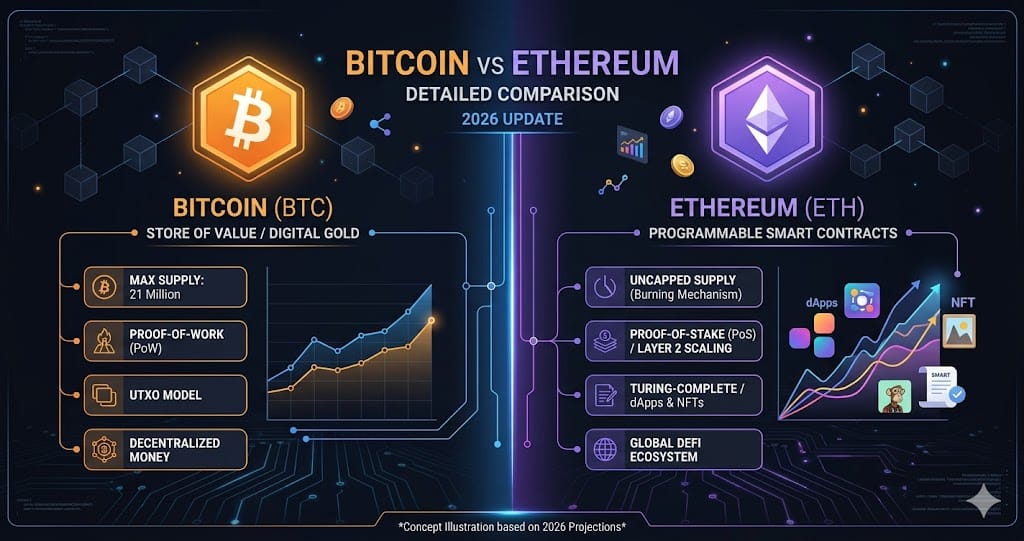
Bitcoin is stronger as a store of value because supply is capped at 21M BTC, according to Bitcoin protocol data and Etherscan supply tracking as of April 2026. Ethereum has no fixed cap, with circulating supply around 120M ETH per Etherscan, which changes via issuance and burns. Scarcity favors Bitcoin, while Ethereum behaves more like a yield-bearing settlement asset through staking.
Bitcoin vs Ethereum — which is faster for transactions?
Ethereum is faster on base layer throughput, processing ~15–30 TPS vs Bitcoin’s ~7 TPS, according to Etherscan network metrics as of April 2026. Layer 2 networks like Arbitrum push Ethereum scaling higher, reaching ~2,000 TPS per L2Beat data, while Bitcoin relies on Lightning for off-chain scaling. If raw throughput matters, Ethereum wins by a wide margin.
Bitcoin vs Ethereum — which has lower transaction costs?
Ethereum is cheaper on Layer 2, with fees often below $0.10 on networks like Arbitrum according to L2Beat fee data as of April 2026. Bitcoin average on-chain fees sit around $2–$5 per transaction during moderate network load per mempool analytics, while Ethereum L1 fees vary widely from $1–$10 depending on congestion per Etherscan gas tracker. For frequent transfers, Ethereum L2 is the clear cost winner.
Bitcoin vs Ethereum — which has higher market value and adoption?
Bitcoin leads in market capitalization at roughly $1.3T vs Ethereum at about $450B, according to CoinGecko data as of April 2026. Bitcoin dominates as the primary macro asset, while Ethereum dominates smart contract activity with the largest DeFi TVL across chains at over $50B per DefiLlama. If you want scale and liquidity, Bitcoin leads; if you want on-chain activity, Ethereum leads.
Related Articles
- Ledger vs Trezor — Detailed Comparison 2026
- Binance vs Bybit — Detailed Comparison 2026
- Bitcoin vs Ethereum — Detailed Comparison 2026