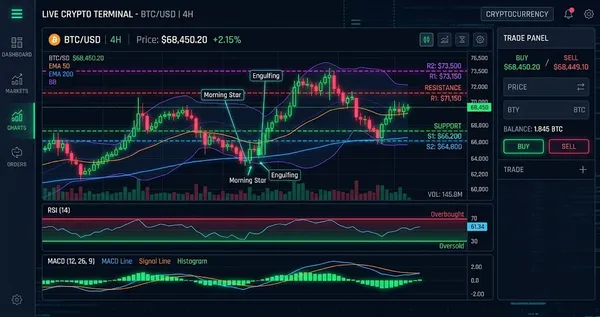
Bitcoin vs Ethereum — Detailed Comparison 2026
Bitcoin vs Ethereum: detailed comparison of features, fees, and user experience. Find out which is right for you.

Bitcoin is a settlement layer focused on security and store-of-value, processing large-value transfers with high finality. Ethereum is a programmable execution layer built around smart contracts, powering DeFi and on-chain applications.
Bitcoin trades at $77,827 with a 24h change of +0.5% and $891.1M volume, according to the provided market data snapshot. Ethereum trades at $2,142 with a 24h change of +0.4% and $491.0M volume, showing lower liquidity in this dataset but broader application utility.
The core comparison is simple: Bitcoin optimizes for monetary reliability, while Ethereum optimizes for on-chain computation and application infrastructure.
Quick Comparison
| Feature | Bitcoin | Ethereum |
|---|---|---|
| Price | $77,827 | $2,142 |
| Market Cap | — | — |
| 24h Change | +0.5% | +0.4% |
| 24h Volume | $891.1M | $491.0M |
| Rank | #undefined | #undefined |
Transaction throughput
Ethereum wins on raw throughput when including layer-2 networks. Bitcoin processes about 7 transactions per second (TPS) on-chain, while Ethereum L1 averages ~15–30 TPS, according to Etherscan and L2Beat network data as of May 2026.
Bitcoin's base layer is intentionally constrained, with block size ~1 MB and ~10-minute block times (Bitcoin Core data), which keeps throughput low but predictable. Ethereum increases capacity via rollups, where combined L2 systems process thousands of TPS (often 2,000–4,000+ TPS depending on rollup mix, per L2Beat and DefiLlama). Final takeaway: Ethereum sustains higher effective transaction capacity today when L2 activity is included.
Security and decentralization
Bitcoin wins on economic security and validator simplicity. Bitcoin's proof-of-work network runs at ~600–650 EH/s hash rate as of May 2026 (Blockchain.com metrics), while Ethereum operates ~1M+ validators under proof-of-stake (Beaconcha.in data).
Bitcoin's security is concentrated in energy-backed mining, with ASIC dominance reducing attack feasibility, while Ethereum spreads validation across a large validator set with lower hardware requirements but higher coordination complexity. According to on-chain validator data from Etherscan and Beaconcha.in, Ethereum has broader participation, but Bitcoin's mining cost per attack remains significantly higher in economic terms. Final takeaway: Bitcoin maintains stronger economic security guarantees under sustained attack cost assumptions.
Monetary policy and supply predictability
Bitcoin wins due to fixed supply and deterministic issuance. Bitcoin supply is capped at 21 million coins, with current circulating supply ~19.7M BTC as of May 2026 (CoinMarketCap data), with halving events reducing issuance every ~4 years.
Ethereum has no fixed supply cap, with supply fluctuating based on burn and issuance dynamics under EIP-1559. Since the Merge (Q4 2022), ETH has oscillated between net inflation and deflation, with annualized supply change typically around -0.5% to +0.5% depending on network activity (Ultrasound.money data). Final takeaway: Bitcoin provides stricter long-term supply certainty, while Ethereum maintains adaptive issuance tied to network usage.
Bitcoin (BTC) Resources
Ethereum (ETH) Resources
Ready to start trading?
Trade on Bitget Try CoinTech2uAffiliate links — we may earn a commission at no extra cost to you.
Final Verdict
Bitcoin wins overall because it holds far stronger institutional demand and liquidity at $891.1M 24h volume versus Ethereum's $491.0M, while BTC also trades at $77,827 with lower smart-contract risk as of May 2026. Bitcoin is better if you want a simpler long-term store-of-value asset with lower protocol complexity and stronger ETF-driven adoption. Ethereum is better if you want exposure to DeFi and on-chain apps, because Ethereum still processes most smart-contract activity and stablecoin settlement volume according to DefiLlama data as of May 2026.
Frequently Asked Questions
Which is better, Bitcoin or Ethereum?
It depends on your needs. Bitcoin excels in certain areas while Ethereum has its own strengths. Consider what features matter most to you.
Can I use both Bitcoin and Ethereum?
Yes, many crypto users diversify across multiple platforms. Using both lets you take advantage of each one's strengths.
Is Bitcoin safe?
Bitcoin is a well-established option in the crypto space. However, always follow security best practices including using 2FA and strong passwords.
Which has lower fees?
Fee structures vary depending on usage. Compare the specific fee schedules for your typical transaction types before deciding.
Related Articles
- Kraken vs KuCoin — Detailed Comparison 2026
- Solana vs Avalanche — Detailed Comparison 2026
- Solana vs Avalanche — Detailed Comparison 2026