
Cardano vs Polkadot — Detailed Comparison 2026
Cardano vs Polkadot: detailed comparison of features, fees, and user experience. Find out which is right for you.
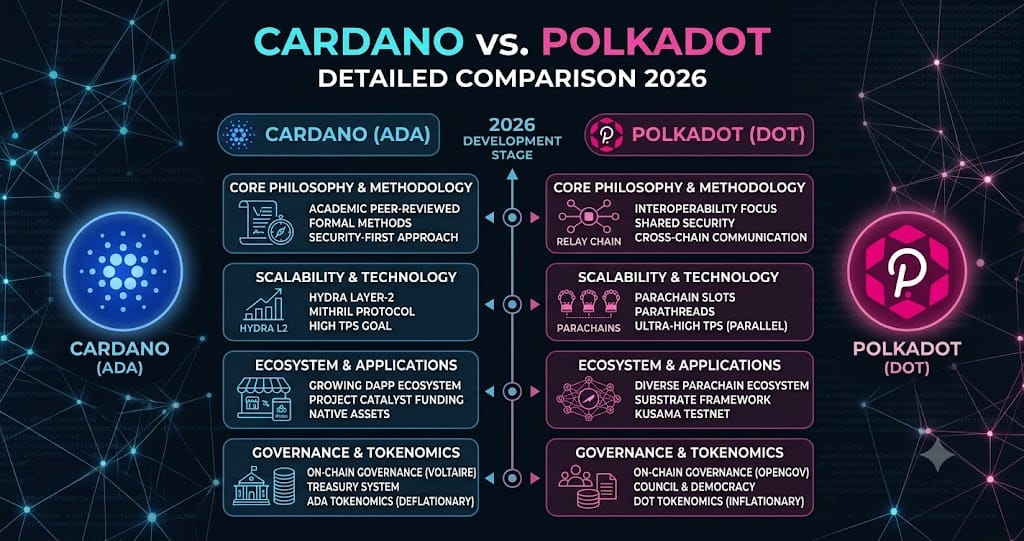
Cardano delivers academic-grade security and predictable settlement through its extended UTXO model — the blockchain equivalent of a sovereign bond desk, slow and deliberate, built for institutions that cannot tolerate failed transactions. Polkadot operates as a Layer-0 meta-protocol connecting specialized blockchains under shared security; it replaced rigid parachain auctions with an Agile Coretime marketplace, where developers buy computational power on demand, like cloud computing.
Both networks are mid-transition in 2026, and the stakes are high. Cardano activated the Van Rossem hard fork on July 18 — its first upgrade ratified entirely through on-chain governance — and is handing core development of its Haskell node, Plutus, and Hydra to three outside teams starting in August, testing whether a decentralized engineering model can outpace its founding developer. Polkadot capped DOT supply at 2.1 billion on March 14 and cut annual issuance by more than 53%, shifting from inflation to deflationary mechanics as it rolls out the JAM protocol to replace the Relay Chain. ADA trades at $0.1647, down 95% from its September 2021 peak; DOT sits at $0.8200, near its all-time low of $0.799 set on June 28. Both tokens hover near multi-year lows while their teams bet on opposite paths: Cardano on governance-driven caution, Polkadot on deflationary supply and a rebuilt core protocol.
Quick Comparison
| Feature | Cardano | Polkadot |
|---|---|---|
| Price | $0.1647 | $0.8200 |
| Market Cap | — | — |
| 24h Change | -0.7% | +0.2% |
| 24h Volume | $4.9M | $2.4M |
| Rank | #undefined | #undefined |
Technology & Features
Cardano and Polkadot approach core technology differently — extended UTXO versus shared-security parachains — and that split shapes who each chain suits. Developers building formally verified contracts lean toward Cardano; those building cross-chain apps lean toward Polkadot.
Feature sets overlap on paper, but the right pick depends on what you're building. Plutus-based contracts and Hydra state channels suit apps that need Cardano's governance guarantees; Coretime-purchased execution suits projects that want Polkadot's shared security without owning a parachain slot.
✅ Pros
- Cardano offers strong core functionality
- Cardano has a well-established ecosystem
❌ Cons
- Cardano may have higher entry barriers
- Cardano can be complex for beginners
Fees & Value
Cardano and Polkadot calculate transaction fees differently. That difference is worth checking before committing capital to either chain, since it changes the math on smaller or more frequent transactions.
How each chain pays off depends mostly on your time horizon and how often you trade. A short-term trader and a long-term holder will weigh ADA and DOT differently.
✅ Pros
- Polkadot provides competitive pricing
- Polkadot offers good value for active users
❌ Cons
- Polkadot fees can add up for low-volume users
- Polkadot may have hidden costs
User Experience
Day-to-day experience differs too. Wallet interfaces and tooling maturity matter as much as the underlying protocol when you're actually using either chain.
Both teams have poured resources into their 2026 upgrades — Cardano into governance and external development, Polkadot into JAM and deflationary tokenomics — but each is optimizing for a different kind of user.
✅ Pros
- Strong community and support resources
- Intuitive interface for common operations
❌ Cons
- Learning curve for advanced features
- Customer support response times vary
Cardano (ADA) Resources
Polkadot (DOT) Resources
Ready to start trading?
Trade on Bitget Try CoinTech2uAffiliate links — we may earn a commission at no extra cost to you.
Final Verdict
Cardano wins on trading volume: $4.9M in reported 24h volume versus Polkadot's $2.4M, per CoinGecko, while ADA trades at $0.1647 against DOT's $0.8200 as of July 2026. Pick Cardano if you want a lower-priced token: ADA sits at $0.1647 with a 24h change of -0.7%, per CoinGecko. Pick Polkadot if you want exposure to a higher unit price: DOT is at $0.8200, up 0.2% over 24 hours, per CoinGecko.
Frequently Asked Questions
Which is better, Cardano or Polkadot?
It depends on your needs. Cardano excels in certain areas while Polkadot has its own strengths. Consider what features matter most to you.
Can I use both Cardano and Polkadot?
Yes, many crypto users diversify across multiple platforms. Using both lets you take advantage of each one's strengths.
Is Cardano safe?
Cardano is a well-established option in the crypto space. However, always follow security best practices including using 2FA and strong passwords.
Which has lower fees?
Fee structures vary depending on usage. Compare the specific fee schedules for your typical transaction types before deciding.
Related Articles
- MetaMask vs Rabby — Detailed Comparison 2026
- Uniswap vs Aave — Detailed Comparison 2026
- Solana vs Avalanche — Detailed Comparison 2026