Coinbase vs Binance — Detailed Comparison 2026
Coinbase vs Binance: detailed comparison of features, fees, and user experience. Find out which is right for you.
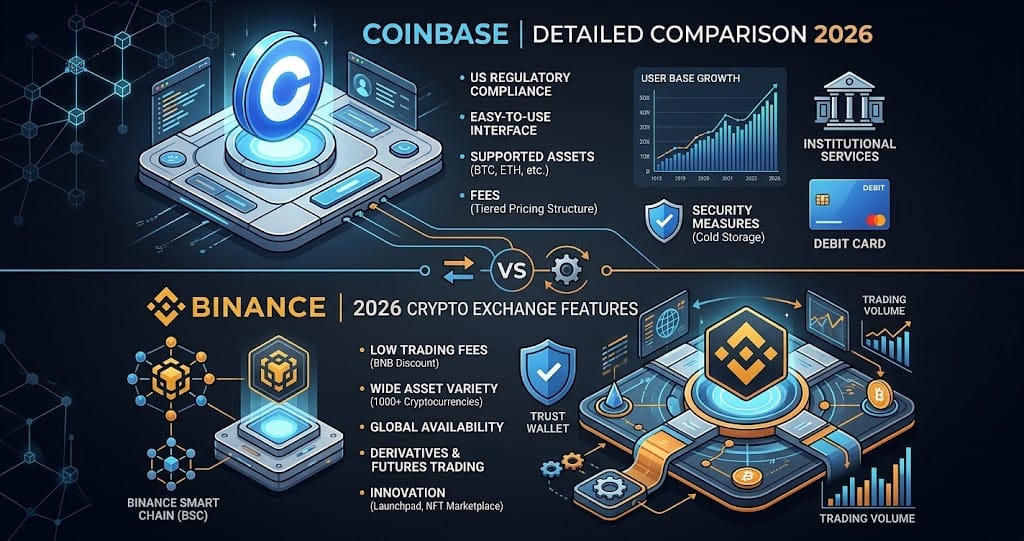
Coinbase is the regulated, publicly-traded US exchange (NASDAQ: COIN) with a record 10.3% global market share in Q2 2026, but its standard fees start at 0.40% maker and 0.60% taker. Binance is the global liquidity leader with 39.5% market share as of June 2026, charging a flat 0.10% spot fee, or 0.075% if paid in BNB.
The fee gap is wide. Binance.US charges 0% maker and 0.02% taker on all pairs, while Coinbase's simple trade fees can exceed 1.5% for casual buyers. Binance's cumulative spot volume hit nearly $1 trillion in 2026, but it still operates under a DOJ monitorship from its $4.3 billion 2023 settlement; Coinbase had its SEC case dismissed in February 2025.
Active traders get a clear cost edge on Binance. US-based investors who want regulatory clarity get a Nasdaq listing and FDIC-insured USD accounts (up to $250,000) from Coinbase.
Quick Comparison
| Feature | Coinbase | Binance |
|---|---|---|
| Type | Centralized Exchange | Centralized Exchange |
Technology/Features
Binance wins Technology/Features as of September 1, 2026. Its developer platform covers Spot, Margin, USDⓈ-M Futures, COIN-M Futures, Options, Portfolio Margin, WebSocket streams, FIX connectivity, and a Spot Testnet, according to Binance's official API documentation.
Coinbase is simpler but narrower. Coinbase Advanced offers 552 spot pairs, TradingView-powered charts, market, limit, and stop-limit orders, plus REST and WebSocket APIs, according to Coinbase data current in 2026.
Binance offers a wider trading toolkit; Coinbase offers 552 spot pairs on a more focused platform. Choose Binance for futures, options, or a broader API stack; choose Coinbase for straightforward spot trading.
Binance Developer Center
✅ Pros
- Coinbase Advanced supports 552 spot pairs and TradingView charting, according to Coinbase data.
- Coinbase
❌ Cons
- Coinbase Advanced's documented spot trading interface centers on market, limit, and stop-limit orders rather than Binance's broader derivatives stack.
- Coinbase Help
Fees/Value
Binance wins Fees/Value for most active traders as of September 2026. Its standard Spot maker and taker rate is 0.10% each, while Coinbase Advanced lists fees up to 0.40% maker and 0.60% taker for lower-volume tiers.
The gap is concrete: on a $10,000 trade, a 0.10% fee equals $10, a 0.40% maker fee equals $40, and a 0.60% taker fee equals $60. Coinbase can get cheaper at higher volume, with advertised maker fees as low as 0.0%, but Binance starts lower for ordinary Spot pricing.
Binance also cuts fees for BNB payments in eligible products, while Coinbase Advanced uses a 30-day volume-based fee structure. If you trade frequently and need lower baseline costs, choose Binance; if you trade enough volume to reach Coinbase's lowest tiers, compare your actual quoted fee before deciding.
✅ Pros
- Coinbase Advanced advertises maker fees as low as 0.0% across its volume-based pricing structure.
- Coinbase
❌ Cons
- Coinbase Advanced lists fees up to 0.40% maker and 0.60% taker, versus Binance's 0.10% maker and 0.10% taker standard Spot example.
- Coinbase Help
User Experience
Coinbase wins User Experience as of September 2026. Coinbase Advanced combines 552 spot pairs, TradingView charts, staking, and wallet and API access in a more focused platform, according to Coinbase's official product pages.
Binance gives users more choices, but that breadth adds complexity. Its official developer documentation splits products into Spot, Margin, Futures, Options, Portfolio Margin, Wallet, Sub-Accounts, and Simple Earn, while Coinbase Advanced concentrates its trading experience around a single advanced interface.
Coinbase wins on simplicity. Choose Coinbase for a cleaner path to spot trading; choose Binance for the widest set of trading products and a steeper learning curve. Coinbase's 552 spot pairs remain the benchmark that makes it the better usability pick without being feature-poor.
✅ Pros
- Coinbase Advanced offers TradingView charts with EMA, MA, MACD, RSI, Bollinger Bands, and drawing tools in the same platform.
- Coinbase Help
❌ Cons
- Coinbase Advanced has 552 spot pairs, but users needing a broad derivatives workflow may find Binance's Futures and Options product range more suitable.
- Coinbase
Ready to start trading?
Trade on Bitget Try CoinTech2uAffiliate links — we may earn a commission at no extra cost to you.
Final Verdict
Binance wins overall for active traders: its 0.10% standard spot fee (0.075% with BNB) undercuts Coinbase Advanced Trade's 0.40% maker and 0.60% taker entry-tier fees by roughly 5x, saving frequent traders thousands per year. Binance also holds 35.34% global market share with average daily spot volumes above $10B as of Q2 2026, versus Coinbase's 10.3% record high. Coinbase is better if you're a US-based beginner who wants regulatory clarity and simplicity — it's a Nasdaq-listed public company available in all 50 states, while Binance is blocked for US residents and its US affiliate operates in only 14 states with fewer features. Binance is better if you're an international active trader who wants the lowest fees, the deepest liquidity (427 assets, with the lowest BTC slippage up to $1M per CoinDesk Research), and a full derivatives suite including futures up to 125x leverage.
Frequently Asked Questions
Which has lower trading fees, Coinbase or Binance?
Binance is dramatically cheaper. Binance charges a flat 0.10% spot maker and taker fee by default, with discounts available for BNB holders or higher volume tiers- 1 - 43 . Coinbase Advanced Trade starts at 0.40% maker and 0.60% taker for the lowest volume tier- - 1 . For a $10,000 trade, Binance costs $10 while Coinbase Advanced costs $60 — and Coinbase's standard simple interface adds a roughly 0.5% spread on top, pushing effective costs above 1.5% for casual buyers- 4 - 43 - 42 . Winner: Binance by a wide margin.
Which exchange is safer or more regulated?
Coinbase is the safer, more regulated choice for U.S. users. Coinbase is a publicly traded company on Nasdaq (COIN), holds licenses in all 50 states, and had its SEC enforcement case dismissed in February 2025- 2 - 43 . Binance's global platform is not available to U.S. residents, and its parent company remains under federal compliance monitorship following a $4.3 billion criminal settlement with the DOJ in 2023- 2 . Binance has roughly 270 million users globally versus Coinbase's 100 million, but that scale comes with regulatory baggage- . Winner: Coinbase for regulatory clarity and U.S. availability.
Which has more cryptocurrencies and trading features?
Binance offers far more assets and advanced tools. Binance lists 350+ cryptocurrencies versus Coinbase's 240+- 2 - 43 . Binance supports margin trading, futures with up to 125x leverage, options, staking, and a launchpad for new tokens- 43 . Coinbase deliberately omits most of these features to reduce retail risk- 43 . Per CryptoRank data, Binance captured $252.6 billion in monthly spot volume in April 2026 (26.5% market share) versus Coinbase's $50.4 billion (5.3%)- - 30 . Winner: Binance for active traders and altcoin hunters.
Which is better for a beginner just buying Bitcoin?
Coinbase is the better choice for beginners. The interface is clean, account setup takes under ten minutes, and it's fully available across all 50 states- 43 . Binance's interface is dense and assumes prior knowledge, and U.S. residents can only use the restricted Binance.US subsidiary which excludes many features- - 43 . The tradeoff is cost: Coinbase's simple buy interface can charge 1.49% plus spreads on bank purchases, while Binance charges 0.1%- 2 - . If you're buying $100 once, Coinbase's extra ~$1.40 doesn't matter. If you're trading $10,000 monthly, Binance saves you over $500 per year in fees- 43 . Winner: Coinbase for simplicity and U.S. access; Binance only if you're willing to learn and trade frequently.
Related Articles
- MetaMask vs Trust Wallet — Detailed Comparison 2026
- Dogecoin vs Shiba Inu — Detailed Comparison 2026
- MetaMask vs Trust Wallet — Detailed Comparison 2026