2026 Crypto Narratives Explained: BTCFi, DeFAI, AI Restaking, and Capital Rotation Trends
Explore 2026 crypto narratives including BTCFi ($3.9B+ TVL), EigenLayer AI restaking, and DeFAI. Learn capital flow and trading structure shifts.
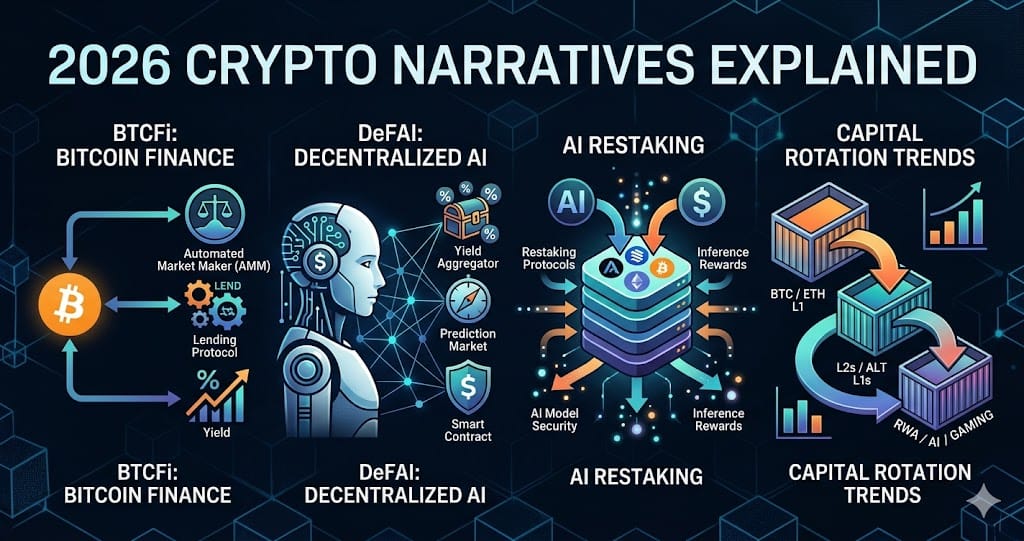
Crypto narratives in 2026 are defined by measurable infrastructure growth rather than speculative cycles, with BTCFi protocols reaching roughly $3.9B–$5B TVL and EigenLayer restaking exceeding $18B–$20B in ETH locked. At the same time, DeFAI sits at a smaller but active ~$655M market cap across 160+ tokens, reflecting early-stage AI-finance experimentation. This shift matters because capital is no longer rotating only between tokens but between entire financial layers such as Bitcoin yield systems, AI verification infrastructure, and tokenized assets. BTCFi (Babylon, Lombard), AI restaking (EigenLayer), and DeFAI are forming a stacked liquidity structure that defines where risk and yield concentrate in
In This Guide
Step-by-Step Guide
Map Core Narrative Categories
Crypto market structure in 2026 is dominated by four measurable narrative clusters: BTCFi, AI restaking, DeFAI, and tokenized assets. Each is defined by on-chain capital rather than social hype, with BTCFi alone reaching $3.9B–$5B TVL through Babylon-based staking systems. Understanding these categories helps separate structural liquidity from short-term momentum. For example, BTCFi represents Bitcoin yield expansion, while AI restaking transforms ETH into computation collateral, and DeFAI captures experimental AI-driven trading systems.
Analyze BTCFi as Bitcoin Yield Infrastructure
BTCFi converts Bitcoin from passive storage into productive capital through staking and liquidity protocols. Babylon leads this segment with multi-billion-dollar TVL, while Lombard’s LBTC integrates Bitcoin liquidity across 70+ DeFi protocols. Lombard’s ~$1.9B TVL demonstrates how BTC liquidity is being reused across Ethereum-based lending markets. This creates a layered yield system where Bitcoin exposure is no longer static but embedded in DeFi credit cycles.
Evaluate AI Restaking as Infrastructure Security Layer
EigenLayer extends restaking into AI verification through EigenAI and EigenCompute, where ETH is staked to guarantee AI inference accuracy. The system introduces slashing penalties for incorrect outputs, linking computation quality directly to economic security. With ~$18B–$20B in restaked ETH, EigenLayer is evolving from yield optimization into a decentralized trust layer for AI computation. This positions ETH staking as infrastructure collateral for off-chain AI execution.
Assess DeFAI as High-Beta Experimental Sector
DeFAI represents decentralized AI financial systems with approximately $655M market cap and around 160 active tokens. It remains a fragmented but structured niche within broader AI crypto classification. Unlike BTCFi or restaking, DeFAI is primarily driven by speculative experimentation in autonomous trading agents and AI-driven liquidity strategies. Its volatility reflects early-stage adoption rather than stable capital formation.
Track Cross-Narrative Capital Rotation
Capital in 2026 rotates between overlapping infrastructure layers rather than isolated cycles. BTCFi captures Bitcoin-native liquidity, AI restaking absorbs ETH staking demand, and DeFAI captures speculative retail flow. The key trading signal is not individual token performance but liquidity migration between these layers. When BTCFi TVL expands while DeFAI stagnates, capital is moving from experimental risk to structured yield systems.
Tips and Best Practices
- Always test with small amounts before committing significant funds.
- Bookmark the official websites of tools mentioned in this guide to avoid phishing.
- Keep detailed records of your transactions for tax reporting purposes.
Ready to start trading?
Trade on Bitget Try CoinTech2uAffiliate links — we may earn a commission at no extra cost to you.
Frequently Asked Questions
What is BTCFi in 2026 crypto markets?
BTCFi refers to Bitcoin-based decentralized finance systems that enable staking and yield generation. Protocols like Babylon and Lombard collectively manage billions in TVL, turning BTC into productive collateral across DeFi ecosystems.
How does EigenLayer AI restaking work?
EigenLayer allows ETH to be restaked as collateral for AI computation tasks via EigenAI and EigenCompute. Validators can be slashed if AI outputs are incorrect, linking staking rewards directly to computation accuracy.
Why is DeFAI considered a high-risk sector?
DeFAI combines decentralized finance with AI agents but remains early-stage with about $655M market cap and ~160 tokens. Its liquidity is fragmented, making it highly sensitive to sentiment and narrative shifts.
Related Articles
- How to Stake Loopring (LRC) — Beginner's Guide 2026
- How to Buy and Store Bitcoin (BTC) Safely — Beginner's Guide 2026
- How to Set Stop-Loss Orders in Crypto — Beginner's Guide 2026