Crypto Market Week June 17 2026: RWA Perps, DePIN, and Yield Stablecoins
Ondo Finance Perps Beta, DePIN surpassing oracles, and tokenized private credit at USD 18.58B define the week of June 14-17, 2026.
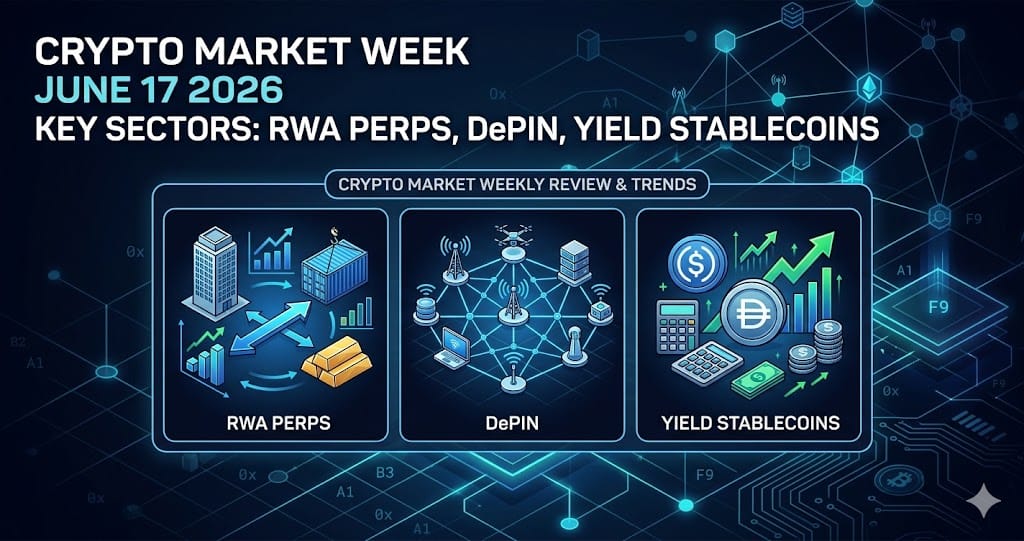
Three converging signals define crypto markets in the week of June 14-17, 2026: Ondo Finance launched a perpetual contracts beta on June 14 allowing non-US accredited users to trade tokenized stocks and ETFs with up to 20x leverage, the CFTC approved the first US-listed perpetual contract, and Standard Chartered forecast DeFi and tokenized assets reaching USD 2.7 trillion by 2030. ONDO token gained 59% over the prior 30 days to USD 0.37, with total value locked at approximately USD 3.76 billion.
BTC dominance sits at 58% and the CoinMarketCap Altcoin Season Index stands at 46 out of 100, firmly inside Bitcoin Season territory. That means the week's gains are narrative-driven and selective rather than broad-based, with capital concentrating in protocols that demonstrate real revenue or hard regulatory catalysts rather than spreading across the altcoin market evenly.
RWA Meets Perpetual Trading — Ondo Finance and the CFTC Signal
The most structurally significant development of the week is the merger of two previously separate narratives: real-world asset tokenization and on-chain perpetual derivatives. Ondo Finance's Perps Beta, live since June 14, enables eligible users outside the US to open leveraged positions of up to 20x on tokenized equities and ETFs — assets that previously existed on-chain only as spot instruments. For comparison, Hyperliquid offers leverage of 3x to 40x on crypto-native pairs, so Ondo's 20x ceiling places it in competitive range for the institutional DeFi audience.
On June 15, Standard Chartered published a forecast placing the total addressable market for DeFi and tokenized assets at USD 2.7 trillion by 2030. That same week the CFTC approved the first perpetual contract listing in the United States, opening a domestic regulatory pathway that had been absent from the RWA narrative until now. Together these three events — product launch, institutional forecast, and regulatory clearance — form a convergence that reinforces ONDO's 30-day price appreciation of 59% and provides a ceiling-level valuation anchor from a major financial institution.
DePIN Emerges as a Standalone Sector Beyond Speculation
Decentralized Physical Infrastructure Networks, commonly called DePIN, crossed a structural threshold this week: the sector's aggregate market capitalization now exceeds that of the entire oracle category in crypto. As of May 2026, 265 DePIN tokens carry a combined market cap of approximately USD 18.92 billion with 24-hour trading volume of USD 2.74 billion, up from roughly USD 9-10 billion at the start of 2026. On-chain revenue from DePIN networks has also begun to outpace most oracle protocols, a shift that analysts cite as evidence of genuine service demand rather than speculative inflows.
The leading DePIN tokens show clear differentiation in scale. Bittensor (TAO) holds approximately USD 3.45 billion in market cap and overlaps with the AI narrative, making it the largest token at the intersection of artificial intelligence and physical infrastructure. Internet Computer (ICP) sits at approximately USD 1.25 billion, Render (RENDER) at USD 887 million, and Filecoin (FIL) at USD 629 million. During the most recent broad market pullback, TAO declined only 2.4% week-over-week while major Layer 1 tokens posted double-digit losses, a divergence that signals stronger conviction in the sector's revenue-based valuation framework.
Yield-Bearing Stablecoins and Tokenized Private Credit Hit Mainstream Scale
A second sector that was absent from earlier market cycles is now maturing at measurable pace. Yield-bearing stablecoins currently offer 5-10% APY generated through mechanisms including tokenized Treasury cash management, on-chain money markets, protocol savings rates, and basis or funding-rate arbitrage. The appeal is structural rather than speculative: yields are anchored to short-end real-world interest rates rather than token emissions, which makes the return profile comparable to a money-market fund rather than a liquidity mining program.
On the institutional side, tokenized real-world assets grew 229% in 2025, rising from USD 5.5 billion to USD 18.1 billion. Within that category, US Treasuries more than doubled from USD 3.91 billion to USD 8.68 billion, while tokenized private credit grew from USD 9.85 billion to USD 18.58 billion, making it the single largest RWA subcategory. Private credit instruments in this space typically offer APY of 6-13% and give retail participants access to asset classes — including pre-IPO equity and private debt — that have historically required institutional minimums or accredited investor status.
Market Structure: Bitcoin Season and the Logic of Narrative Selection
The broader market structure confirms that selectivity is essential this week. BTC dominance at 58% and an Altcoin Season Index of 46 out of 100 place the market firmly in Bitcoin Season, not a broad altcoin rotation. Capital is flowing into protocols with verifiable cash flows or hard regulatory catalysts, a pattern consistent with the H2 2026 outlook published by multiple research sources identifying five dominant narratives: AI combined with DePIN, stablecoin payments, RWA tokenization, modular blockchain infrastructure, and prediction markets.
The DePIN valuation framework has already shifted from speculative to revenue-based, with analysts now evaluating networks on recurring income, real usage volume, and network demand. The modular blockchain narrative has similarly matured — the question is no longer which chain is fastest but how to make chain selection invisible to end users. Investors who positioned in ONDO, TAO, and RENDER ahead of the current catalysts captured most of the week's available alpha; without a broad altcoin season, protocols without hard fundamentals are unlikely to participate meaningfully in the rotation.
What to Watch
- ONDO — TVL approximately USD 3.76 billion, +59% over 30 days; Perps Beta live June 14 with up to 20x leverage on tokenized equities and ETFs, plus CFTC regulatory tailwind
- TAO (Bittensor) — market cap approximately USD 3.45 billion; fell only 2.4% during the most recent broad pullback while major Layer 1 tokens declined double digits, reflecting its dual positioning in AI and DePIN
- RENDER — market cap approximately USD 887 million; GPU rendering network sits at the intersection of AI compute demand and decentralized physical infrastructure, two of the top five H2 2026 narratives
- FIL (Filecoin) — market cap approximately USD 629 million; decentralized storage with measurable real-world utilization metrics and recurring network revenue, fitting the new DePIN revenue-based valuation framework
Ready to start trading?
Trade on Bitget Try CoinTech2uAffiliate links — we may earn a commission at no extra cost to you.
Frequently Asked Questions
What is RWA perpetual trading and how does Ondo Finance's platform work?
RWA perpetual trading allows users to take leveraged long or short positions on tokenized versions of traditional assets such as stocks and ETFs, using on-chain infrastructure instead of a brokerage account. Ondo Finance's Perps Beta, launched June 14, 2026, supports leverage up to 20x for non-US accredited users. Unlike spot RWA tokens, which track an asset's price without expiry, perpetual contracts settle continuously and charge funding rates between longs and shorts, eliminating the need to roll expiry dates as with traditional futures.
What is the DePIN sector and why has it overtaken oracle networks in market cap?
DePIN stands for Decentralized Physical Infrastructure Networks — protocols that coordinate real-world hardware such as wireless base stations, GPU clusters, storage drives, and IoT sensors using token incentives. As of May 2026, 265 DePIN tokens hold a combined market cap of approximately USD 18.92 billion. The sector now generates more on-chain revenue than most oracle networks because it sells physical compute and connectivity services to paying customers rather than relying solely on token emissions to attract capital.
How do yield-bearing stablecoins generate 5-10% APY and what are the main risks?
Yield-bearing stablecoins earn returns by deploying reserves into short-duration instruments — most commonly tokenized US Treasury bills — or by capturing funding rates and basis spreads in derivatives markets. The 5-10% APY range broadly tracks short-end real-world rates rather than inflationary token emissions, making the yield more durable over time. Key risks include smart contract vulnerabilities, counterparty exposure to the underlying Treasury custodians, and regulatory changes that could restrict on-chain access to government securities in certain jurisdictions.