Bitcoin Short Squeeze June 2026: $536M Liquidated in 24 Hours
On June 16 2026, $536M was liquidated across crypto markets — 70% from shorts. Here's the data behind the two-day squeeze and what drove it.
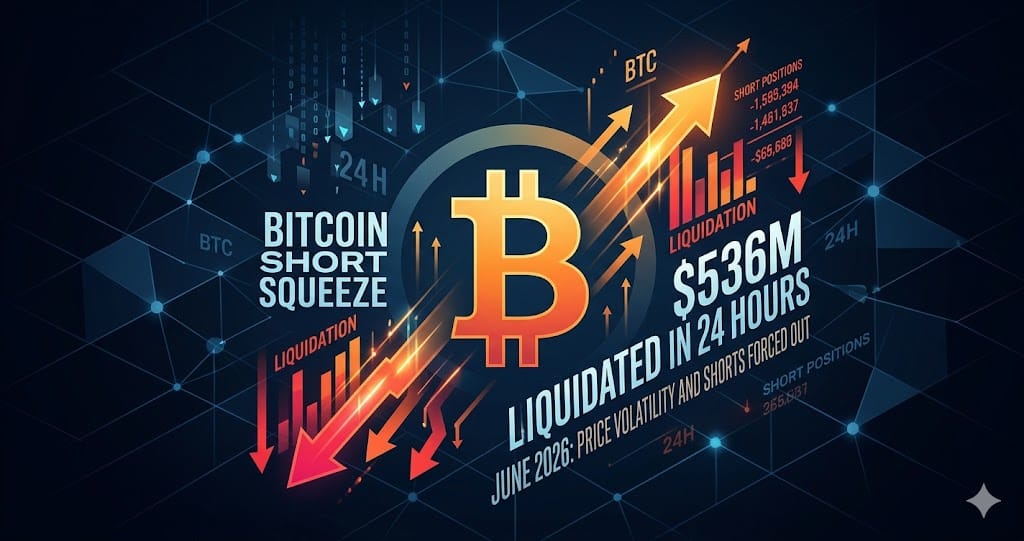
On June 16, 2026, Bitcoin's derivatives market recorded $536 million in liquidations over 24 hours, with short positions accounting for 70% of that total at $375 million. This followed June 15, when shorts represented 74% of a $193 million liquidation day — marking a consecutive two-day pattern of short-dominated forced exits that represented a sharp structural reversal from the long-dominated cascade earlier in the month.
The immediate catalyst was the Bank of Japan raising its benchmark rate from 0.75% to 1.0%. What would normally be treated as a risk-off trigger instead became a "sell the rumor, buy the news" moment: options traders had already priced in the hike at 98% probability before the announcement, leaving almost no downside surprise. With the negative funding rate deepening from -0.0001% on June 14-15 to -0.0006% on June 16 — a sixfold increase in cost for short holders — the conditions for a forced short unwind were firmly in place.
How the Two-Day Short Squeeze Unfolded
On June 16, Bitcoin opened at $66,195, climbed to a daily high of $67,253 around 11:30 EDT, then pulled back to a support level of $65,595 by late evening. The $1,058 intraday move was accompanied by $110 billion in global 24-hour trading volume, up 57% from the prior week's baseline of $70 billion. A surge in volume alongside rising prices and short liquidations is a meaningful distinction from a low-volume technical bounce.
The structural context matters. From June 4 to June 6, long positions had dominated liquidations at roughly 85% of total forced exits. By June 15, that ratio had fully inverted — shorts were taking 74% of the damage. June 16 confirmed the reversal was not noise: at 70% short liquidation share on roughly 2.7 times the prior day's absolute dollar volume, the direction held while the scale intensified.
Bank of Japan, Priced-In Catalysts, and the Backfire Effect
The BoJ rate decision on June 16 illustrates a dynamic that experienced traders track carefully: when a negative macro event is nearly fully priced into derivatives markets before it happens, the actual announcement removes uncertainty rather than creating it. With 98% of options traders having already positioned for the 0.75%-to-1.0% hike, there was no incremental selling pressure left to release. The result was a short-covering rally rather than the drawdown many had anticipated.
This pattern repeated a dynamic seen on June 14-15, when a US-Iran peace agreement served as the geopolitical catalyst for the prior day's short squeeze. The underlying condition enabling both events was the same: a market crowded with short positions and a negative funding rate structure that made holding those shorts progressively more expensive. The specific catalyst rotated from geopolitical to monetary policy, but the structural setup did the heavy lifting.
Funding Rates, Open Interest, and the Self-Reinforcing Loop
Bitcoin perpetual swap funding rates on June 16 settled at -0.0006%, meaning short position holders were paying fees to long holders rather than receiving them. This is the inverse of the more common positive funding environment seen during bull runs. On June 14-15, the rate stood at approximately -0.0001% — negative, but comparatively mild. The sixfold deepening in a single day signals that the short-side crowding intensified even as the price was rising against those positions.
The mechanism compounds on itself. As the funding rate turns more negative, the carry cost of maintaining a short increases. Traders managing risk-adjusted positions face pressure to reduce exposure. When many do so simultaneously, their buy orders to close shorts push the price higher, triggering stop-losses and liquidations for other short holders. Deribit data from the broader June 2026 period showed put options at the $60,000 strike accumulating over $1 billion in open notional interest before the market low — evidence that institutional-scale hedging had already reflected peak fear before the reversal began.
Fear and Greed, Volatility, and the Macro Overlay
The Crypto Fear and Greed Index moved from a reading of 8 one week before June 16 to a range of 20-24 on the day itself, according to aggregations from smallworldfs and milkroad respectively. The spread between those two readings reflects different methodologies, but both confirm the same directional shift: the index exited the extreme fear floor zone for the first time since the early June cascade. The index remained firmly within the broader fear band, however, and analysts cited in coverage from smallworldfs characterized the move as "panic may be fading" rather than a sentiment recovery.
BTC realized volatility had compressed to approximately 17% as of June 1, per CryptoQuant data cited by cryptonews.net — down more than 56% from a Q2 peak near 39%. Historically, similar compression periods in 2026 preceded sharp directional moves. On the macro side, WazirX's analysis of the June cascade framed it as a combination of crypto-native selling and a separate macro-driven correlation event, identifying VIX readings above 20 and significant Nasdaq futures declines as observable thresholds that increase the probability of correlated crypto selling pressure.
Ten-Day Liquidation Context and What the Numbers Add Up To
Zooming out from the two-day short squeeze, the ten-day period ending around June 16 saw roughly $1.57 billion in cumulative Bitcoin liquidations, predominantly long positions, as the market fell toward the $59,100 low. Against that backdrop, a single 15-minute window during the June 16 recovery saw approximately $320 million in short positions forcibly closed — a sharp contrast that captures the speed with which market structure can flip once a squeeze dynamic takes hold.
The cumulative picture from June 4 through June 16 covers both phases of the cycle: a long liquidation cascade during the decline, followed by a short liquidation cascade during the recovery. Fear and Greed readings moving from the single digits toward the low 20s, funding rates running persistently negative, and volume expanding on up-days all sit on the recovery side of that ledger. Whether that recovery sustains depends in part on whether the negative funding environment persists long enough to exhaust remaining short positioning, or whether the rate returns to positive territory as new speculative long demand enters the market.
What to Watch
- Funding rate direction: a move back toward 0% or into positive territory would signal that the short-covering fuel is being exhausted and speculative longs are re-entering
- Fear and Greed Index crossing 30: moving from the fear band into neutral territory would confirm sentiment has structurally recovered, not just bounced
- VIX behavior: readings above 20 combined with Nasdaq futures weakness have historically preceded correlated crypto selloffs, per WazirX June 2026 analysis
- BTC $65,595 support level: this intraday low from late June 16 represents the most recent tested support; a break below would re-engage the liquidation waterfall on the long side
Ready to start trading?
Trade on Bitget Try CoinTech2uAffiliate links — we may earn a commission at no extra cost to you.
Related Articles
- Bitcoin's June 2026 Liquidation Cascade: $3.5B Forced Selling Explained
- Crypto Narratives 2026: Fair Launch, Prediction Markets, and InfoFi Emerge
- Bitcoin Liquidation Cascade June 2026: What the Data Reveals
Frequently Asked Questions
Why did the Bank of Japan rate hike cause Bitcoin to rise on June 16?
The BoJ rate increase from 0.75% to 1.0% was already reflected in options pricing at a 98% probability before the announcement. When a negative event is fully priced in, its actual occurrence removes uncertainty rather than adding it. With no incremental selling pressure to release, traders who had been short in anticipation of a crypto drawdown were caught offside, and the forced buybacks from their liquidated positions pushed prices higher.
What does a negative funding rate of -0.0006% mean for Bitcoin traders?
In Bitcoin perpetual swap markets, the funding rate is a periodic payment exchanged between long and short holders to keep the contract price anchored to spot. When the rate is negative, short holders pay long holders — typically around every 8 hours depending on the exchange. At -0.0006% on June 16, shorts were paying longs to maintain their positions. The more negative the rate, the more expensive it becomes to stay short, which creates structural pressure for short holders to exit their positions, particularly in a rising price environment.
Is a Fear and Greed Index reading of 20-24 a signal to buy Bitcoin?
A reading of 20-24 places the index in the fear zone, below the extreme fear threshold of roughly 10-20 depending on the aggregator. The move from 8 to the low 20s over one week reflects a meaningful improvement in sentiment following the June 2026 cascade, but it does not constitute a greed reading or a contrarian buy signal in isolation. Most Bitcoin price models tracked by intellectia.ai remained conservative as of mid-June 2026, noting that the memory of a $1.57 billion liquidation event would likely suppress appetite for rebuilding leveraged positions in the short term.