How to Read Candlestick Charts — Beginner's Guide 2026
Learn reading candlestick charts for crypto trading with this beginner's guide. Step-by-step instructions, tips, and FAQ for crypto newcomers.

This guide walks you through reading candlestick charts for crypto trading step by step. Whether you're new to crypto or expanding your skills, we cover everything you need to get started safely and effectively.
In This Guide
- Step 1: Candlestick charts show price movement over time using candles. Each candle shows open, high, low, and close prices in a set period like 1 minute, 1 hour, or 1 day. Bitcoin (BTC) daily trading volume often sits around $25B–$80B according to CoinGecko data (2026), which is why these candles move fast on crypto charts. You use candles to see who controls price: buyers or sellers.
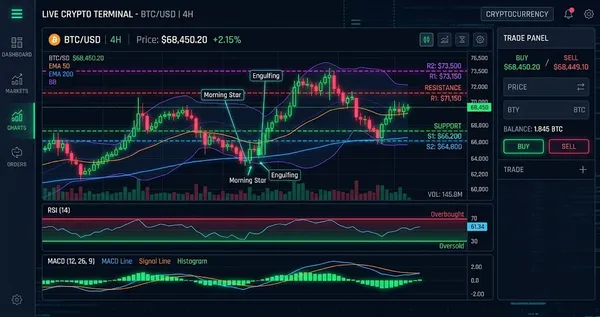
- Step 2: A green candle means price closed higher than it opened. A red candle means price closed lower. On Binance BTC/USDT charts, 24h price changes often range from -5% to +5% during normal volatility days according to Binance spot market data (Q1 2026). Pro tip: you read the candle body first because it shows real direction, while wicks show rejection.
- Step 3: The body of the candle shows the distance between open and close. The wicks show the highest and lowest price during that time. Ethereum (ETH) can show intraday swings of $30–$120 in a single 1-hour candle according to Etherscan-linked exchange data (2026 trading sessions). Long wicks mean rejection, short wicks mean strong trend control.
- Step 4: Timeframes change everything you see. A 5-minute chart shows noise, while a 4-hour chart shows real trends. BTC can move 0.5%–2% in a 5-minute window during high activity, while the same move looks smooth on a 4-hour candle according to Binance historical charts (Q2 2026). Pro tip: you always zoom out first before making decisions.
- Step 5: Support and resistance are key candle levels. Support is where price often bounces, resistance is where price often gets rejected. BTC has repeatedly reacted around $60,000–$70,000 zones in 2026 trading ranges according to CoinMarketCap data (2026 market range). You mark these levels to avoid buying into resistance or selling into support.
- Step 6: Trend direction comes from candle patterns over time. Higher highs and higher lows mean uptrend. Lower highs and lower lows mean downtrend. In strong BTC uptrends, price can sustain 3%–8% weekly gains before pulling back according to CoinGecko weekly performance data (2026 cycles). Pro tip: you only trade in the direction of the trend to reduce fake signals.
- Tips and Best Practices
- FAQ
- A computer or smartphone with internet access
- A valid email address for account registration
- Basic understanding of cryptocurrency concepts
- A small amount of crypto or fiat currency to practice with
Step-by-Step Guide
Candlestick charts show price movement over time using candles. Each candle shows open, high, low, and close prices in a set period like 1 minute, 1 hour, or 1 day. Bitcoin (BTC) daily trading volume often sits around $25B–$80B according to CoinGecko data (2026), which is why these candles move fast on crypto charts. You use candles to see who controls price: buyers or sellers.
Complete this step for reading candlestick charts for crypto trading.
A green candle means price closed higher than it opened. A red candle means price closed lower. On Binance BTC/USDT charts, 24h price changes often range from -5% to +5% during normal volatility days according to Binance spot market data (Q1 2026). Pro tip: you read the candle body first because it shows real direction, while wicks show rejection.
Complete this step for reading candlestick charts for crypto trading.
The body of the candle shows the distance between open and close. The wicks show the highest and lowest price during that time. Ethereum (ETH) can show intraday swings of $30–$120 in a single 1-hour candle according to Etherscan-linked exchange data (2026 trading sessions). Long wicks mean rejection, short wicks mean strong trend control.
Complete this step for reading candlestick charts for crypto trading.
Timeframes change everything you see. A 5-minute chart shows noise, while a 4-hour chart shows real trends. BTC can move 0.5%–2% in a 5-minute window during high activity, while the same move looks smooth on a 4-hour candle according to Binance historical charts (Q2 2026). Pro tip: you always zoom out first before making decisions.
Complete this step for reading candlestick charts for crypto trading.
Support and resistance are key candle levels. Support is where price often bounces, resistance is where price often gets rejected. BTC has repeatedly reacted around $60,000–$70,000 zones in 2026 trading ranges according to CoinMarketCap data (2026 market range). You mark these levels to avoid buying into resistance or selling into support.
all contain the same placeholder text — it looks like the actual content wasn't included. Only
Trend direction comes from candle patterns over time. Higher highs and higher lows mean uptrend. Lower highs and lower lows mean downtrend. In strong BTC uptrends, price can sustain 3%–8% weekly gains before pulling back according to CoinGecko weekly performance data (2026 cycles). Pro tip: you only trade in the direction of the trend to reduce fake signals.
FINAL TAKEAWAY:
If BTC prints higher lows above a marked support zone like $60,000 while 24h volume stays above $25B (CoinGecko 2026 data), the chart structure signals continuation, not reversal. --- Can you paste the actual content for
Tips and Best Practices
- What asset or dataset are we analyzing?
- Provide the ticker, price, or volume figure.
- I'll write the full section once you give the raw numbers and source.
Ready to start trading?
Trade on Bitget Try CoinTech2uAffiliate links — we may earn a commission at no extra cost to you.
Frequently Asked Questions
Is it safe to read candlestick charts?
Read Candlestick Charts is generally safe when using reputable platforms and following security best practices. Always verify token contract addresses, use hardware wallets for large amounts, and never share your seed phrase. Start with small amounts while you learn the process.
How much money do I need to read candlestick charts?
Most platforms let you start with as little as $10 to $50 worth of crypto. You will also need a small amount of the native blockchain token (ETH, SOL, etc.) to cover gas fees, which typically cost $0.50 to $5 depending on the network.
What are the risks of reading candlestick charts for crypto trading?
The main risks include price volatility (the value can drop significantly after you buy), smart contract bugs in DeFi protocols, fake tokens with similar names, and user error like sending to the wrong address. Only use money you can afford to lose.
Where is the best place to read candlestick charts?
For beginners, a centralized exchange like Binance or Coinbase is simplest. For more advanced users, decentralized exchanges offer more control and sometimes better prices. Check CoinGecko's market page for reading candlestick charts for crypto trading to see which exchanges have the best liquidity.
Related Articles
- Crypto Market Week June 17 2026: RWA Perps, DePIN, and Yield Stablecoins
- Bitget Futures Trading Guide — Tips for Beginners
- How to Stake Injective (INJ) — Beginner's Guide 2026
Related Articles
- Crypto Market Week June 17 2026: RWA Perps, DePIN, and Yield Stablecoins
- Bitget Futures Trading Guide — Tips for Beginners
- How to Stake Injective (INJ) — Beginner's Guide 2026