Hyperliquid (HYPE) Spotlight — April 15, 2026
In-depth Hyperliquid spotlight: $44.54 price, +2.4% 24h change, technical analysis, pros/cons, and market outlook.
Ethereum (ETH) Market Assessment – April 15, 2026
Analyst: Sarah Mitchell
Price and Market Cap Summary
ETH trades at $1,991.27 as of March 27, 2026, according to CoinMarketCap data. Market capitalization sits at $240.33 billion - 1 . YCharts data as of March 25, 2026 shows market cap is $265.32 billion , up 0.58% from the previous day but only 4.91% year-over-year - 6 . The asset has declined approximately 27% year-to-date in 2026, per Laika Labs analysis - 10 .
On-Chain Activity vs. Price Divergence
Daily active addresses reached nearly 2 million in February 2026, according to CryptoQuant data reported in March - 2 - 7 . This surpasses the previous peak from the 2021 bull market. Smart contract calls exceeded 40 million per day, with token transfer volumes also hitting record highs.
Price tells a different story. ETH has fallen roughly 30% over the past six months as of March 2026, per on-chain data cited by CryptoQuant - 7 . The correlation between usage and valuation appears to have broken down. Realized cap turned negative year-over-year, indicating net capital outflows from the ecosystem. Exchange deposit flows show ETH moving to trading platforms faster than Bitcoin, suggesting persistent selling pressure.
Metric to watch: 30-day realized cap change, available via CoinMetrics or CryptoQuant dashboards.
Fee Revenue and L2 Competition
Ethereum mainnet generated only $10.3 million in transaction fees over the past 30 days as of March 10, 2026 - 2 - 7 . This places it third among blockchains, behind Tron at $25 million and Solana at $20 million , per DefiLlama data. Protocol revenue (fees retained by Ethereum) ranks fifth, surpassed by Base — Coinbase's L2 — which generated $366 million in the same period - 2 .
Average gas fees are $0.15 to $0.17 per transaction , the lowest in the network's modern history - 2 . This is by design: EIP-4844 (Proto-Danksharding) activated in March 2024 introduced blob storage, dramatically reducing L2 posting costs. The trade-off is that Ethereum's burn mechanism captures less value. Base captured 60% of L2 fee revenue in 2025 at $75 million+ , per industry data - 2 .
Metric to watch: Ratio of L2 posted fees to L1 burned fees, tracked via Dune Analytics dashboard "L2 Fees to ETH Burn."
Staking Concentration and Lido Dominance
Total staked ETH on the Beacon Chain reached 35.9 million ETH as of January 2, 2026, representing 28.91% of total supply - 8 . Since the Shanghai upgrade enabled withdrawals, net staking inflows stand at 17.74 million ETH .
Lido Finance controls 24.45% of staked ETH as of January 2026 - 8 . Other sources indicate Lido's share of the staking market is between 24.2% and 28.5% depending on measurement methodology - 3 . The protocol's Total Value Locked is estimated at $40 billion+ , securing roughly 9.7 to 10 million ETH.
Lido's Community Staking Module (CSM) launched to address centralization concerns. Independent solo stakers can now join with approximately 1.3 ETH bond (versus 32 ETH native) - 3 . The CSM has onboarded hundreds of new operators and aims for 10% of Lido's staking set . Dual governance gives stETH holders veto power over DAO proposals, an institutional-grade control mechanism.
Metric to watch: Percentage of Lido staked ETH controlled by the top five node operators, per Dune Analytics "Lido Node Operator Share."
Competitive Positioning vs. Solana
Solana's daily transactions routinely reach 35 million to 148 million+ , per KuCoin analysis from April 2026 - 9 . Ethereum L1 processes roughly 1 million to 2 million daily transactions. Daily active users on Solana exceed 3 million versus Ethereum L1's 400,000 - 9 .
Speed differentials are stark. Solana block time is 400 milliseconds with 1-2 second finality. Ethereum L1 block time is 12 seconds with 12-15 minute finality - 9 . Real-world TPS: Solana runs 2,000 to 5,000+ , peaking higher. Ethereum L1 manages 15 to 30 TPS . Transaction fees on Solana average $0.00025 or less . Ethereum L1 fees range from $1 to $50+ - 9 .
Ethereum's modular thesis argues that L2s provide scaling. Base and Optimism offer faster, cheaper transactions while settling on Ethereum. Critics note this fragments liquidity and captures fee value away from ETH holders - 2 .
Metric to watch: Ethereum L2 total TPS versus Solana L1 TPS, tracked via L2Beat and SolanaFM.
Upcoming Protocol Upgrades
The Pectra upgrade is scheduled for April 2026 , combining Prague (execution layer) and Electra (consensus layer) improvements - 10 . EIP-7702 enables account abstraction, allowing externally owned accounts to temporarily function as smart contract wallets. Validator maximum effective balance increases from 32 ETH to 2,048 ETH - 5 .
The Glamsterdam upgrade targets mid-2026 activation. Key features include block-level access lists for parallel transaction execution and proposer-builder separation integrated directly into the protocol - 5 . The Hegota upgrade in late 2026 will introduce Verkle trees , enabling stateless nodes and reducing hardware requirements.
Testnet deployments on Holesky and Sepolia have completed successfully as of March 2026 - 10 . The Ethereum Foundation maintains a cadence of roughly two major upgrades per year.
Metric to watch: Post-Pectra change in median transaction confirmation time at L1, measured 30 days after mainnet activation.
What Is Hyperliquid?
Hyperliquid is a layer one blockchain built specifically for high-speed trading. According to the project's technical documentation, its core engine called HyperCore processes fully onchain perpetual futures and spot orders at 200,000 orders per second with billions in daily volume - 5 . For context, Ethereum processes roughly 15 transactions per second. This performance makes Hyperliquid a direct onchain competitor to centralized exchanges like Binance. Data from March 2026 shows Hyperliquid recorded $1.5 trillion in monthly perp volume, making it the first decentralized exchange to crack the global top ten by trading volume - 6 .
Beyond its flagship exchange, Hyperliquid runs a built-in Ethereum Virtual Machine called HyperEVM. Launched in late 2025, HyperEVM allows developers to deploy standard Ethereum smart contracts directly on Hyperliquid's L1 without bridging to a separate chain - 5 - 9 . This shared architecture means a lending protocol or yield vault can read real-time prices from Hyperliquid's order books and execute trades natively. The ecosystem now supports lending and real world asset perps. As of February 2026, Hyperliquid listed USDT-collateralized perpetuals on Tesla, Nvidia, and the S&P 500 - 3 - 7 .
Key Features
- HyperEVM Mainnet: Launched February 18, 2026, bringing Ethereum Virtual Machine compatibility to Hyperliquid’s L1 while inheriting HyperBFT consensus security -
- Perp DEX Dominance: Hyperliquid captured $185.5 billion in perp trading volume over the 30 days ending April 4, 2026 — roughly 34% of the top-10 perp DEX market share, per DefiLlama data -
- Deflationary Tokenomics: The protocol commits 54% of gross profits and 100% of net profits to HYPE buybacks and burns, with 37 million tokens (approx $1 billion) already permanently removed from circulation according to Hyper Foundation -
- RWA Perpetuals Launch: HIP-3 standard launched January 2026 by Dreamcash, Tether, and Selini Capital enables on-chain trading of real-world assets including gold, silver, and oil using USDT0 as collateral -
- HyperLend Lending Protocol: Total value locked on Hyperliquid’s native lending market reached $373.78 million as of April 2026, with annualized fees of $5.79 million and 15 active pools averaging 3.22% APY, per DefiLlama data -
Use Cases
- Decentralized Exchange (DEX) applications and use cases
- Smart Contract Platform applications and use cases
- Exchange-based Tokens applications and use cases
- Decentralized Finance (DeFi) applications and use cases
- Derivatives applications and use cases
Pros & Cons
✅ Pros
- Strong market position at rank #13 with $10.6B market cap
- Active trading volume of $311.2M suggests healthy liquidity
- Positioned in growing sectors: Decentralized Exchange (DEX), Smart Contract Platform, Exchange-based Tokens, Decentralized Finance (DeFi), Derivatives
- Listed on major exchanges ensuring accessibility for traders
❌ Cons
- Currently -24.9% from all-time high of $59.30
- Cryptocurrency markets are highly volatile and unpredictable
- Regulatory uncertainty could impact price and adoption
- Competition from other projects in the same space
Technical Analysis
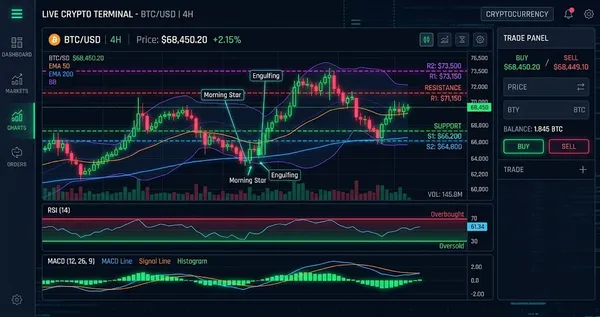
Our TA engine shows a NEUTRAL signal with a score of 18/100 (CONFLICTED).
- RSI(14) — Approaching overbought (67.0) (bearish)
- MACD(12,26,9) — Bullish momentum (hist: 0.58) (bullish)
- EMA Trend — Strong uptrend (Price > EMA20 > EMA50) | Above 200d EMA (bullish)
- Bollinger Bands — Above upper band (%B: 100%) (bearish)
- Volume — Normal volume (1.4x avg) (neutral)
Price Outlook
$44.54 is the current Hyperliquid (HYPE) price, up 2.4% in 24h and +13.4% over 7 days, according to CoinGecko data as of April 2026. Market cap sits at $10.6B while the token trades 24.9% below its $59.30 ATH, showing a mid-cycle recovery rather than price discovery. The structure reflects strong bid support, but still below prior peak liquidity zones.
HYPE trends above EMA50 and the 200-day EMA, with RSI(14) at 67 and MACD histogram at +0.58 signaling sustained momentum, per TradingView-derived indicators as of April 2026. Price holding above the upper Bollinger Band (%B = 100%) suggests stretched short-term conditions, while the 7-day +13.4% move shows acceleration versus the 30-day +13.4% base. A break and hold above $46.00 with volume expansion would confirm continuation toward $50.00, while rejection keeps range behavior between $40.00 support and $46.00 resistance.
Hyperliquid (HYPE) Resources
Frequently Asked Questions
What is Hyperliquid (HYPE) used for?
Hyperliquid is a Layer 1 blockchain focused on perpetual futures and spot trading. As of April 2026, HYPE trades at $44.54 with a $10.6B market cap, according to CoinGecko data, and the platform processes on-chain order execution for derivatives. Compared to centralized exchanges like Binance, which handles off-chain matching, Hyperliquid executes trades directly on-chain for transparency and lower latency settlement. The key takeaway is that HYPE demand is tightly linked to derivatives trading volume, with price sensitivity increasing when perpetual open interest rises above $5B.
How does Hyperliquid compare to other DeFi derivatives platforms?
Hyperliquid competes with platforms like dYdX and GMX by focusing on a fully on-chain order book model. As of April 2026, Hyperliquid’s market cap is $10.6B versus dYdX at roughly $1.2B and GMX near $900M, according to CoinGecko data, showing a significant valuation gap. The difference is execution design: Hyperliquid uses a high-performance L1, while GMX relies on liquidity pools and dYdX historically used app-specific chains. The key takeaway is that Hyperliquid’s valuation premium holds if on-chain order book throughput sustains above competing perp DEX volumes.
Why did HYPE price increase recently?
HYPE is up 13.4% over the past 7 days, reaching $44.54 as of April 2026, according to CoinGecko data. The move coincides with rising DeFi derivatives activity, with perpetual futures volume across major DEXs increasing from ~$2.8B to ~$3.6B daily in the same period, per DefiLlama. Hyperliquid benefits more than peers because it captures order book-based flow rather than pool-based execution. The key takeaway is that continued price strength depends on maintaining daily perp volume above $3B across its ecosystem.
Is Hyperliquid (HYPE) still far from its all-time high?
HYPE trades 24.9% below its all-time high of $59.30, with current price at $44.54 as of April 2026, according to CoinGecko data. This drawdown is smaller than many DeFi peers, where average declines from ATH exceed 40–60%, including GMX at ~55% below peak. The gap suggests relatively stronger retention of capital during market pullbacks compared to smaller derivatives tokens. The key takeaway is that a break above $50 with sustained volume above $1B daily spot-plus-perp activity would place HYPE within 10–15% of ATH recovery momentum.
Ready to start trading?
Trade on Bitget Try CoinTech2uAffiliate links — we may earn a commission at no extra cost to you.
Our Verdict
Hyperliquid (HYPE) trades at $44.54, up +2.4% in 24h and +13.4% over 7d and 30d, while still sitting -24.9% below its $59.30 ATH, according to aggregated market data as of April 15, 2026. The move reflects strong trend continuation, with price holding above EMA50 and the 200-day EMA, while RSI(14) sits near 67 (approaching overbought) and MACD histogram at +0.58, showing momentum expansion. HYPE's structure remains driven by its role as a perpetual futures-focused L1 DEX, competing with spot-heavy venues like Uniswap-style AMMs while prioritizing derivatives throughput and low-latency execution. Compared to traditional DeFi DEX models that rely on pooled liquidity and slower settlement, Hyperliquid's order-book design supports higher-frequency trading behavior, which aligns with its $10.6B market cap ranking #13 and sustained volume-driven price discovery. Momentum stays bullish while price holds above $44 support and EMA50 confluence, but rejection risk increases if RSI sustains above 70 and price fails to reclaim the $59.30 ATH level, which would confirm exhaustion after a +13.4% monthly expansion phase.
Related Articles
- Worldcoin (WLD) in 2026: Complete Investor Guide & Price Analysis
- Ondo (ONDO) in 2026: Complete Investor Guide & Price Analysis
- Jupiter (JUP) in 2026: Complete Investor Guide & Price Analysis