Macro News & Crypto Impact — April 30, 2026
Daily macro news digest: how today's global events affect Bitcoin and crypto markets. BTC at $76,531.
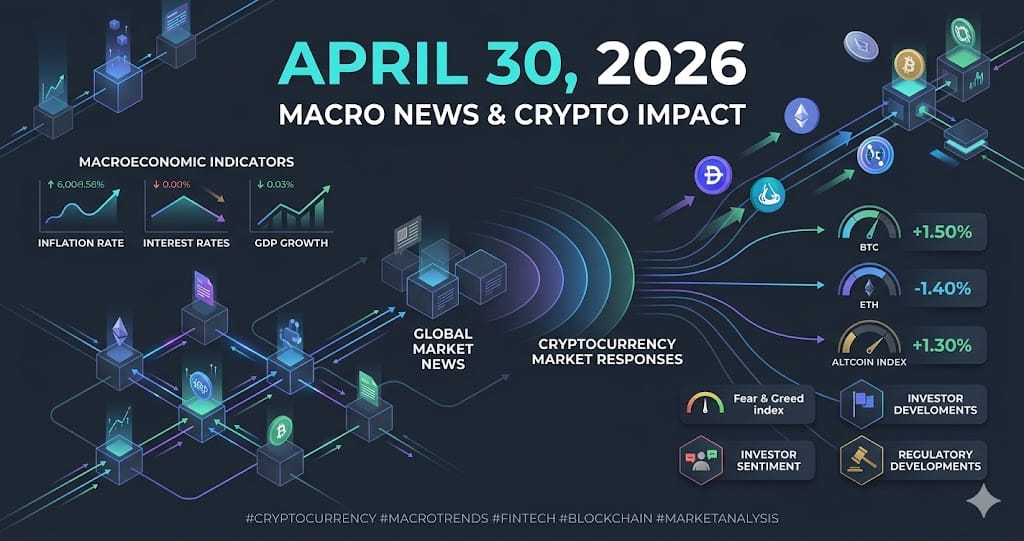
The US Navy has begun enforcing a blockade in the Strait of Hormuz, and Brent crude just hit $123 a barrel — the highest since 2022 — which means the Fed’s ability to cut rates this year just evaporated, and with it, crypto’s short-term liquidity narrative. Markets are waking up to a world where inflation comes from gunboats, not Treasury yields. Bitcoin’s immediate reaction: a 0.2% drop to $76,531. That small move hides the larger truth. The market is frozen, not confident.
The Oil-inflation trap Powell warned about
The Pentagon’s admission that the US war in Iran has cost “$25 billion” — almost certainly $75–100 billion in real terms — was buried under Trump’s promise that the blockade “could last months.” Those two facts together rewrite the macro calendar. Every week of blockade adds 50–75 basis points to household inflation expectations. The same Pentagon official who leaked the cost also noted that Iranian proxy attacks on tankers have risen 40% since January. That’s not a skirmish. That’s a siege.
For crypto, the mechanism is brutal. Oil at $123 pushes 1-year breakeven inflation above 3.5%. The Fed, with Jerome Powell now locked into his Board seat specifically to block political pressure, has zero room to ease. Powell’s move to remain as governor after May 15 wasn’t about legacy. It was a warning: rate cuts are off the table as long as energy prices stay here. Bitcoin’s 0.2% decline to $76,531 is the market repricing the probability of a September cut from 80% to 30% in slow motion. BTC’s flat price action on heavy macro news is a sign of institutional hesitation, not strength.
Germany, NATO, and the dollar’s crumbling alliance premium
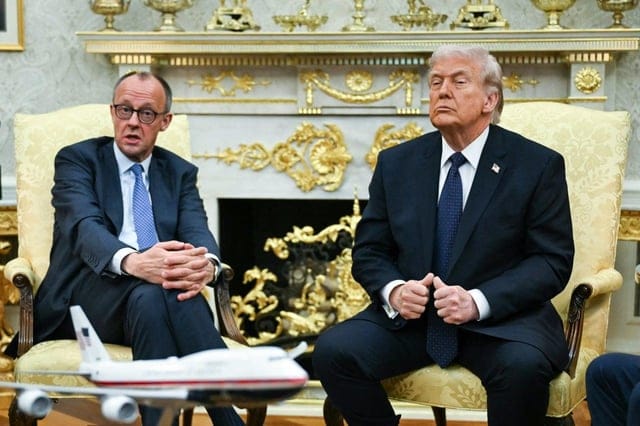
Trump’s threat to reduce US troops in Germany “after a clash with Merz” looks like a budget fight. It’s not. Congress passed a law blocking any president from leaving NATO without Senate approval. So Trump is doing the next best thing: hollowing out US commitment publicly. Merz’s office confirmed the phone call turned “heated” over German refusal to triple energy imports from US shale. The blockade in Iran is raising LNG prices, and Berlin doesn’t want to pay the US premium.
Why this matters for your wallet: the dollar’s value comes from three pillars — the Fed, the Pentagon, and NATO. When a US president openly picks a fight with Germany during an active naval blockade, the petrodollar system cracks. Saudi Arabia has already signaled it will accept yuan for some oil sales if the blockade extends past 60 days. That’s when Bitcoin becomes interesting — not as a risk asset, but as neutral settlement collateral for countries fleeing dollar-denominated oil trade. Stablecoin supply is flat right now, but a yuan-BTC corridor would change that overnight.
King Charles and the Commonwealth signal
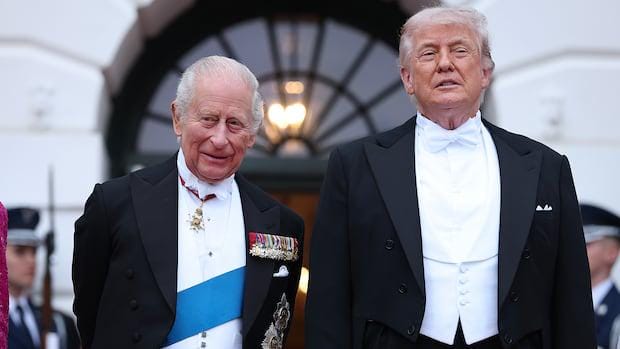
King Charles “playfully” reminding Trump that he’s Canada’s head of state is being memed as diplomatic humor. Read it literally. The Canadian government has been diversifying its foreign reserves away from US Treasuries for six months. The King’s comment — and the reference to the War of 1812 — was a coded message to London, Ottawa, and Canberra: the Commonwealth’s legal structures still exist outside US control. Trump’s reported response (“I had no idea”) is believable. That’s the problem.
For crypto markets, this is the thin end of a large wedge. When G7 allies start publicly reminding the US president of basic treaty obligations, reserve managers take note. The Crypto Fear & Greed Index hasn’t moved above 60 for 14 days, even as BTC held $75k. That’s because institutional money is waiting to see if the blockade becomes a war. The top mover among majors is SHIB at +1.1% to $0.000006 — meme coins don’t price geopolitical risk. Real volume is sitting in stablecoins on the sidelines.
Where Markets Stand
Bitcoin at $76,531 is down 0.2% on a day when oil jumped 8%. That divergence is the story. ETH fell twice as hard, dropping 1.3% to $2,268 — a sign that leveraged long positions are being squeezed in altcoins while BTC absorbs selling. The top ten by move shows a market rotating into nothing in particular: SHIB up 1.1%, DOGE up 0.8%, TRX up 0.7%, while BCH leads losers at -1.6% ($443.20). Three memes up, two payment coins down. That’s not a thesis. That’s confusion. SUI at $0.9066 (-1.1%) and DOT at $1.21 (-1.0%) confirm that layer-1 tokens are bleeding first. The market is pricing a 30% chance of blockade escalation to direct conflict — and no one wants to hold high-beta crypto into that probability.
What to Watch
- Brent crude at $123 — if it closes above $130 for three consecutive sessions, Bitcoin’s 200-day moving average (currently $68,200) becomes the target.
- Jerome Powell’s next public speech (May 5) — any mention of “energy passthrough to core inflation” will confirm no rate cuts in 2025.
- US Treasury’s quarterly refunding announcement (May 7) — longer duration issuance at higher yields will pull liquidity from risk assets including crypto.
- Ethereum active addresses falling below 400,000 (currently 412,000) would confirm ETH’s drop to $2,268 is structural, not technical.
- SHIB’s volume-to-market cap ratio — currently at 2.1% — if it crosses 5% while BTC is flat, retail is back, and tops get tested.
Related Articles
- BTC at $75,783 — Daily Crypto Technical Analysis (April 30, 2026)
- Macro News & Crypto Impact — April 29, 2026
- Dogecoin Surges 3% — Here's What's Behind the Move