Macro News & Crypto Impact — July 7, 2026
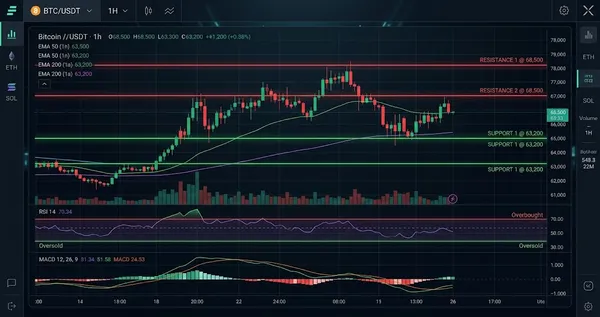
Daily macro news digest: how today's global events affect Bitcoin and crypto markets. BTC at $63,026.

New York Fed President John Williams told Fox Business he is "more sanguine" on inflation because energy prices are retreating[reference:0]. Bitcoin popped 2.0% to $63,026 on the news. Ethereum followed at $1,772, up 1.6%. The total crypto market cap edged up to $2.26 trillion. But the Fear & Greed index stayed stuck at 27 — firmly in Fear territory. Because underneath Williams's optimism, three structural fractures are widening.
The Oil Mirage and the FX Reality
Williams expects energy prices to "come down quite a bit" and pull headline inflation with them[reference:1]. He cited big declines in both current and future oil prices[reference:2]. The mechanism is straightforward: a ceasefire following the U.S.-Israeli war on Iran has eased pressure on global energy markets[reference:3]. But he stopped short of changing his policy stance. "Monetary policy is well positioned," he said, refusing to signal whether the next rate move is up or down[reference:4]. The Fed left rates at 3.5%-3.75% last month[reference:5].
That verbal dovishness is one thing. A formal pivot is another. StoneX notes that the entire USD/CAD rally hinges on what the Fed actually does, not what it says. The market is pricing 30 basis points of hikes by year-end[reference:6]. The Canadian dollar is effectively a leveraged bet on whether those hikes get unwound. Williams has not unwound them. He pointed at crude and hoped.
The Legal Shield That Enables Complacency
While Williams talked inflation, the Supreme Court was reshaping the Fed's institutional immunity. In Trump v. Slaughter, Chief Justice Roberts overruled bedrock precedent and held that the president can fire independent agency heads without cause[reference:7]. But in Trump v. Cook, Roberts carved out an exception for the Federal Reserve[reference:8][reference:9]. The central bank remains protected from the political removal that now applies to the SEC, the CFTC, and every other independent regulator[reference:10].
That exception was designed for crisis stability. But it also enables a certain complacency. If the Fed cannot be touched, it cannot be scared. And a Fed that cannot be scared is a Fed that will tolerate asset bubbles far longer than prudence would dictate.
The Bubble Thesis and the Bank That Is Cracking
Michael Hudson argues the Federal Reserve has learned to love bubbles[reference:11]. Not because they are healthy, but because they are convenient. Asset inflation masks wage stagnation, props up balance sheets, and buys time for the real economy to adjust[reference:12]. The Fed finances government deficits by creating electronic money to buy Treasury securities[reference:13]. The problem is that bubbles do not deflate gently. They burst, and they take the real economy with them.
That bursting process may already be starting at the margins. Regulators declared Lenexa-based Small Business Bank severely undercapitalized and gave it 30 days to fix the problem[reference:14]. The bank faces potential receivership after regulators flagged mounting loan risks[reference:15]. This is not Silicon Valley Bank. It is not systemic. But it is symptomatic. When the marginal lender to Main Street starts to wobble, it tells you credit conditions are tighter than the Fed's aggregate statistics suggest. Williams sees energy falling and assumes the inflation problem is transitory. The borrowers at that small bank see rates at 3.75% and their margins disappearing. Those are two different realities.
Where Markets Stand
Bitcoin's 2.0% gain to $63,026 puts it back above the psychological $62,000 level, but the Fear & Greed index at 27 confirms the rally is tentative. Ethereum's 1.6% move to $1,772 mirrors BTC's direction but with less conviction. The top mover to the downside is XLM at $0.1924, down 3.2% — the only double-digit percentage loser in the top ten. HBAR followed at $0.0710, off 2.9%. DOGE slipped 1.2% to $0.0744, and ADA fell 1.1% to $0.1780. On the green side, SHIB gained 1.9% to $0.000004, PEPE rose 1.1% to $0.000003, SUI added 1.1% to $0.7357, and TRX advanced 1.1% to $0.3311. The market cap increase to $2.26 trillion is a rounding error on a $100 billion range. In a true risk-on repricing, the altcoin cohort leads. Instead, we have selective buying in the two largest assets and a laggard bleeding 3.2%. That is the signature of a market that believes the Fed's words but distrusts the Fed's system.
What to Watch
- Oil prices: WTI crude trading below $75 per barrel would confirm Williams's disinflation thesis. A spike back above $80 would invalidate it.
- Small Business Bank's 30-day clock: If regulators place the bank into receivership before August 7, it signals broader credit stress in regional lending.
- Fed funds futures: The 30 basis points of hikes priced by year-end[reference:16]. A move to 20 basis points or lower would indicate the market is pricing out the hike narrative entirely.
- BTC at $62,000: A daily close below this level would put Bitcoin back below the range low and confirm that today's rally was a dead cat bounce.
- July 29 FOMC meeting: Williams said the next move "depends on what happens with the data"[reference:17]. The July statement will reveal whether the rest of the committee shares his energy-driven optimism.
This column is for informational purposes only and does not constitute financial advice.
Related Articles
- Daily Market Movers — Tuesday, July 7, 2026
- BTC at $63,354 — Daily Crypto Technical Analysis (July 7, 2026)
- Macro News & Crypto Impact — July 6, 2026