Macro News & Crypto Impact — July 9, 2026
Daily macro news digest: how today's global events affect Bitcoin and crypto markets. BTC at $63,118.

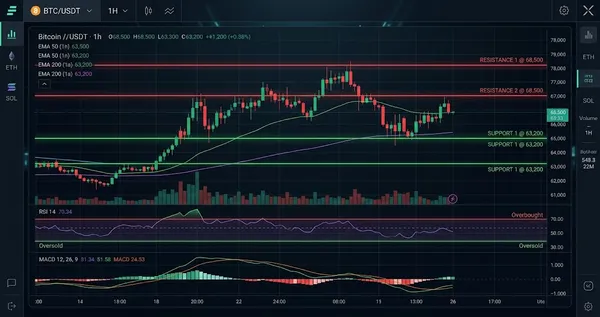
The Federal Reserve’s June minutes introduced an entirely new inflation bogeyman – surging artificial-intelligence infrastructure demand – and in doing so, flipped the dot plot from a consensus of cuts to a fractured outlook that now prices at least one rate hike by December. For crypto traders, that hawkish pivot has turned the July 14 CPI report into a binary event: a hotter-than-expected print would validate the Fed’s new “chipflation” concern and likely send Bitcoin back below $62,000, while a cooler number could finally break the 200-day streak of negative apparent demand and push BTC through the $63,500 ceiling that has held for weeks. Today’s 1.8% bounce to $63,118 suggests the market is leaning into the latter scenario, but the weight of tariff-driven price increases and the Fed’s quiet pre-meeting blackout period means this rally is built on sand until the data speaks.
The New Inflation Variable: ‘Chipflation’ and the AI Demand Shock
For months, the dominant inflation narratives have been oil, labor, and trade policy. The Fed’s minutes tore up that script by explicitly naming “ongoing strong demand for AI infrastructure” as a durable upward pressure on semiconductor prices and the electricity that powers hyperscale data centers. The staff’s revised PCE forecast of 3.6% for both 2026 and 2027 is no longer a function of transient supply-chain noise; it reflects corporate capex cycles that stretch into the back half of the decade. Nine of 18 officials now expect a hike by December, with six projecting two 25-basis-point moves – a stark reversal from March, when only one official saw any tightening. This is not a hawkish tilt; it is a structural repricing of neutral rates, driven by a sector that barely existed in Fed models five years ago. The immediate crypto implication is a compression of liquidity expectations. Bitcoin’s negative apparent demand – now stretching past 200 consecutive days – is a direct symptom of institutional capital fleeing duration risk, and the Coinbase Premium Index’s 46-day negative streak confirms that US buyers are still on the sidelines, waiting for clarity on whether AI-driven inflation will force the Fed to hike into a slowing economy.
The Tariff Tax: Trump’s ‘Trickle-Up’ Economy and the Fed’s Hidden Cost
If AI is the new frontier, tariffs are the old reality that refuses to fade. Both the 24/7 Wall St. and Fortune reports converge on a single, uncomfortable truth: the Trump administration’s import taxes have created a “trickle-up” economy, where the cost of raw materials, intermediate goods, and final assembly is now passed upward through the supply chain, hitting consumer prices with a lag that the Fed now acknowledges will arrive just as the summer shopping season peaks. The Fed’s own analysis, cited in Event 3, warns that these hidden costs are about to hit household wallets directly, not through one-time price spikes but through a sustained erosion of purchasing power. Fortune’s reporting makes clear that US companies are not done hiking prices; the margin compression from earlier tariff rounds is being recouped through second-round price increases on electronics, machinery, and even packaged foods. For crypto, this is a double bind. Higher consumer inflation reinforces the Fed’s hawkish posture, pressuring risk assets. Yet the very same tariffs are driving a wedge between US and offshore pricing, creating arbitrage opportunities in stablecoin flows and cross-border settlements that benefit networks like XRP and AVAX – the latter being today’s top mover, up 5.0% to $6.78, as traders hedge against fiat devaluation through faster, cheaper settlement layers.
The Divide Widens, but Silence Is Golden
The Washington Post op-ed argues that the Fed’s pre-meeting quiet period is a virtue – a deliberate suppression of public guidance that forces markets to focus on hard data rather than chair-speak. That silence, however, has only amplified the growing divide on Wall Street. Fox Business reports that asset managers are splitting into two camps: one that believes the Fed will ultimately capitulate to recession risks and cut by year-end, and another that sees the AI-driven capex cycle and tariff pass-through as sufficient to justify a hike even as growth slows. This schism is visible in the options market, where Bitcoin’s 30-day implied volatility has steepened to 62%, and in the bond market, where the 10-year Treasury yield climbed to one-month highs of 4.565% even as equities wobbled. The irony is that the Fed’s silence, intended to reduce noise, has instead magnified the importance of every incoming data point – making the July 14 CPI report the most consequential macro release since the March 2023 banking crisis. For crypto, the divide translates into range-bound paralysis. The Fear and Greed Index sits at 22 – Extreme Fear – yet total market cap has held $2.25 trillion, and today’s broad-based gains (BCH +2.2%, SUI +1.9%, SHIB +1.9%) suggest that retail traders are buying the dip in altcoins even as institutions stay cautious. That divergence is the hallmark of a market that is pricing in two conflicting futures: one where the Fed hikes and crushes liquidity, and another where the Fed’s new inflation concerns are transitory, and the central bank quietly pivots to backstopping risk assets as the election year unfolds.
What This Means for Crypto’s Next Move
Today’s price action – BTC at $63,118, ETH at $1,749, and AVAX leading the top ten with a 5.0% rally – is a fragile truce between these competing narratives. The +1.8% bounce in Bitcoin does not signal a trend reversal; it reflects short covering ahead of the CPI data, combined with the seasonal tendency for crypto to rally into major macro events. But the underlying fundamentals remain bearish. Negative apparent demand, a negative Coinbase Premium, and a Fed that is increasingly worried about both AI and tariffs mean that any upside is capped unless the CPI print shows a decisive cooling in core services excluding housing – the one category that the Fed’s new models do not yet attribute to either chipflation or trade policy. The Polymarket odds of a hike by December, now at 57-61%, are a stark reminder that the market is pricing in a Fed that is more likely to tighten than ease over the next six months. For traders, the smart play is to watch the 10-year breakeven inflation rate and the weekly jobless claims, because those leading indicators will signal whether the Fed’s growth concerns outweigh its inflation fears. Until July 14, the only certainty is uncertainty – and in that vacuum, volatility is the only tradable asset. Bitcoin may be the ultimate hedge against fiat debasement, but in a world where the Fed’s new bogeyman is the very technology that drives productivity gains, the old correlations are breaking down, and the next move will be dictated not by crypto-native catalysts, but by whether Jerome Powell’s quiet period ends with a hawkish bang or a dovish whimper.
Related Articles
- Daily Market Movers — Thursday, July 9, 2026
- BTC at $62,971 — Daily Crypto Technical Analysis (July 9, 2026)
- Macro News & Crypto Impact — July 8, 2026