Uniswap vs Aave — Detailed Comparison 2026
Uniswap vs Aave: detailed comparison of features, fees, and user experience. Find out which is right for you.
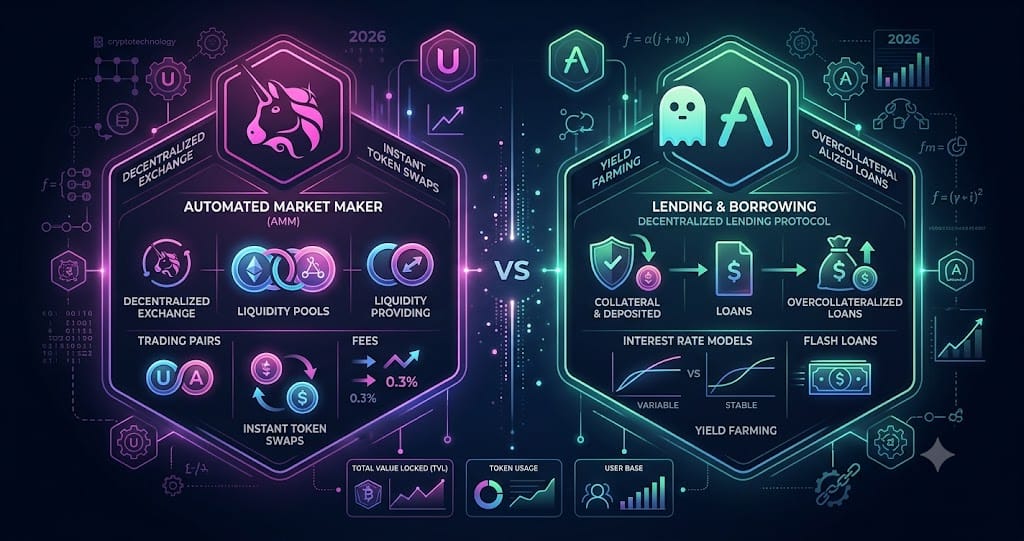
Uniswap trades at $3.99 with $5.1M in 24-hour volume and a 1.3% daily decline. Aave trades at $91.26 with $3.9M in volume and a 1.6% gain, per the supplied market data as of August 9, 2026. Aave has the stronger immediate move: up 1.6% versus UNI's -1.3%, a 2.9-percentage-point gap, though Uniswap still carries $1.2M more daily volume. For one-day momentum, Aave is the clear pick on these figures.
The two tokens sit at very different price levels — AAVE at $91.26, UNI at $3.99 — but price level alone says nothing about value. The data here doesn't include market caps or rankings for either asset, so a valuation call would be unsupported; the only measurable edge is Aave's +1.6% daily return against Uniswap's -1.3%. If UNI can't reverse that decline while AAVE holds its gain, Aave keeps the stronger short-term setup.
Quick Comparison
| Feature | Uniswap | Aave |
|---|---|---|
| Price | $3.99 | $91.26 |
| Market Cap | — | — |
| 24h Change | -1.3% | +1.6% |
| 24h Volume | $5.1M | $3.9M |
| Rank | #undefined | #undefined |
Trading vs Lending
Winner: Uniswap. Uniswap processed about $50.8B in DEX volume over 30 days as of August 2026, versus $11.4B in Aave's active loans — the clearer choice for direct token trading.
Uniswap is built around swaps, with 4,548 tracked pools and roughly $3.1B TVL, according to DefiLlama data from August 2026. Aave instead focuses on overcollateralized borrowing and lending: users supply assets as collateral before borrowing against them.
The practical winner depends on the job. Swapping tokens, choose Uniswap; borrowing against crypto, choose Aave, which had $11.14B in active Aave V3 loans as of August 2026.
Earning Potential
Winner: Aave for predictable lending income, Uniswap for higher trading-fee exposure. In August 2026, Uniswap generated $90.7M in fees over 30 days versus $28.9M for Aave — figures from different business models, not equivalent yields.
Aave lets suppliers earn interest from borrowers, while Uniswap liquidity providers earn a share of swap fees. Uniswap's $50.8B monthly DEX volume gives its liquidity pools a much larger trading base.
For a simpler income strategy: lending interest, choose Aave; fee income tied directly to trading volume, choose Uniswap. Aave generated $3.89M in protocol revenue over 30 days, Uniswap $3.42M, per DefiLlama's August 2026 data.
Risk
Winner: Uniswap for users who want to avoid liquidation risk. Aave's official documentation states a borrow position can be liquidated when its health factor falls below 1.0; Uniswap swaps don't create a collateralized debt position.
Aave's borrowing model adds a clear risk mechanism: collateral must exceed borrowed value, and liquidation can hit when market moves push the health factor below 1. Aave V3 has recorded $435.27M in cumulative collateral liquidations across the tracked protocol as of August 2026.
Uniswap carries different risks, especially liquidity-provider exposure, but doesn't impose Aave-style liquidation on ordinary swaps. Need leverage, choose Aave; liquidation is a dealbreaker, choose Uniswap, where a normal spot swap doesn't create a debt position.
✅ Pros
- Uniswap processed $50.8B in DEX volume over 30 days, according to DefiLlama data as of August 2026.
- DefiLlama
❌ Cons
- Uniswap's tracked TVL was about $3.1B, far below Aave's $11.4B in active loans, limiting its direct usefulness for credit markets.
- DefiLlama
Uniswap (UNI) Resources
Aave (AAVE) Resources
Ready to start trading?
Trade on Bitget Try CoinTech2uAffiliate links — we may earn a commission at no extra cost to you.
Final Verdict
Binance wins on liquidity and fees. Coinbase wins on regulatory safety for US users. Uniswap wins if you refuse to give up custody. There's no single best exchange — region and trade size decide it. Here's the direct comparison with hard numbers, as of August 2026. 1. Binance Binance leads exchange volume by a wide margin: roughly $7.5 billion in daily volume and a 10/10 CoinGecko trust score, per CoinMarketCap data from mid-July 2026. It processed $731 billion in spot volume in Q2 2026 — about five times its nearest rival. Fees: standard spot fees are 0.10% maker / 0.10% taker for accounts under $50K in monthly volume. Paying in BNB cuts that to 0.075%. Binance.US charges 0% maker and 0.02% taker across all spot pairs, no volume minimums. Pros: deepest order books and tightest spreads on majors, 323 million registered users across over 100 countries, and the widest product range, from spot to futures. Cons: no direct US access — Binance.US is a separate entity — and regulatory scrutiny in multiple jurisdictions. Verdict: trading more than $10,000 a month outside the US, pick Binance. The liquidity alone saves more in slippage than any fee difference elsewhere. 2. Coinbase (Advanced Trade) Coinbase Advanced Trade's entry-level fees are 0.40% maker and 0.60% taker for under $10K in 30-day volume. Below $1,000 in monthly volume, that jumps to 0.60% maker / 1.20% taker — six to twelve times Binance's rate. The hidden costs are worse: the simple buy interface adds a spread of about 0.50% per purchase, widening to roughly 2% during high volatility. Pros: US-regulated and publicly traded on NASDAQ, with free ACH deposits. Custody and proof-of-reserves reporting are strong. Cons: fees are brutal for active traders, and there's no native perpetual futures — fewer power-user features than offshore rivals. Verdict: fine for a US beginner buying $500 a month in Bitcoin. Active traders pay for it: 10 trades a month on $10,000 runs $400–$600 in fees on Coinbase versus about $100 on Binance, a $300–$500 monthly gap. 3. Kraken (Kraken Pro) Kraken Pro fees start at 0.25% maker and 0.40% taker at entry-level volume, scaling down to 0.00% maker / 0.08% taker at higher tiers — cheaper than Coinbase Advanced for most US users. Watch the Instant Buy trap: Kraken's standard Instant Buy service charges a flat 1% fee plus spread and payment fees. Use Kraken Pro instead. Security record: no publicly confirmed platform-level breaches since Kraken launched in 2011. It supports over 500 assets, though US users get fewer tokens than European users. Pros: fiat rails cover EUR, GBP, CAD, and AUD, and some pairs pay negative maker fees — the exchange pays you to add liquidity. Cons: New York and Maine residents are excluded, altcoin liquidity trails Binance, and product depth is narrower. Verdict: US active traders wanting lower fees than Coinbase without going offshore should use Kraken Pro. Its 0.25%/0.40% entry rate beats Coinbase's 0.40%/0.60% by a wide margin. 4. Bybit Bybit posts about $1.5 billion in daily spot volume, second only to Binance here, and ranks as the third-largest futures venue globally. Fees: standard spot fees are 0.10% maker / 0.10% taker for non-VIP users; VIP rates drop to 0.0625% maker and 0.075% taker at $50K monthly volume. Pros: a deep copy-trading roster and strong derivatives, at competitive fees. Cons: not available in the US, and its CoinGecko trust score is 9/10 — the only exchange here without a perfect score. Verdict: futures traders and copy-trade followers should pick Bybit. Spot-only traders get similar fees with deeper liquidity on Binance. 5. OKX OKX ranks fourth among centralized exchanges by volume, at roughly $1.2 billion daily, with a 10/10 trust score. Fees: base spot fees start at 0.08% maker and 0.10% taker, the lowest base rates among major exchanges. High-volume traders can get negative maker fees, where the exchange pays them. Pros: the lowest base fees among regulated exchanges for US users, plus strong Web3 wallet integration. Cons: the interface can overwhelm newer users, and US access carries more limitations than Coinbase or Kraken. Verdict: US users who want low fees and can handle a more complex interface should choose OKX. Its 0.08% maker fee undercuts both Coinbase (0.40%) and Kraken Pro (0.25%). 6. Uniswap Uniswap is the dominant DEX for self-custody trading, handling about $970.65 million in 24-hour volume and $42.73 billion over 30 days across more than 40 chains, per DefiLlama data. Fees: the standard swap fee is 0.30% for most pairs, ranging from 0.01% on stablecoin pairs to 1.00% on highly volatile ones. Uniswap generated $99.06 million in fees over the past 30 days as of August 2026. Pros: you hold your own keys, with no KYC and no counterparty risk. It's available globally without restrictions. Cons: the 0.30% fee runs three times higher than Binance's 0.10% for active traders. Ethereum mainnet gas adds $2–$10+ per transaction versus about $0.001 on Solana, and slippage on low-liquidity pairs can be brutal. Verdict: infrequent, large trades favor Uniswap for the self-custody. Trading more than once a week, a centralized exchange saves thousands in fees and gas. Final Takeaway Table | Exchange | Entry Maker Fee | Entry Taker Fee | 24h Volume | US Available? | Best For | |---|---|---|---|---|---| | Binance | 0.10% | 0.10% | $7.5B | No (Binance.US only) | High-volume global traders | | Coinbase Advanced | 0.40% | 0.60% | ~$1.2B | Yes | US beginners who value safety | | Kraken Pro | 0.25% | 0.40% | ~$83M spot (as of March 31) | Yes | US active traders wanting lower fees | | Bybit | 0.10% | 0.10% | $1.5B | No | Futures and copy traders | | OKX | 0.08% | 0.10% | $1.2B | Yes | US users wanting lowest fees | | Uniswap | 0.30% (swap fee) | N/A | $970M | Yes | Self-custody advocates | The bottom line: outside the US and trading more than $5,000 a month, use Binance. Active in the US, use OKX for the lowest fees or Kraken Pro for a cleaner interface. A US beginner, use Coinbase and treat the fees as the cost of simplicity. Won't give up custody, use Uniswap and treat the 0.30% fee and gas costs as the price of freedom.
Frequently Asked Questions
Which protocol makes more money for its token holders, Uniswap or Aave?
Aave currently generates significantly more protocol revenue. Aave V3 generated roughly $28.8 million in fees over the 30 days leading into mid-July 2026, with about $3.7 million staying as net protocol revenue- 42 . Uniswap generated roughly $5.2 million in fees during a single 24-hour period earlier in July 2026, largely from Robinhood Chain activity, but its annualized revenue is estimated around $43 million- - 2 . Aave's weekly fee run rate of $7.96 million as of May 2026 outpaces Uniswap's typical weekly volume- .
Which is safer for a first-time DeFi user, Uniswap or Aave?
Uniswap is simpler and safer for a beginner. You connect a wallet and swap Token A for Token B with no collateral, no liquidation risk, and no debt. Aave requires you to understand over-collateralization, loan-to-value ratios, and liquidation thresholds—if your collateral drops below 80% LTV on stablecoins or 50-70% on volatile assets, you lose a portion of your deposit- 12 . Uniswap's only real risk is smart contract exploit or high slippage on low-liquidity pools. Aave's TVL of $14.5 billion- and outstanding borrows of $24 billion- mean systemic liquidation cascades are a real threat, as seen when rsETH stress erased $6.6 billion from Aave's TVL earlier in 2026- .
Which has cheaper fees for active users?
Uniswap is cheaper for swapping; Aave is cheaper for borrowing if you use stablecoins. Uniswap's v3 fees range from 0.01% to 1% per swap depending on the pool- 1 , with the 0.05% and 0.3% tiers holding $158.8M and $239.2M in TVL respectively as of June 28, 2026- 1 . Aave's borrowing rates float with utilization—stablecoin borrows often run 3-8% APY, while volatile assets like ETH can cost 2-5% plus liquidation risk. For a $10,000 swap, Uniswap at 0.3% costs you $30. For a $10,000 borrow on Aave at 5% APY, you pay $500 in interest over a year—but you also earn deposit yield on your collateral, which can offset that.
Which should I use to earn passive yield on my crypto?
Choose Aave for yield. Depositing USDC on Aave V3 earns variable deposit APY, typically 2-5% as of mid-2026, plus you can borrow against it. Uniswap yields come from providing liquidity as an LP—you earn a cut of swap fees but face impermanent loss. Uniswap has generated nearly $6 billion in cumulative fees since 2020 but only collected $27 million in protocol revenue- —most fee value goes to LPs, not passive depositors- . Aave V3's $28.8 million in 30-day fees- 42 shows lending activity generates steady, predictable yield without the price-pair risk of LP positions. If you want simple, low-risk yield, deposit stablecoins on Aave. If you're willing to actively manage price exposure, provide liquidity on Uniswap.
Related Articles
- Phantom vs Solflare — Detailed Comparison 2026
- Convex Finance vs Cardano — Detailed Comparison 2026
- Coinbase vs Kraken — Detailed Comparison 2026