
2026 Crypto Narratives: Capital Is Rotating, Not Retreating
BTC ETFs shed USD 1.47B in their worst 2026 outflow week as SOL ETPs gained. Memecoins, prediction markets, and DeFAI now lead the capital rotation.
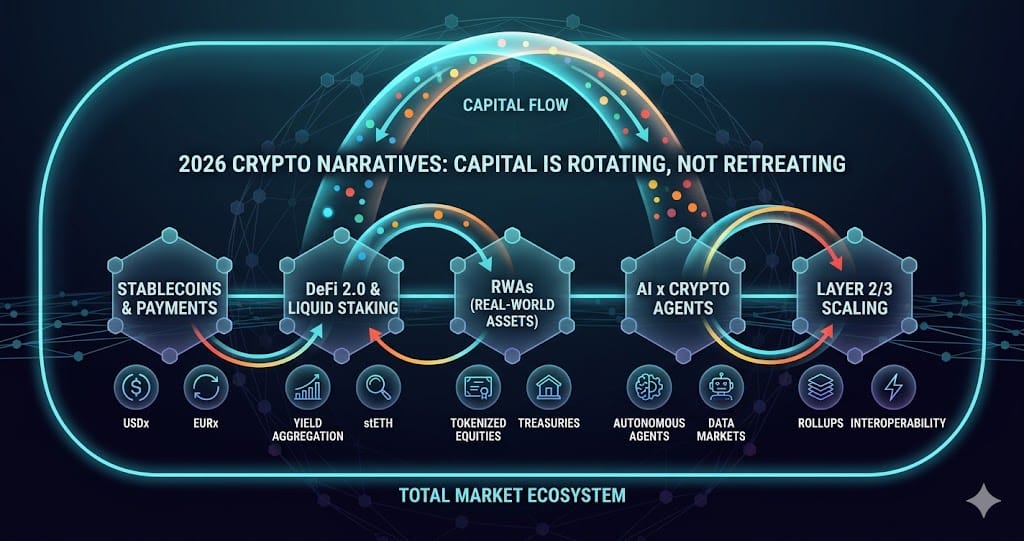
The dominant signal in crypto markets this week is not a broad risk-off exit but a structured rotation: institutions moved out of BTC products and into Solana ETPs while retail capital re-entered memecoins, producing three measurably distinct capital flows running simultaneously. BTC spot ETF products recorded their worst weekly outflow of 2026 at USD 1.47 billion for the week ending May 24, with BlackRock's IBIT logging a single-day redemption of USD 527.8 million on May 28 — just USD 500,000 short of its all-time daily outflow record of USD 528.3 million set on January 30.
At the same time, Solana ETPs netted approximately USD 15.6 million in inflows over that same stretch, continuing a counter-trend that has persisted across three months of negative SOL price performance. This divergence is the clearest structural read available right now: the money leaving BTC products is not leaving crypto entirely, it is rotating within it. Three sectors — memecoins, prediction markets, and DeFAI — now represent where the next leg of capital allocation is being targeted by both institutional and retail participants.
BTC ETF Outflows and the SOL Rotation Signal
US spot BTC ETF products shed roughly USD 1.26 billion during a six-day consecutive outflow streak through late May 2026, the steepest such run since these products launched in early 2024. IBIT's near-record single-day exit of USD 527.8 million on May 28 concentrated the selling pressure, but the flows were broad across multiple issuers. The macro backdrop driving outflows remains unchanged: US Treasury yields are holding at elevated levels, the dollar has strengthened, and geopolitical uncertainty continues to weigh on risk assets.
The counterpoint is Solana. SOL ETPs absorbed approximately USD 15.6 million in net inflows over the same period, extending a trend that has held for roughly three months despite Solana's price trading in a bear-flag pattern between USD 79 and USD 82. Standard Chartered carries a year-end SOL price target of USD 250, while VanEck's long-range 2030 model reaches USD 3,211. The near-term catalyst most analysts are tracking is the Alpenglow network upgrade, which targets block confirmation times of 100 to 150 milliseconds and is scheduled for Solana mainnet deployment in the second half of 2026.
Memecoin Volume Surge and the Retail Re-Entry Indicator
The memecoin sector added roughly USD 8 billion in market capitalization in early 2026, bringing the total to approximately USD 47 billion — a year-to-date gain of 30 percent. Trading volume across the category rose 87 percent year-over-year while aggregate market cap declined 4 percent. That combination — sharply higher volume, flat-to-negative market cap — describes high-turnover speculative rotation rather than sustained appreciation, consistent with the compressed 4-to-12-week altseason windows seen in prior cycles.
PEPE gained 56 percent in January, FLOKI briefly saw whale transaction volume spike 950 percent, and BONK, WIF, and POPCAT are the three Solana-native meme tokens most tracked for Q2 positioning. Analysts continue to use DOGE as the primary retail re-entry proxy: when DOGE volume lifts in tandem with mid-cap memes, it has historically preceded broader altcoin momentum. The current pattern fits that template, but the 87-percent-volume versus negative-market-cap divergence is a reminder that this is a speculative rotation with a short half-life, not a structural re-rating.
Prediction Markets and DeFAI: Two Narratives Being Upgraded
Prediction markets captured 18 percent of all crypto venture capital in the first four months of 2026, with Kalshi raising USD 1 billion and Polymarket raising USD 600 million. Estimated on-chain prediction market volume for full-year 2025 was approximately USD 51 billion; projections for 2026 reach USD 240 billion, with a USD 1 trillion estimate for 2030. The 2026 FIFA World Cup is cited across multiple institutional research notes as the single most likely mainstream breakout event for the sector. Coinbase, Robinhood, Crypto.com, Gemini, and Kraken have each announced or launched prediction market products, and US tax policy discussions around derivative-anchored instruments may redirect additional retail participation to the category.
DeFAI — the pairing of AI agents with DeFi protocols — has been upgraded by several research firms from an incremental thesis to the primary driver of the 2026 bull market. Virtuals Protocol and Bittensor are the most frequently cited infrastructure projects, framed as platforms analogous to WordPress: tools that allow developers to deploy AI agents without building the underlying model stack. The core user-facing value proposition is consolidating fragmented DeFi front-ends into a single agent-driven terminal, addressing the interface complexity that has historically limited DeFi's retail adoption. The AI and DePIN segment collectively generates roughly USD 150 million in monthly on-chain verifiable revenue, providing the economic foundation the thesis previously lacked.
Emerging Sectors: Crypto Cards, DePIN, and the Broader Capital Map
Crypto payment cards have grown from roughly USD 100 million in monthly spending in early 2023 to approximately USD 1.5 billion by end of 2025 — a 15-fold increase that puts annualized card volume near USD 18 billion, approaching on-chain peer-to-peer stablecoin transfer volume of about USD 19 billion. Mastercard launched a Crypto Partner Program in March 2026 with over 85 ecosystem partners, and Rain secured direct Visa membership, reaching an annualized run rate of USD 3 billion and a January 2026 valuation of USD 1.95 billion. Enterprise-focused card infrastructure provider Reap separately reports annualized volume exceeding USD 6 billion. This trajectory has moved crypto card infrastructure from a niche product category to a distinct investable sector with real revenue.
DePIN protocols collectively reached a market cap of approximately USD 9.42 billion by end of Q1 2026, up roughly 25 percent in the period, with the broader AI and DePIN segment generating about USD 150 million in monthly on-chain revenue. Real-world asset tokenization reached approximately USD 19.3 billion in on-chain market cap, and perpetual DEX platforms processed USD 492.7 billion in volume during Q1 2026 alone. CoinGecko's nine narrative categories for 2026 — meme launchpads, ICO launchpads, prediction markets, privacy and ZK, perp DEXs, stablecoins, ETF and data company exposure, RWA, and crypto cards — map closely to the sectors where measurable capital flows have been recorded this year, with prediction markets and crypto cards representing the two categories with the least prior-cycle precedent.
What to Watch
- SOL ETP inflows continuing against negative price action: the Alpenglow mainnet timeline in H2 2026 is the binary catalyst, and three months of counter-trend institutional buying suggests conviction beyond short-term price momentum
- Prediction market funding velocity: with USD 1.6 billion raised in four months and five major exchanges now entering the space, any World Cup-linked product launches before mid-2026 will be the first real test of the USD 240 billion volume projection
- Memecoin volume-to-market-cap divergence: the current 87-percent volume growth against a 4-percent market cap decline signals a speculative rotation cycle, not a new baseline — DOGE volume remains the earliest-warning retail re-entry proxy to monitor
- Crypto card annualized volume approaching USD 18 billion: Mastercard's 85-plus partner network and Rain's Visa membership mark the sector's infrastructure maturity, and inclusion in formal token index classifications or ETF product wrappers is the next structural step
Ready to start trading?
Trade on Bitget Try CoinTech2uAffiliate links — we may earn a commission at no extra cost to you.
Frequently Asked Questions
Why are BTC ETF outflows happening at the same time as SOL ETP inflows?
The data points to internal rotation rather than a risk-off exit from crypto. During the six-day outflow streak ending late May 2026, US spot BTC ETFs lost approximately USD 1.26 billion net while Solana ETPs gained roughly USD 15.6 million. This divergence has held for three consecutive months despite SOL trading in a bear-flag range between USD 79 and USD 82. The most likely explanation is that institutional allocators are repositioning ahead of Solana's Alpenglow upgrade, which targets 100-to-150-millisecond block confirmation times on mainnet in the second half of 2026 — a technical milestone that would make Solana meaningfully more competitive for high-frequency and payments-oriented applications.
What is DeFAI and why are research firms calling it the primary 2026 bull market driver?
DeFAI refers to AI agents embedded in or built on top of decentralized finance protocols. The thesis has been elevated from an experimental category to a primary narrative because the underlying infrastructure now generates measurable revenue: the AI and DePIN segment produces approximately USD 150 million in monthly on-chain verifiable revenue, not pure speculation. Virtuals Protocol and Bittensor are the most-cited infrastructure projects. The practical argument is that AI agents can replace the fragmented, technically demanding front-ends that characterize most DeFi products today, replacing them with a unified interface that lowers the barrier for retail users substantially.
How large is the prediction market sector and what is driving the 2026 growth projections?
On-chain prediction markets recorded roughly USD 51 billion in volume across full-year 2025. In just the first four months of 2026, the category captured 18 percent of all crypto venture capital, with Kalshi raising USD 1 billion and Polymarket raising USD 600 million. Projections for 2026 full-year volume reach USD 240 billion. Three factors drive that estimate: the 2026 FIFA World Cup as a mainstream liquidity event, US regulatory discussions that may steer retail users toward derivative-anchored markets, and the entry of Coinbase, Robinhood, Crypto.com, Gemini, and Kraken, each of which brings existing user bases that previously had no prediction market access.