Crypto Narratives 2026: Fair Launch, Prediction Markets, and InfoFi Emerge
CoinGecko's 2026 top 9 narratives include Fair Launch, Crypto Cards, and Prediction Markets. DAT inflows collapsed 90% to USD 1.32B monthly.
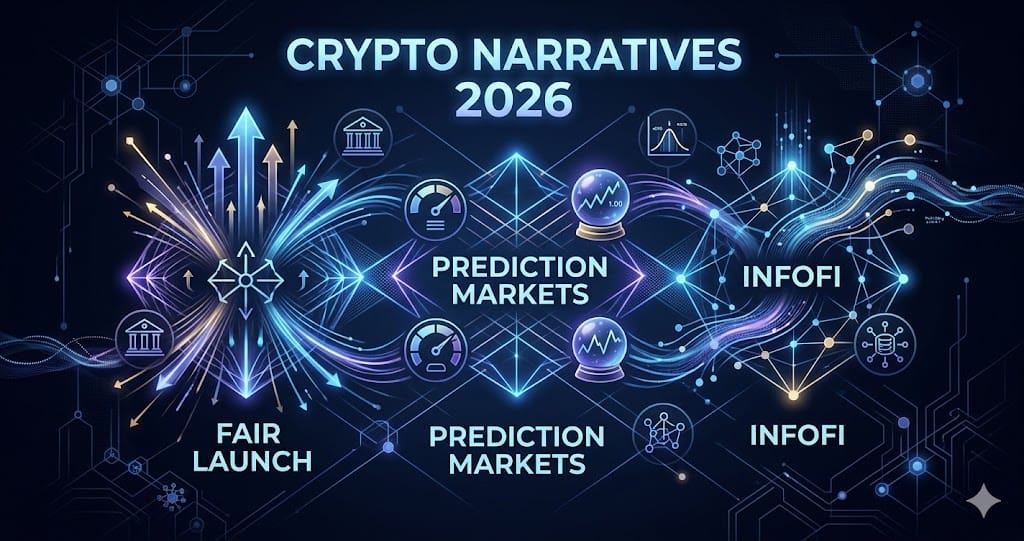
Three narratives entered crypto's top tier for the first time in June 2026: Fair Launch launchpads, Crypto Cards, and Prediction Markets. CoinGecko's 2026 rankings now list nine co-equal macro narratives, placing these new entrants at the same level as RWA, stablecoins, and Perp DEX.
At the same time, Digital Asset Treasury inflows collapsed 90% from their July 2025 peak to USD 1.32 billion per month, the lowest monthly figure recorded in 2025. The week's data collectively signals a market rotating from speculative accumulation toward infrastructure-grade utility and capital preservation.
Fair Launch Infrastructure: ICO 2.0 Becomes a Top-Tier Narrative
The term "Fair Launch" now refers to a concrete technical stack, not a marketing claim. Launchpads deploying it use smart-contract escrow, milestone-based fund release, bonding curves with delayed liquidity migration, anti-sniper logic, and on-chain reputation systems designed to resist sybil attacks. CoinGecko elevated both Meme Launchpads and ICO Launchpads to standalone macro narratives for 2026, placing them alongside RWA and stablecoins in the nine co-equal narratives defining this cycle.
The framing that consolidated this week was "infrastructure replacing speculation" — a phrase that positions the issuance tooling layer as more important than any single token. This language aligns the Fair Launch narrative with the broader 2026 H2 theme of cash-flow and accountability filtering. Projects demonstrating milestone-based escrow and sybil-resistant governance are attracting the most capital attention in this segment.
Prediction Markets Cross USD 9.7 Billion Monthly Volume and Expand Into Crypto-Native Bets
Prediction markets graduated from a narrative mention to a data-backed sector this week. Polymarket recorded USD 9.7 billion in 30-day trading volume and Kalshi hit USD 6 billion, capturing a 52.6% market share. Total sector open interest reached USD 1.3 billion in May 2026, with Kalshi accounting for 58% of total flow and Polymarket 28%. Full-year 2026 volume is projected at USD 240 billion, up from an estimated USD 51 billion in 2025, with a USD 1 trillion target by 2030.
The more structurally notable development is the sector expanding into crypto-native underlying events. Active markets now include bets on token FDV at launch — Sentient at USD 200 million FDV with 99% implied confidence, Gensyn at USD 400 million FDV with 55% confidence, and whether ETHGAS issues a token before end of June 2026 at 69% implied probability. BTC options markets reflect similar extremes: pricing as of early June 2026 implies roughly even odds between USD 70,000 and USD 130,000 for end-of-June BTC, and near-even odds between USD 50,000 and USD 250,000 for end-of-2026.
InfoFi and Crypto Cards: The Lowest-Barrier Retail Entry Points of 2026
InfoFi, short for Information Finance, describes a sector that tokenizes social attention and on-chain information flows. Projects Kaito and Xeet are the primary examples, with the behavior of earning on-chain rewards through social content creation — known informally as "yapping" or "quacking" — entering the sector's working vocabulary. InfoFi requires no capital commitment from participants, making it one of the most accessible expressions of the 2026 utility-first theme alongside Proof-of-Humanity and AI Agents.
Crypto Cards cleared a concrete usage threshold in May 2026, with monthly consumer spending reaching USD 747 million, up 48.6% year-to-date. a16z crypto named 2026 the year stablecoins move from pilot programs into enterprise pipelines, covering payroll, cross-border settlement, and B2B programmable payments. European banks added a regional catalyst with the announced Qivalis euro-denominated stablecoin, planned for launch in the second half of 2026.
DAT Inflows Drop 90% and Treasury Companies Pivot to RWA
Digital Asset Treasury inflows reached USD 1.32 billion in the most recent monthly reading, a 90% decline from the July 2025 peak and the lowest single-month figure in 2025. The three largest DAT holders by current position are Strategy at USD 48.411 billion, BitMine at USD 10.6 billion, and Marathon at USD 4.5 billion. This funding-flow data adds a leading-indicator dimension to a collapse that had previously been measured only in equity market-cap terms.
Analysts are recommending DAT companies reduce exposure to high-volatility assets such as ETH and SOL and reallocate toward tokenized RWA, with capital preservation replacing speculative accumulation as the stated objective. On the regulatory side, U.S. Treasury Secretary Bessent testified before the Senate Finance Committee on June 3, 2026 on a U.S. Bitcoin strategic reserve and the CLARITY Act, while the GENIUS Act introduced yield-like incentive structures for stablecoin-holding crypto firms. One item to watch: a single source from intellectia.ai claims Strategy made a symbolic BTC sale breaking its long-standing no-sell policy, but this has not been confirmed by any second source and should be treated as unverified.
What to Watch
- Prediction market open interest and sector volume — total OI hit USD 1.3 billion in May 2026 and projections call for USD 240 billion in full-year volume; expansion into FDV and token-launch bets marks a structural shift in how retail prices issuance risk
- DAT monthly inflow data — the 90% collapse from July 2025 to USD 1.32 billion per month is the clearest leading indicator of institutional accumulation appetite; any recovery would signal a notable reversal of trend
- Fair Launch launchpad adoption — CoinGecko now treats Meme Launchpads and ICO Launchpads as top-tier 2026 narratives on par with RWA; watch which protocols implement milestone-based escrow and bonding curve delays as the technical bar for this designation
- Strategy BTC sale claim — if confirmed by a second source, a break from the no-sell policy would represent a significant sentiment shift; currently a single-source, unverified report from intellectia.ai dated June 12, 2026
Ready to start trading?
Trade on Bitget Try CoinTech2uAffiliate links — we may earn a commission at no extra cost to you.
Frequently Asked Questions
What does "Fair Launch" mean in the context of 2026 crypto narratives?
Fair Launch in 2026 refers to a specific technical framework for token issuance that includes smart-contract escrow, milestone-based fund release, bonding curves with delayed liquidity migration, anti-sniper mechanisms, and on-chain reputation systems for sybil resistance. CoinGecko elevated it to one of nine co-equal top-tier narratives for 2026, framing it as the infrastructure-level response to 2017-era unregulated ICOs. The key distinction is that funds are released programmatically based on verifiable project milestones rather than founder discretion.
Why did Digital Asset Treasury inflows collapse 90% in 2025?
DAT inflows fell from a peak in July 2025 to USD 1.32 billion per month, the lowest monthly figure in 2025. The data reflects reduced institutional appetite for adding BTC and other digital assets to corporate balance sheets after a period of aggressive accumulation. Analysts are now recommending treasury companies rotate from high-volatility assets like ETH and SOL into tokenized RWA. The three largest holders currently are Strategy at USD 48.411 billion, BitMine at USD 10.6 billion, and Marathon at USD 4.5 billion.
What is InfoFi and how does it differ from DeFi?
InfoFi, short for Information Finance, is a sector that tokenizes social attention and on-chain information flows. Participants earn protocol rewards by generating and curating content — a behavior called "yapping" in the Kaito and Xeet ecosystems — without committing any capital. Unlike DeFi, which financializes capital and liquidity, InfoFi financializes human-generated data and social engagement. This makes it one of the lowest barrier-to-entry sectors for retail participants in the current cycle.