Coinbase vs Binance — Detailed Comparison 2026
Coinbase vs Binance: detailed comparison of features, fees, and user experience. Find out which is right for you.
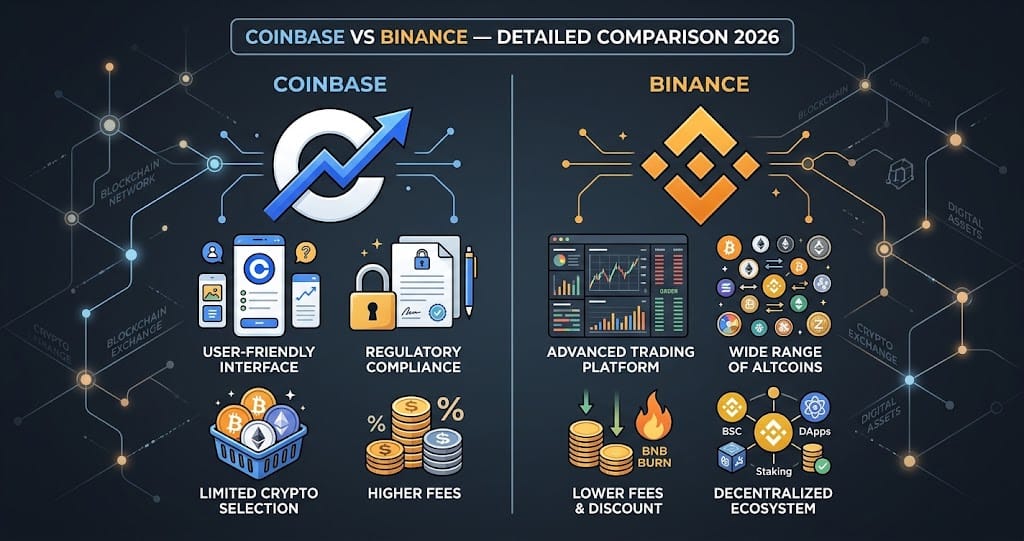
Binance charges 0.10% on standard spot trades; Coinbase's Advanced Trade runs 0.40% maker and 0.60% taker. In April 2026, Binance processed $252.6 billion in monthly spot volume, 26.5% of the market, while Coinbase handled $50.4 billion and ranked fourth globally. Coinbase holds a MiCA license in Luxembourg, giving it EU access; Binance never obtained MiCA approval and suspended EU services on July 1, 2026.
Pick Binance for lower costs and deeper liquidity. Pick Coinbase for a regulated on-ramp with legal protection in the U.S. or EU.
Centralized exchange spot volume fell to $951.8 billion in April 2026, the lowest in 25 months and 60% below the $2.36 trillion peak from August 2025. With retail activity down and Bitcoin trading between $60,000 and $70,000, fee differences matter more on thinner volumes. Binance paid a $4.3 billion DOJ settlement and remains under compliance monitorship; Coinbase's SEC case was dismissed in February 2025. Binance lost EU market access in June 2026, while Coinbase gained CFTC approval for U.S. perpetual futures on May 29, 2026.
Quick Comparison
| Feature | Coinbase | Binance |
|---|---|---|
| Type | Centralized Exchange | Centralized Exchange |
Technology/Features
Binance wins. As of August 2026, it runs Spot, Futures, Options, Copy Trading, Trading Bots, and Simple Earn, plus a self-custodial wallet across 60+ blockchains. Coinbase covers spot, derivatives, staking, and its Base ecosystem.
Binance suits active traders better: its 2026 platform pairs Spot and Futures copy trading with six bot categories — Spot Grid, Futures Grid, Arbitrage, Rebalancing, Spot DCA, and Auto-Invest. Coinbase is cleaner for traders who also want staking and on-chain access. Coinbase Advanced has TradingView charts, and as of August 15, 2026 the Base App added sponsored fees and batched transactions.
✅ Pros
- Coinbase supports 350+ market pairs in Advanced Trade, with TradingView charts and indicators such as RSI, MACD, and Bollinger Bands as of August 2026.
- Coinbase offers ETH staking with no minimum balance, while its Base App supports staking and liquid-staking options as of August 2026.
❌ Cons
- Coinbase's derivatives access is jurisdiction-dependent, and its perpetual futures are available only in eligible markets as of August 2026.
- Coinbase Advanced lists 350+ market pairs, which is less breadth than Binance's much wider product ecosystem as of August 2026.
Fees/Value
Binance wins. As of August 2026, its standard spot fee is 0.10% for both maker and taker orders. Coinbase Advanced charges up to 0.40% maker and 0.60% taker at its published base tiers.
Frequent traders feel this gap: a $10,000 Binance Spot trade at 0.10% costs about $10, versus up to $40 maker or $60 taker on Coinbase Advanced. Coinbase makes some of it back elsewhere: eligible USDC balances earn up to 3.50% APY, and staking is available across supported assets as of August 2026.
✅ Pros
- Coinbase Advanced has a maximum published base fee of 0.40% maker and 0.60% taker, with lower rates available as 30-day volume rises.
- Coinbase offers up to 3.50% APY on eligible USDC balances as of August 2026, giving passive users a value option beyond trading fees.
❌ Cons
- A $10,000 Coinbase Advanced taker trade can cost up to $60 at the published 0.60% base rate, versus about $10 on Binance at 0.10%.
- Coinbase's fee tiers depend on 30-day trading volume, so low-volume traders do not automatically receive the lower rates available to larger traders as of August 2026.
User Experience
Coinbase wins. As of August 2026, it suits users who want a simpler interface. Binance suits experienced traders willing to manage a denser platform with more trading controls.
Coinbase keeps spot trading, staking, derivatives, rewards, and the Base App under one roof, and Advanced Trade adds TradingView charts without a separate professional platform. Binance has far more functionality: its June 2026 product documentation lists Spot, Futures, Copy Trading, Trading Bots, Options, Loans, Earn, and a 60+ blockchain wallet. That breadth means a steeper learning curve.
✅ Pros
- Coinbase Advanced supports market, limit, and stop-limit orders plus TradingView charts with RSI, MACD, Bollinger Bands, and other indicators as of August 2026.
- Coinbase's Base mode supports sponsored network fees and batched transactions, with the transition affecting unsupported networks after August 15, 2026.
❌ Cons
- Coinbase's simplified experience comes with fewer trading products than Binance, which lists Options, Copy Trading, Trading Bots, Futures, Loans, and other categories as of June 2026.
- Some Coinbase derivatives products are restricted to eligible jurisdictions, so the experience can differ materially by country as of August 2026.
Ready to start trading?
Trade on Bitget Try CoinTech2uAffiliate links — we may earn a commission at no extra cost to you.
Final Verdict
Binance wins on cost and liquidity. Its 0.10% standard spot fee beats Coinbase Advanced's 0.40% maker and 0.60% taker rates, and Binance's roughly $64.1 billion in 24-hour spot volume dwarfs Coinbase's $1.87 billion. Coinbase suits a U.S. beginner who wants regulatory clarity: it operates in all 50 states, trades publicly as NASDAQ: COIN, and settled its SEC case with no penalty. Binance suits an active trader or non-U.S. user chasing low fees and a wide altcoin selection, with over 350 assets listed against Coinbase's 240+. U.S. residents are limited to Binance.US.
Frequently Asked Questions
Is Coinbase or Binance cheaper for crypto trading in 2026?
Binance is the clear winner for standard spot trading: Binance lists a typical 0.10% maker fee and 0.10% taker fee, while Coinbase Advanced starts at 0.40% maker and 0.60% taker for its lowest-volume tier, according to exchange fee data updated in January 2026 and Coinbase's current fee schedule. If you trade $10,000, that is roughly $10 per Binance trade versus up to $60 for a Coinbase taker trade, so choose Binance if minimizing trading costs is your priority.
Is Coinbase safer than Binance?
Coinbase has the stronger U.S.-focused regulatory and custody case, with Coinbase Advanced supporting 2FA, address whitelisting, YubiKey security, and FDIC-insured USD balances up to $250,000 for eligible balances, according to Coinbase's current documentation as of August 2026. Binance can still be suitable for active traders, but if regulated U.S. custody and account protections matter more than fees, choose Coinbase.
Which exchange is better for beginners, Coinbase or Binance?
Coinbase is the better beginner pick because its main platform combines buying, selling, staking, and wallet features, while Coinbase Advanced adds TradingView charts and advanced order types without a separate subscription, according to Coinbase's August 2026 product documentation. Binance is better if you already understand order books and want lower 0.10% standard spot fees, but choose Coinbase if simplicity matters more than trading cost.
Can I use Coinbase or Binance in Malaysia?
Coinbase supports Malaysian identity verification, with Malaysia listed among the regions where Coinbase accepts a driver's license, passport, or national ID for verification as of August 2026. Availability and specific trading products can vary by jurisdiction, so if you are in Malaysia and want the platform with documented Coinbase onboarding support, choose Coinbase after confirming the products available on your account.
Related Articles
- Binance vs Bybit — Detailed Comparison 2026
- Phantom vs Solflare — Detailed Comparison 2026
- Ethena vs Gala — Detailed Comparison 2026