
Crypto Narratives 2026: DATCO Bust, AI Tokens, and Selective Altseason
In May 2026, crypto narratives pivot around AI tokens like NEAR and FET, a bursting DATCO bubble, and a selective altseason with BTC dominance near
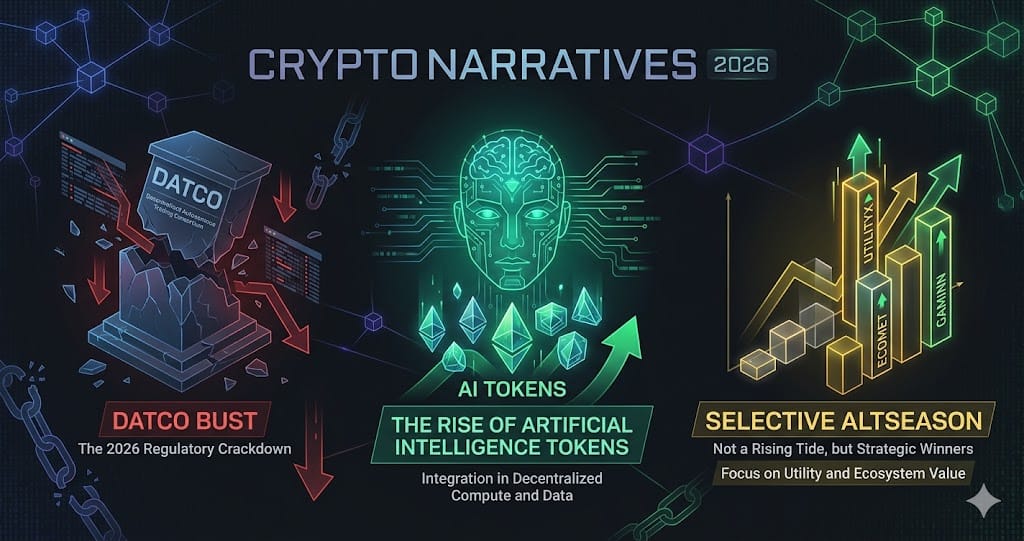
The defining crypto market event of late May 2026 is not a price breakout but a structural unwind: approximately 142 digital asset treasury companies (DATCos) collectively hold around USD 137.3 billion in crypto assets, yet Strategy stock has fallen 67% from its peak and CoinShares head of research James Butterfill declared the bubble decisively burst as most DAT shares now trade below their net asset value, a condition called mNAV below 1.
Against that backdrop, the Altcoin Season Index sits at 30-39 out of 100 as of May 28, 2026, with BTC dominance at 59-60%. Rotation is happening, but it is sector-specific: AI tokens NEAR (+28.5% in a single session) and FET (+11.4%) are absorbing capital flowing out of privacy coins, while DePIN, RWA, and Perp DEX round out the four institutional-grade sectors showing structured buying pressure.
The DATCO Bubble: From 4 Companies in 2020 to 142 in 2026 — and Now a Unwind
The digital asset treasury company narrative expanded from just 4 firms in 2020 to roughly 142 by early 2026, with combined holdings peaking near USD 137.3 billion. The central premise was that publicly listed equities offered accessible Bitcoin exposure in jurisdictions where direct spot purchases were restricted or operationally difficult for institutional allocators.
The correction has been sharp. Strategy, the largest DATCO by holdings, has seen its stock decline 67% from highs, and US public pension funds have collectively lost approximately USD 337 million on DAT positions. With most DATCo shares now priced at a discount to their underlying crypto holdings, the premium that once justified the proxy thesis has evaporated — making narratives around buying MSTR or similar names as a Bitcoin surrogate particularly fragile in the current environment.
AI Tokens Lead the May 2026 Rotation With Verifiable On-Chain Data
The clearest directional signal in the week ending May 30, 2026 comes from AI-linked tokens. NEAR Protocol gained 28.5% and Fetch.ai (FET) rose 11.4% in a single session, with the source capital visibly rotating out of privacy coins. This continues a trend established earlier in 2026 when NEAR, Worldcoin, Render, and ASI Alliance collectively drew institutional-grade inflows, making AI infrastructure the most consistent large-cap breakout theme of the year.
What distinguishes this move from speculative pumps is that it is verifiable on-chain, not just in price action. Other sectors in the CoinGecko 2026 top-9 narrative framework — particularly Perp DEX protocols and RWA projects — are also recording structured inflows, but with less single-session velocity than AI names. For traders tracking momentum, the AI sector remains what analysts are calling the cleanest rotation target in an otherwise range-bound market.
Selective Altseason: Why the 2026 Cycle Looks Nothing Like 2017 or 2021
The Altcoin Season Index reading of 30-39 throughout May 2026 means the market remains firmly in Bitcoin Season — a reading above 75 is required before a broad altseason qualifies. BTC dominance holding at 59-60.3% reinforces the picture. Three conditions would need to align to trigger a broader rally: BTC reaching a new all-time high, dominance falling below 59.63%, and the index breaking above 50. As of May 30, 2026, none of those thresholds have been crossed.
The structural explanation is that ETF-driven institutional demand for Bitcoin is absorbing capital that in prior cycles rotated into altcoins. This compresses any altcoin window from the multi-quarter cycles seen in 2017 and 2020-21 to roughly 4-12 weeks of narrative-driven bursts. Positioning for altcoin gains in this environment requires selectivity: the four sectors with documented institutional buying are RWA, AI infrastructure, Perp DEX protocols, and DePIN — a list that notably excludes the broad meme and layer-1 categories that drove earlier cycles.
DePIN and RWA Reach Verifiable Revenue and Market Cap Milestones
DePIN (decentralized physical infrastructure networks) has moved beyond the conceptual stage. As of May 2026, CoinMarketCap tracks 265 DePIN tokens with a combined market cap of USD 18.92 billion and 24-hour trading volume of USD 2.74 billion — a figure that now exceeds the entire oracle sector by total market cap. January 2026 on-chain fee revenue for DePIN protocols reached approximately USD 150 million for the month, spread across nine active sub-categories including AI compute, GPU networks, decentralized storage, wireless infrastructure, and bandwidth.
RWA (real-world asset tokenization) shows equally concrete numbers: Q1 2026 on-chain market cap reached USD 19.3 billion, up 256.7% from USD 5.42 billion at the start of 2025. The stablecoin market crossed USD 310 billion in April 2026, representing more than 50% growth since early 2025. Both sectors are increasingly described not as speculative verticals but as live financial infrastructure — stablecoins functioning as payment rails, settlement assets, and DeFi collateral, while RWA embeds tokenized assets into active traditional financial workflows rather than remaining demonstration projects.
What to Watch
- NEAR and FET: leading the AI-token rotation as of late May 2026 with single-day gains of 28.5% and 11.4% respectively — the clearest on-chain-verified momentum in the current market
- Altcoin Season Index at 30-39 out of 100 — watch for a sustained move above 50 alongside BTC dominance dropping below 59.63% as the two-condition breakout signal for a broader rotation
- DATCo mNAV ratios: most digital asset treasury company shares now trade at a discount to their underlying crypto holdings, meaning the leveraged-proxy premium has collapsed and these vehicles no longer serve as reliable bullish sentiment proxies
- DePIN monthly on-chain fee revenue: hit approximately USD 150 million in January 2026 — Q2 2026 figures will confirm whether real user demand is holding or inflating
Ready to start trading?
Trade on Bitget Try CoinTech2uAffiliate links — we may earn a commission at no extra cost to you.
Frequently Asked Questions
What is a DATCO and why does it matter that the DATCO bubble is bursting?
A digital asset treasury company (DATCO) is a publicly listed firm whose primary strategy is holding crypto assets — most commonly Bitcoin — on its balance sheet. Strategy is the largest example. The 2026 unwind matters because approximately 142 DATCos accumulated USD 137.3 billion in holdings, but Strategy stock falling 67% from its peak and most DAT shares trading below net asset value (mNAV below 1) signals that the premium investors paid for indirect exposure has disappeared. US public pension funds have already recorded approximately USD 337 million in losses on these positions.
Is altseason 2026 structurally different from past crypto cycles?
Yes. In 2017 and 2020-21, altseasons lasted multiple quarters and produced broad gains across hundreds of tokens. In 2026, the Altcoin Season Index has remained in the 30-39 range while BTC dominance holds near 60%, meaning none of the three breakout conditions — new BTC all-time high, dominance below 59.63%, index above 50 — have been met. Analysts attribute this compression to ETF-driven institutional Bitcoin demand absorbing capital that previously cycled into altcoins, resulting in a rotation window of only 4-12 weeks concentrated in four specific sectors: RWA, AI tokens, Perp DEX protocols, and DePIN.
Which crypto sectors have verifiable revenue in 2026 rather than purely speculative narratives?
Two sectors stand out with hard data. DePIN protocols generated approximately USD 150 million in on-chain fee revenue in January 2026 alone, spanning sub-categories including AI compute, decentralized storage, GPU networks, and wireless infrastructure. RWA tokenization reached a USD 19.3 billion on-chain market cap in Q1 2026, up 256.7% from USD 5.42 billion at the start of 2025, with use cases transitioning from experimental pilots to active integration within traditional financial workflows. The stablecoin market at USD 310 billion also reflects genuine transactional volume, increasingly functioning as payment infrastructure and DeFi collateral rather than a purely speculative holding.