Crypto Narratives Gaining Traction in 2026: Prediction Markets, Zcash, and DePIN
Prediction markets reach USD 4.8B weekly volume, Zcash clears SEC review with no action, and DePIN hits USD 9-10B market cap in May 2026.
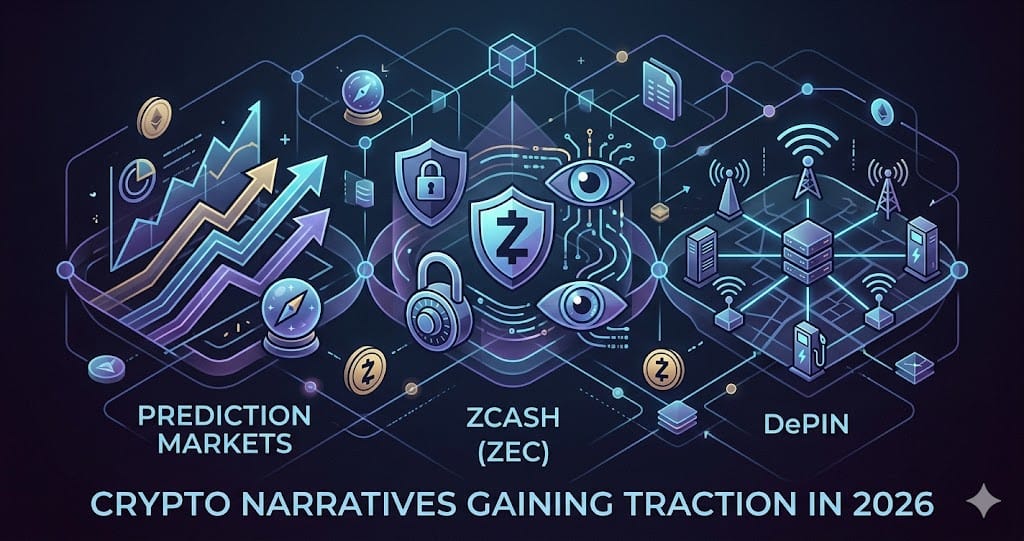
The three narratives driving crypto capital in May 2026 are prediction markets cementing a USD 4.8 billion combined weekly volume between Kalshi and Polymarket, Zcash completing an SEC regulatory review with no enforcement action and securing a USD 25 million seed round from Paradigm and a16z crypto, and DePIN crossing into a verified revenue phase with sector market cap between USD 9 billion and USD 10 billion.
The Altcoin Season Index sits at 35 this week, down from 39 in the prior reading, with BTC dominance at 60.3 percent. The broad altcoin rally that defined 2024 has not returned; instead, capital is rotating selectively into sectors with measurable on-chain revenue or regulatory clarity.
Prediction Markets: From Narrative to Dual-Oligopoly
Kalshi reported weekly volume of approximately USD 2.7 billion across 350,000 active markets in the most recent data, representing a 53 percent global market share. Polymarket added USD 2.1 billion in weekly volume over the same period. Together they have processed a cumulative USD 150 billion in total, but the more significant signal is the real-time weekly run rate, which confirms the sector has moved past the storytelling phase into an operating duopoly.
The Super Bowl 60 event generated USD 1.63 billion in Polymarket volume from a single event, directly countering the April 2026 narrative of user activity cooling. That figure proves event-driven liquidity can reach billion-dollar scale. Both platforms simultaneously opened access to Indian users, expanding the addressable market to one of the world's largest unserved gambling populations.
The regulatory picture is mixed. The Trump administration has expressed public support for prediction markets, but the SEC is still reviewing prediction market ETF applications and has delayed approvals. Kalshi's reported valuation stands at USD 22 billion, and the unresolved ETF question is the primary uncertainty that could either accelerate or slow institutional adoption in the second half of 2026.
Zcash: Regulatory Exit and Institutional Entry
In January 2026, the SEC ended a long-running review of Zcash without filing any enforcement action. That outcome, combined with the March 2026 USD 25 million seed round for the Zcash Open Development Lab led by Paradigm, a16z crypto, Coinbase Ventures, Winklevoss Capital, and Balaji Srinivasan, completed what analysts are describing as a regulatory-exit and institutional-entry combination.
The practical effect is a category migration. ZEC is no longer grouped alongside retail speculative assets. Shielded pool usage accounts for roughly 30 percent of ZEC transactions, which provides the kind of auditable on-chain evidence institutional compliance teams require when evaluating portfolio inclusion.
ZEC broke above the USD 500 resistance level following the ZODL funding announcement in March. The institutional narrative is now supported by both regulatory structure and tier-one venture capital backing, which are the two conditions that typically precede broader allocator interest in a privacy asset.
DePIN and AI Agents: Entering the Revenue Phase
DePIN sector market cap has entered the USD 9 billion to USD 10 billion range with monthly on-chain revenue in the tens of millions of dollars. That shift is meaningful because the sector had previously been valued on network growth metrics rather than revenue metrics. Protocols are now competing on utilization rates and fee generation, which is a measurable and auditable basis for valuation.
A subset category called DePAI, focused on AI data collection and incentive mechanisms, is expected to reach its own incentive breakthrough in 2026. Four protocols have emerged as the named contenders: BitRobot, PrismaX, Shaga, and Chakra. These projects sit at the intersection of verifiable compute and data provenance, the two inputs most AI infrastructure buyers currently lack access to on-chain.
AI agents are returning to prominence in 2026 in a structurally different form from the 2024 speculative cycle. The current iteration is defined by verifiable execution, meaning agents that can sign transactions, pay APIs, interact with DeFi protocols, and manage portfolio rebalancing without human intervention. The combination of DePIN infrastructure and autonomous AI agents is described by multiple research sources as a verifiable compute plus autonomous execution dual-engine architecture.
Stablechains, Restaking, and the Fair Launch Meme Cycle
A new infrastructure category called stablechains has emerged, defined as L1 or L2 networks purpose-built for stablecoin settlement. Four projects represent the current field: Plasma, backed by Tether and Bitfinex as a BTC-anchored EVM-L1 that saw billions of USDT bridge in during its September 2025 beta mainnet launch; Stable, which launched in December 2025; Codex, an OP-stack L2 backed by Coinbase Ventures and Dragonfly targeting a 2026 mainnet; and Circle Arc, a USDC-native L1 also targeting 2026.
The stablecoin market reached USD 311 billion in April 2026, up from USD 205 billion at the start of 2025, a rise of more than 50 percent. One warning signal: Stable launched with a USD 2.5 billion fully diluted valuation against zero recorded DEX volume as of late March 2026, reinforcing the market shift toward product-proof as a required allocation filter before entry.
Ethereum liquid staking TVL stands at USD 44.8 billion, with Lido at USD 27.5 billion, Aave at USD 27 billion, and EigenLayer at USD 13 billion. Restaking and liquid restaking have absorbed the role that DeFi blue-chip tokens played in prior cycles as default infrastructure allocation targets. In the meme sector, the May 27 Ethereum fair launch of Wadoozie via Uniswap's bonding curve, with no presale, no private allocation, and no insider distribution, is the current benchmark example of the fair-launch mechanism. The project paired the on-chain launch with a 48-state US tour as offline event marketing.
What to Watch
- Kalshi and Polymarket India market expansion: whether daily active user data over the next 30 days confirms the geographic TAM thesis that opening the world's largest unserved gambling market translates into sustained volume rather than a one-time spike
- Zcash ZODL product roadmap: the USD 25 million seed from Paradigm and a16z implies a development timeline for shielded transaction tooling aimed at institutional custodians, and the first public milestone disclosures will test whether the institutional narrative holds
- DePAI protocol incentive launches: BitRobot, PrismaX, Shaga, and Chakra are the four named projects entering incentive activation in 2026, and their ability to attract verifiable AI data buyers will determine whether DePAI separates into its own investable category
- Stablechains product proof: whether Codex and Circle Arc reach mainnet with measurable DEX or settlement volume before the end of 2026, given that Stable launched at a USD 2.5 billion fully diluted valuation with zero DEX activity, setting a cautionary precedent for the category
Ready to start trading?
Trade on Bitget Try CoinTech2uAffiliate links — we may earn a commission at no extra cost to you.
Frequently Asked Questions
What is driving prediction market volume growth in 2026?
Two factors are compounding. First, event-driven volume spikes: the Super Bowl 60 event alone generated USD 1.63 billion in Polymarket volume, proving a single mainstream event can produce billion-dollar platform throughput without sustained daily engagement. Second, geographic expansion: both Kalshi and Polymarket opened access to Indian users in the same week, entering one of the world's largest unserved gambling markets. The combined weekly run rate of USD 4.8 billion across both platforms represents a structural shift confirmed by real-time data rather than cumulative totals.
Why is Zcash attracting institutional investors in 2026?
Two events created the conditions simultaneously. The SEC closed its Zcash review in January 2026 without any enforcement action, removing the primary regulatory overhang that had kept institutional compliance teams away. Then in March 2026, the Zcash Open Development Lab raised USD 25 million from Paradigm, a16z crypto, Coinbase Ventures, Winklevoss Capital, and Balaji Srinivasan, signaling tier-one venture conviction. The 30 percent shielded pool usage rate provides on-chain evidence that privacy functionality is actively used, which is the kind of auditable metric institutional allocators require.
What is DePAI and how does it differ from standard DePIN?
DePIN refers to decentralized physical infrastructure networks that coordinate real-world hardware such as compute, storage, and connectivity through token incentives. DePAI is a subset focused specifically on AI data collection protocols, where nodes gather, verify, and sell training or inference data to AI buyers. The named DePAI projects entering incentive activation in 2026 are BitRobot, PrismaX, Shaga, and Chakra. The distinction matters because DePAI revenue is tied to AI compute demand rather than general network utilization, giving it a different growth driver and a different valuation framework from broader DePIN.