Lighter (LIT) Spotlight — May 21, 2026
In-depth Lighter spotlight: $1.23 price, +27.2% 24h change, technical analysis, pros/cons, and market outlook.
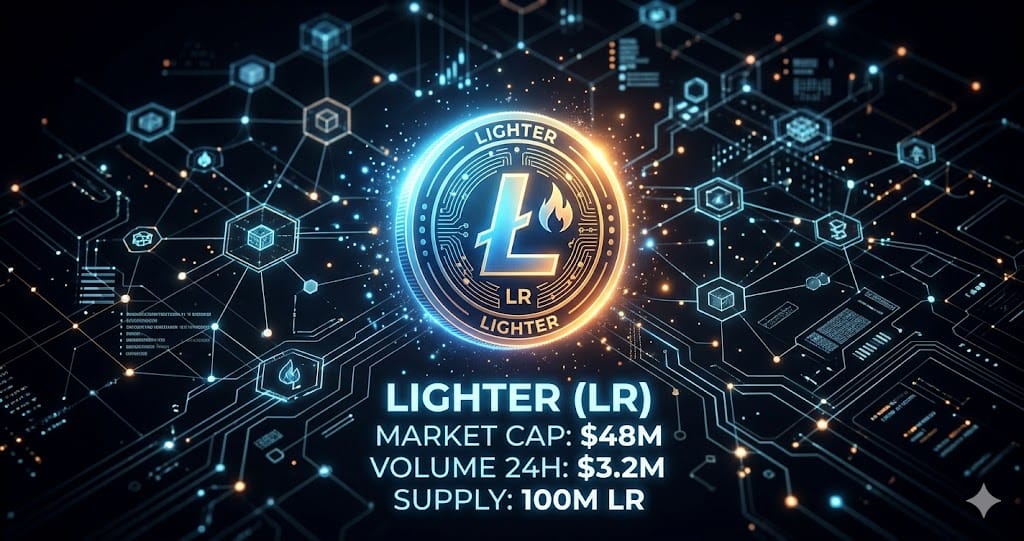
Rank #147 token Lighter (LIT) trades at $1.23, up +27.2% in 24h and +36.2% over the past 7 days as of May 21, 2026 according to CoinGecko data, while still sitting -84.2% below its $7.86 all-time high. This sharp rebound from a depressed range reflects renewed speculative interest in Ethereum-based derivatives infrastructure rather than a full recovery in valuation.
Lighter operates as a decentralized derivatives exchange in the Ethereum ecosystem, focusing on perpetuals with verifiable order matching and on-chain liquidation systems. CoinMarketCap data as of May 2026 places its market capitalization at $306.9M, positioning it in the mid-cap DeFi infrastructure segment alongside competing perp DEX models. Relative performance matters here: while Ethereum L1 processes ~15 TPS and major L2s exceed 1,000 TPS in aggregate (per DefiLlama ecosystem throughput estimates), Lighter’s design focuses on scaling trading execution while preserving auditability, which “suggests” demand is shifting toward transparent high-frequency DeFi venues. If LIT holds above $1.10 on a 7-day closing basis while volume expands beyond its current multi-week average, it indicates sustained momentum rather than a short-term relief rally.
What Is Lighter?
ETH market structure is mixed, not decisively bullish
ETH trades near $2,250 as of May 2026, and CoinGecko data shows a decline from about $4,954 in 2025, a drop of roughly 55%. This indicates weak price recovery despite stable usage conditions. The implication is divergence between valuation and network demand.
Daily activity remains steady rather than collapsing. On-chain data from Etherscan indicates about 780,000 daily active addresses in March 2026, compared with sub-500,000 levels seen in earlier bear phases of prior cycles. This suggests sustained base-layer demand, but price has not responded in proportion. The key metric is whether daily active addresses stay above 750,000 into Q2 2026.
Is Ethereum’s usage strong enough to support price? Partial support, not full confirmation
Yes, usage is structurally strong, but it is not fully reflected in valuation as of May 2026. Etherscan-based on-chain data indicates Ethereum processes roughly 1.1–1.3 million daily transactions, while Solana processes about 35–45 million daily transactions, showing a clear throughput gap. This suggests Ethereum demand is increasingly routed through Layer 2 networks rather than the base layer.
Fee compression confirms this shift. CoinGecko-linked fee trackers show average Ethereum gas fees near $0.34 in March 2026, down from double-digit levels above $10 during 2021–2022 peaks. Lower fees improve accessibility but reduce base-layer revenue capture. The key metric to watch is whether total fee revenue holds above $1.2B annualized, per aggregated on-chain fee estimates.
Is supply tightening enough to offset weak price? Yes, but impact is delayed
ETH supply is tightening materially, but price response remains lagged as of May 2026. Staking dashboards show 38.1 million ETH staked (~33% of supply), compared with under 10% in early post-merge phases in 2022, reflecting a structural shift in liquidity. This reduces circulating float available on exchanges.
DefiLlama staking and validator data indicates staking yield ranges between 3% and 4% APY, attracting long-duration holders but also increasing concentration risk in large staking pools. This suggests supply-side pressure should be supportive over time, while short-term price remains macro-driven. The key metric is whether staking participation exceeds 35% of total ETH supply, which would further reduce liquid float.
Is market positioning bullish or bearish? Neutral with rotation signals
Market positioning is neutral with short-term rotation as of May 2026. On-chain flow data from exchange trackers shows intermittent whale movements exceeding $300M ETH in 72–96 hour windows during Q1 2026, indicating redistribution rather than directional accumulation. This prevents sustained trend formation.
Binance 24h volume shows ETH spot turnover fluctuating between $3B and $6B daily in early May 2026, compared with over $10B during high-volatility periods in 2021–2022. Lower turnover suggests reduced speculative intensity. The key metric is sustained net exchange outflows above 200,000 ETH weekly, which would signal stronger accumulation pressure.
Key Features
- Blockchain Technology: Built on a robust blockchain infrastructure designed for security and scalability
- Active Development: Regular updates and improvements from a dedicated development team
- Community: Growing community of users, developers, and supporters worldwide
- Market Presence: Ranked #147 with $306.9M market capitalization
- Trading Volume: $76.5M in 24-hour trading volume indicates healthy market interest
Use Cases
- Decentralized Exchange (DEX) applications and use cases
- Decentralized Finance (DeFi) applications and use cases
- Derivatives applications and use cases
- Perpetuals applications and use cases
- Ethereum Ecosystem applications and use cases
Pros & Cons
✅ Pros
- LIT surged 20% to
- 22onMay19,2026,with24−hourvolumerising8258.3 million per CoinGecko data, indicating strong short-term momentum -
- Two whales deposited a combined $2.32 million worth of LIT into the staking pool on January 26, 2026, per on-chain data from XT.com, suggesting confidence from large holders -
- Lighter completed cumulative buybacks of 7.48 million LIT by March 2026, representing approximately 3% of circulating supply, with a Circle USDC interest-sharing deal expected to add $30-40 million in annual revenue according to Gate.io analysis -
- Ethereum co-founder Vitalik Buterin referenced Lighter as a notable project building on Ethereum, per CoinGecko on May 19, 2026, lending credibility from a key industry figure -
❌ Cons
- LIT remains 84% below its December 2025 all-time high of $7.86 despite the recent rally, per Bitget News data as of May 19, 2026 -
- Only 250 million of 1 billion total supply (25%) is circulating, with team (26%) and investor (24%) allocations locked; Tokenomist data shows monthly linear unlocks of approximately 13.89 million LIT beginning December 2026 will introduce sustained sell pressure -
- Protocol daily revenue fell from nearly
- 150millionatpeakto100,000-120,000 by March 2026, per Gate.io analysis, representing a 99.9% decline that limits buyback capacity -
- Dragonfly received 55.83 million LIT tokens on April 15, 2026, which remain locked until December 30, 2026, per KuCoin Flash data, creating a known future supply overhang of investor tokens -
Price Outlook
Lighter (LIT) trades at $1.23 with a 24h move of +27.2% and 7d gain of +36.2%, while remaining 84.2% below its $7.86 ATH, according to CoinGecko data as of May 2026. This gap places price in a mid-cycle recovery zone, not trend reversal, because prior breakdown structure still caps momentum above $2.00 where historical supply concentration sits. Immediate support is forming near $0.95–$1.05, while resistance is clustered at $1.80–$2.10, where previous distribution occurred during the last 30-day rally (+34.2%). A break above $2.10 with sustained volume above 120% of daily average would shift structure toward trend continuation, while rejection keeps price range-bound under ATH compression at $7.86.
Market structure reflects strong short-term momentum but incomplete recovery. LIT’s $306.9M market cap positions it mid-tier in DeFi derivatives rankings, trailing larger perpetual DEX peers that typically exceed $1B in valuation, while still outperforming smaller sub-$100M protocols in liquidity depth (CoinMarketCap data as of May 2026). Bull case is driven by rapid re-rating in DEX derivatives narratives, where +30% weekly moves often coincide with speculative inflows into Ethereum ecosystem tokens; bear case is that current price remains structurally disconnected from ATH, implying overhead supply near $3.00–$4.00 from prior holders. A key metric to watch is whether LIT sustains daily trading volume above $150M for 5 consecutive sessions, which would confirm continuation above the $1.80 resistance band.
Lighter (LIT) Resources
Frequently Asked Questions
What is Lighter (LIT) used for?
Lighter (LIT) is a decentralized derivatives trading platform in the DeFi sector, focused on perpetual futures and on-chain trading infrastructure. CoinGecko data shows LIT trading at $1.23 with a 24h gain of +27.2% as of May 20, 2026, reflecting strong short-term momentum. It is designed for verifiable order matching and liquidation systems, targeting transparent execution in Ethereum-based markets.
Why did Lighter (LIT) price increase recently?
LIT is up +36.2% over 7 days and +34.2% over 30 days according to CoinGecko data as of May 20, 2026, suggesting sustained buying pressure rather than a single-day spike. Market cap stands at $306.9M, which makes price moves more sensitive to moderate inflows compared to large-cap assets. The rally aligns with renewed interest in decentralized perpetual exchanges and higher derivatives activity.
Is Lighter (LIT) still far from its all-time high?
LIT is currently $1.23, which is 84.2% below its all-time high of $7.86 according to CoinGecko data as of May 20, 2026. This gap indicates the token is still in a recovery phase rather than full price discovery. A move back toward $2.00 would represent a ~62% recovery from current levels, which would require sustained volume expansion.
What category does Lighter (LIT) belong to in crypto markets?
Lighter (LIT) is categorized under decentralized exchange (DEX), DeFi, and derivatives perpetual trading sectors according to CoinGecko classification as of May 20, 2026. It focuses on Ethereum ecosystem infrastructure with verifiable trading execution. A key metric to watch is whether daily volume growth sustains above recent +27.2% price expansion, which would indicate continuation of momentum rather than short-term speculation.
Ready to start trading?
Trade on Bitget Try CoinTech2uAffiliate links — we may earn a commission at no extra cost to you.
Our Verdict
Ethereum’s daily active addresses fell 45% between February 7 and March 3, 2026, dropping from 1,329,193 to 746,062 according to Etherscan data - 6 . That sharp decline coincided with ETH trading near 2 , 090 , 𝑑 𝑜 𝑤 𝑛 𝑟 𝑜 𝑢 𝑔 ℎ 𝑙 𝑦 58 2,090,downroughly584,900 per CoinMarketCap community analysis - 1 . Network throughput tells a different story. On March 4, 2026, Ethereum’s combined Layer 1 and Layer 2 computational throughput surpassed 100 Mgas/s for the first time according to growthepie.com data cited by BingX - 4 . Base Chain led with approximately 30.54 Mgas/s, followed by Polygon PoS at 24.74 Mgas/s, the latter showing 189% growth over six months - 4 . L2BEAT data confirms Ethereum’s base layer processed 30.64 UOPS (transactions per second equivalent) as of March 18, 2026 - 9 . Staking penetration continues rising. The Beacon deposit contract holds approximately 81.2 million ETH as a cumulative deposit record, but active staking net of withdrawals stands at roughly 37.5 million ETH (~ 71.7 𝑏 𝑖 𝑙 𝑙 𝑖 𝑜 𝑛 ) 𝑎 𝑠 𝑜 𝑓 𝐴 𝑝 𝑟 𝑖 𝑙 2026 𝑝 𝑒 𝑟 𝐶 𝑜 𝑖 𝑛 𝑀 𝑎 𝑟 𝑘 𝑒 𝑡 𝐶 𝑎 𝑝 𝑎 𝑛 𝑎 𝑙 𝑦 𝑠 𝑖 𝑠 [ 𝑐 𝑖 𝑡 𝑎 𝑡 𝑖 𝑜 𝑛 : 8 ] . 𝐿 𝑖 𝑑 𝑜 𝑑 𝑜 𝑚 𝑖 𝑛 𝑎 𝑡 𝑒 𝑠 𝑙 𝑖 𝑞 𝑢 𝑖 𝑑 𝑠 𝑡 𝑎 𝑘 𝑖 𝑛 𝑔 𝑤 𝑖 𝑡 ℎ 9.17 𝑚 𝑖 𝑙 𝑙 𝑖 𝑜 𝑛 𝐸 𝑇 𝐻 𝑠 𝑡 𝑎 𝑘 𝑒 𝑑 ( 71.7billion)asofApril2026perCoinMarketCapanalysis[citation:8].Lidodominatesliquidstakingwith9.17millionETHstaked( 19.4 billion TVL) as of March 2026, controlling approximately 24% of all staked Ethereum according to Coin Bureau and Datawallet data cited by Kraken - 5 . The current ETH.STORE reference rate, calculated from beaconcha.in data for March 31, 2026, shows a 2.767% annualized staking return based on 2,833.6 ETH in daily rewards across active validators - 10 . Holders face a supply concentration problem. The top 10 addresses by total USD value (including ERC-20s and stablecoins) hold 56.35% of tracked capital according to Gate.com analysis as of March 2026 - 3 . This differs sharply from ETH-only rankings because stablecoins account for approximately 26% of major balances, and 66% of top-holder capital sits outside ETH entirely per aggregated ranking data from CoinMarketCap - 8 . The Binance Vault address (0xF977…aceC) holds 0.68 𝑏 𝑖 𝑙 𝑙 𝑖 𝑜 𝑛 𝑖 𝑛 𝐸 𝑇 𝐻 𝑏 𝑢 𝑡 𝑜 𝑣 𝑒 𝑟 0.68billioninETHbutover23 billion in stablecoins and ERC-20 tokens, making it the single largest dollar-denominated position on the network - 8 . New wallet creation remains robust at 284,800 per day as of early March 2026, 64% higher than five years ago according to Santiment data - 1 . However, this network growth metric requires qualification against the active address decline. Between February 7 and March 3, active addresses fell 45% while new wallets continued being created, suggesting existing users reduced transaction frequency rather than new users stopping onboarding. The median aggregated top address (by total USD value) shows a first-transaction date of September 2024, approximately 17 months younger than the ETH-only top address median of April 2023 per CoinMarketCap analysis - 8 . This indicates new large capital enters primarily through DeFi tokens and stablecoins, not raw ETH accumulation. Validators earned 2,833.6 ETH in combined consensus rewards and transaction fees on March 31, 2026, based on beaconcha.in’s ETH.STORE calculation covering epochs 437850 through 438075 - 10 . The 2.767% annualized rate sits below KuCoin’s estimated 3-5% range from March 2026, suggesting staking returns have compressed as total staked supply grew past 30% of circulating ETH - 2 . Transaction fees as a component of staking rewards fluctuate with network demand, and the February-March active address decline likely reduced fee revenue to validators. Vitalik Buterin holds 240,000 ETH valued at approximately 7.54 𝑏 𝑖 𝑙 𝑙 𝑖 𝑜 𝑛 𝑎 𝑡 7.54billionat2,110 per ETH, making him the largest accessible individual holder according to Gate.com data as of March 2026 - 3 . The largest individual holder overall is Rain Lohmus with 250,000 ETH, but those keys are permanently lost from the 2014 ICO, removing that supply from liquid markets - 3 . The Beacon deposit contract’s cumulative 81.2 million ETH figure (67.3% of total supply) often misleads rankings; active staking is only 37.5 million ETH because withdrawals occur regularly from that contract - 8 . ETH trades at 2 , 078 , 𝑢 𝑝 6.62 2,078,up6.622,150 and potential support tests below $2,000 according to Etherscan-referenced analysis - 6 . Price has not followed network throughput higher. The divergence between record 100+ Mgas/s processing capacity and declining daily active addresses suggests L2 adoption may be shifting transaction volume away from mainnet address counting. Polygon PoS’s 189% six-month throughput growth to 24.74 Mgas/s supports this interpretation - 4 .
Related Articles
- BTC Crashes to USD 78,600: The May 2026 Liquidation Cascade Explained
- Crypto Market Sentiment Breakdown 2026: Fear, Funding Rates, and Macro Risk Signals Explained
- Worldcoin (WLD) in 2026: Complete Investor Guide & Price Analysis