Bitcoin's May 2026 Liquidation Cascade: Five Days, USD 657M, and a Tweet
BTC fell to USD 76,270 on May 19 2026 as a five-day cascade erased USD 2.5B. Goldman dumped altcoin ETFs while retail bought the dip.
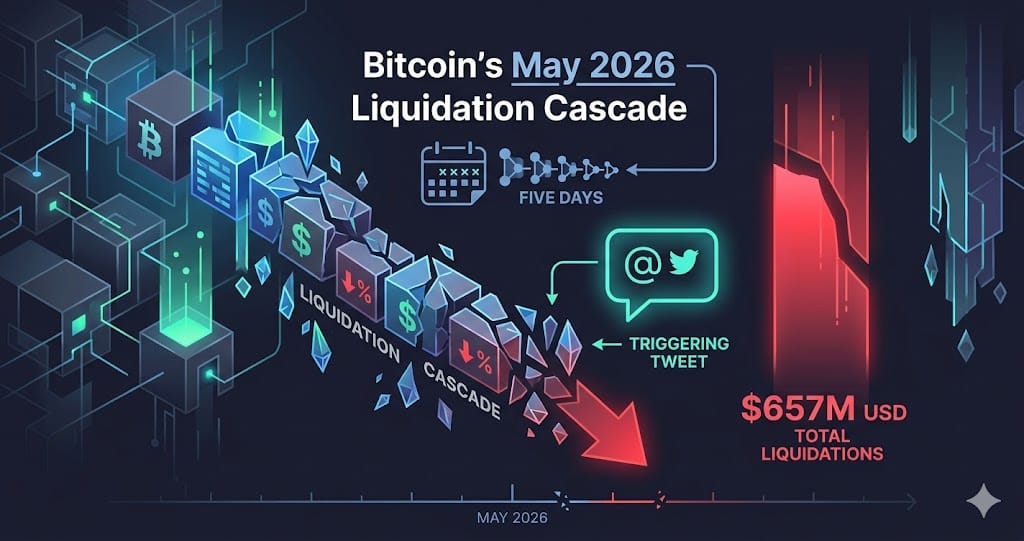
Bitcoin fell to USD 76,270 on May 19, 2026, its lowest level since late April, as a five-day liquidation cascade totaling over USD 657 million in a single session broke the sideways range that had held since early May. The move was not a routine correction: it converted a range-bound structure into a confirmed fresh downtrend.
What made this cascade distinct was the convergence of factors triggering it simultaneously. A Truth Social post from Donald Trump warning Iran that "the clock is ticking" sent Brent crude through USD 112 per barrel within one hour of publication. Goldman Sachs fully exited its XRP and Solana ETF positions on the same day while increasing its Bitcoin allocation. And on Hyperliquid, oil perpetual futures hit USD 106, extending the forced-selling event beyond crypto into commodity derivatives for the first time in 2026.
Five Days of Forced Selling: How the Cascade Built
The May 2026 cascade ran from May 15 through May 19, accumulating an estimated USD 2 to 2.5 billion in liquidations over its first four days before the fifth day delivered the decisive structural break. Bitcoin held above USD 77,000 through May 18 despite sustained pressure, but the psychological level gave way on May 19 when the price touched USD 76,270.
The shift mattered because the first four days had the signature of a volatility spike within a defined range. The May 19 print below USD 77,000 reclassified the event as a trend-level move. Traders who had been fading the drop with leveraged long positions were caught, contributing to the USD 657 million in liquidations recorded on that single session. Cross-asset confirmation arrived as crypto, equities, and gold declined simultaneously, invalidating Bitcoin's recent narrative as a digital-gold safe haven during macro shocks.
Goldman Sachs Exits Altcoins While Retail Buys: A Rotation Paradox
Goldman Sachs fully liquidated its XRP and Solana ETF positions on May 19, 2026, while simultaneously increasing its Bitcoin ETF allocation. That institutional move came against a backdrop of nearly USD 1 billion in Bitcoin fund outflows recorded over the prior week, per CoinDesk. The two data points created a sharp paradox: institutions were rotating into Bitcoin by exiting altcoins, while retail fund flows were doing the opposite.
CoinDesk reported that XRP and Solana funds attracted fresh inflows on the same day Goldman exited them. This divergence is significant. Historically, institutional capital has tended to lead price discovery. Retail accumulation of altcoins at these levels may reflect buy-the-dip behavior into institutional distribution. The resolution of this split between the two capital pools will likely determine whether XRP and SOL found a genuine bottom on May 19 or simply a temporary pause in a larger drawdown.
Social Media as Flash Trigger: The Trump-Netanyahu Event
Prior analysis of the May 18-19 cascade attributed it broadly to macro deterioration, geopolitical risk, and sell-the-news dynamics. Newer information narrows the trigger to a precise timestamp: a Trump Truth Social post following his May 17 call with Israeli Prime Minister Netanyahu, warning Iran that "the clock is ticking." Within 60 minutes of that post, Brent crude crossed USD 112 per barrel, S&P 500 futures fell 0.3%, and the US dollar received a haven bid.
This matters for how traders model cascade risk going forward. The event was not a product of gradual macro accumulation but a single social media post that propagated through commodity markets into equities and then crypto within one hour. Market sensitivity to a single political account is at a historically elevated level. Trump was also scheduled to review military options against Iran in the Situation Room on May 19, meaning geopolitical risk was not resolved by the cascade and remained a live second-round trigger throughout the May 19-25 window.
Hyperliquid's USD 200M Loss Study: James Wynn and Machi Big Brother
Two traders on Hyperliquid, James Wynn and Machi Big Brother, have collectively accumulated more than USD 200 million in documented losses through mid-2026, representing one of the most quantifiable case studies in leveraged derivatives self-destruction in crypto history. James Wynn entered his sixth liquidation event on April 6, 2026, losing a position that had begun at USD 100 million in principal and was reduced to approximately USD 900 before the final forced close. His cumulative liquidation count stood at 194 by the end of March 2026.
Machi Big Brother logged 335 or more total liquidations, including 262 in a single month of January 2026, implying an average of eight to nine forced closures per day during that period. His cumulative losses reached approximately USD 76 million. Both accounts display the hallmarks of revenge trading: re-entering the same directional position immediately after a liquidation, often at higher notional size. Hyperliquid's architecture allows near-instant re-entry with no mandatory cooling-off period, making this self-reinforcing loop structurally easier to sustain than on most centralized venues.
What to Watch
- US military action against Iran following the Situation Room review scheduled for May 19: any confirmed strike would constitute a second-round cascade trigger that markets have not yet fully priced in across the May 19-25 window.
- BTC perpetual funding rates on major venues returning to strongly negative territory, which would signal renewed short-side overcrowding and set up conditions for a squeeze comparable to the April 15 reset that ended the prior 46-day negative funding streak.
- Next 13-F filings from institutional asset managers holding XRP and Solana ETF positions: if Goldman's May 19 exit reflects broad institutional consensus rather than a single outlier decision, the retail inflows into those same funds represent buying into active distribution.
- Hyperliquid oil perpetual open interest following the USD 106 peak on May 18-19: if commodity-linked derivatives volume on the platform remains elevated after the event, it marks a structural change in how macro shocks propagate into crypto liquidation cascades.
Ready to start trading?
Trade on Bitget Try CoinTech2uAffiliate links — we may earn a commission at no extra cost to you.
Related Articles
- Bitcoin's $600M Liquidation Absorbed With Only 2.2% Drop: May 2026
- May 18 2026 Crypto Crash: USD 1.75 Billion Liquidated in One Day
- Bitcoin $1B Long Liquidations in May 2026: Funding Rates and OI Collapse Explained
Frequently Asked Questions
What caused Bitcoin to fall below USD 77,000 on May 19, 2026?
The proximate trigger was a Trump Truth Social post on May 17, 2026, following his call with Israeli Prime Minister Netanyahu, warning Iran that "the clock is ticking." Within one hour, Brent crude crossed USD 112 per barrel and S&P 500 futures fell 0.3%. This social media event compounded five days of existing cascade pressure, pushing BTC to USD 76,270 and converting a range-bound structure into a confirmed fresh downtrend.
Why did Goldman Sachs exit its XRP and Solana ETF positions during the May 2026 downturn?
Goldman Sachs fully liquidated its XRP and Solana ETF holdings on May 19, 2026, and increased its Bitcoin allocation, signaling institutional rejection of the altcoin rotation narrative at current price levels. Because this move occurred simultaneously with retail inflows into the same altcoin funds, it created a directional split between institutional and retail capital that has historically resolved in favor of institutional positioning.
What is the significance of Hyperliquid oil perpetuals reaching USD 106 during the May 2026 crypto sell-off?
Oil perpetual futures on Hyperliquid hitting USD 106 on May 18-19, 2026, marked the first confirmed instance of a liquidation cascade extending into commodity derivatives on a decentralized platform during the same event window as a major crypto sell-off. It broadens the asset class exposure of traders using Hyperliquid during macro shocks and suggests that the platform's forced-selling mechanics now apply to oil-linked positions, not only to crypto perpetuals.