Crypto Narratives Shift in June 2026: DAT Collapse and What Rises Next
Bitcoin treasury stocks shed USD 62B in June 2026. Equity perps, DeSci tokens, and AI DePIN attract fresh capital as the DAT narrative collapses.
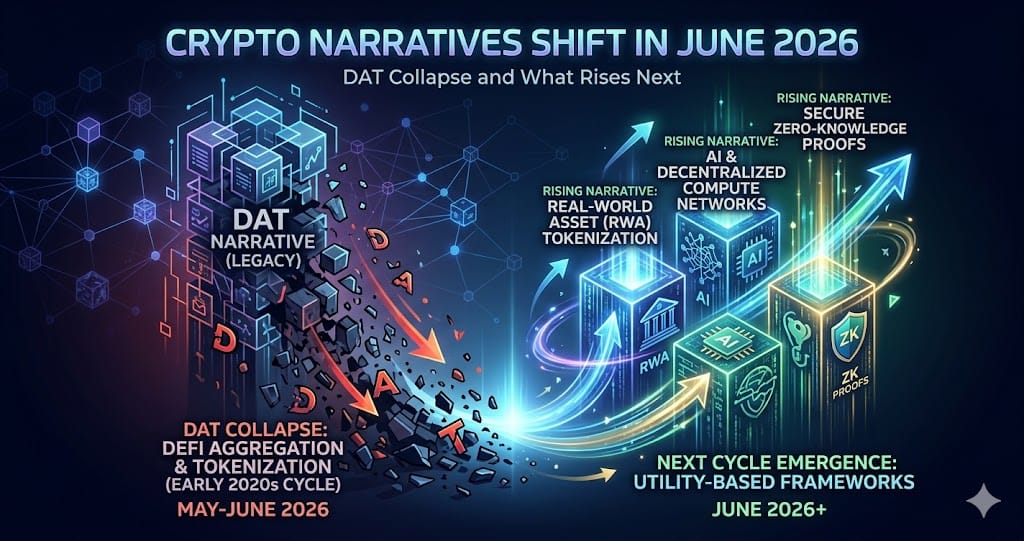
The biggest crypto story in June 2026 is not a new token launch — it is the collapse of the digital asset treasury model. Bitcoin treasury company stocks shed a combined USD 62 billion in market value from their October 2025 peak, with Strategy trading at a 21% discount to its bitcoin holdings and Metaplanet's mNAV premium compressing from 237% in July 2025 to roughly 10%.
BTC dropped below USD 62,000 on June 4, triggering over USD 1.5 billion in long liquidations within 24 hours as capital rotated into the S&P 500, which hit new highs, and KOSPI on semiconductor strength. BTC dominance holds near 58% and the altcoin season index sits at 46, confirming no broad rally is underway. The narratives drawing fresh money are equity perpetuals, decentralized science, AI-native DePIN, and robotics tokens — all carrying market caps below USD 350 million.
The DAT Collapse: USD 62 Billion Lost and mNAV Multiples Inverted
Bitcoin treasury companies — known as DAT, or digital asset treasury firms — accumulated BTC on their balance sheets and issued equity to investors seeking indirect bitcoin exposure. At the October 2025 peak, Bloomberg reported the combined market cap of these stocks approached USD 134 billion. By early June 2026 that figure had fallen to roughly USD 72 billion, a loss of USD 62 billion.
The core problem is mNAV inversion. Strategy, formerly MicroStrategy, once traded at a 7x premium to its net bitcoin asset value; that multiple has now flipped to a 21% discount. Metaplanet's premium compressed from 237% at its July 2025 peak to around 10%. Smaller firms face reverse stock splits and delisting risk. DL News, 99Bitcoins, and Nasdaq have all framed the situation in similar terms: the premium era is over, and the market is now questioning whether the model has a viable future at all.
The emerging successor framing is DAT 2.0, which shifts emphasis from passive BTC accumulation to firms that run productive blockspace operations and can demonstrate real operating revenue. No large-cap company has yet credibly claimed that position, leaving a narrative gap that has yet to resolve.
Equity Perps and Tokenized Stocks: Retail's New Access Point
As treasury proxies lose their premium, retail attention appears to be shifting toward tokenized equity derivatives — perpetual futures on individual stocks traded on decentralized exchanges. CoinGecko and Tiger Research each published dedicated analysis in early June 2026, both citing continuous 24-hour on-chain trading of traditional equities as a structural advantage over legacy brokerage markets.
Price discovery gaps are already measurable across venues. June 2026 data shows Binance's Samsung Electronics perpetual averaging 0.93% higher than the equivalent contract on Hyperliquid, with the SK Hynix spread at 1.03% and peak divergence reaching 2.3%. These gaps are small but real and point to genuine liquidity fragmentation. Hyperliquid, already up approximately 160% year-to-date, is the clearest beneficiary as it expands its full-stack derivatives venue to cover equity underlyings alongside crypto.
Equity perps require no brokerage account and settle continuously in crypto, which lowers access barriers for non-US retail. Regulatory status varies by jurisdiction and remains largely unresolved, and on-chain liquidation mechanics differ materially from traditional margin accounts — a meaningful risk for users unfamiliar with automated position closure.
DeSci and Robotics: Two Sub-USD 350M Sectors Breaking Into View
Two sector categories with essentially no prior-cycle presence drew capital this week. The first is decentralized science, or DeSci. BIO Protocol rose from roughly USD 0.018 on April 13 to USD 0.038 by April 16, a gain of approximately 105%, after announcing that its AI pipeline designed an ADHD treatment peptide called OX2R-004 in just 24 hours. The 24-hour trading volume hit USD 720 million against a market cap of only USD 68 million — an extreme turnover ratio typical of early narrative-entry phases.
The total DeSci sector market cap sits at approximately USD 315 million as of April 2026, with BIO accounting for close to 20% as the primary liquidity anchor. BIO Protocol has Binance Labs backing since November 2024 and has facilitated over USD 50 million in research grants. Investing.com has directly questioned the valuation's sustainability: designing a peptide candidate in 24 hours is a real scientific milestone, but OX2R-004 still faces years of clinical development before any commercial outcome, and USD 720 million in daily volume against a USD 68 million market cap signals speculative positioning well ahead of fundamentals.
The second emerging sector is machine economy or robotics tokens, structured along DePIN lines. The robotics token category crossed USD 315 million in market cap with a reported 24-hour gain of roughly 25.6%. Fabric Protocol's ROBO completed a USD 20 million funding round led by Pantera Capital and launched a public sale on Kaito. Konnex, which positions itself as the first robotics DePIN network, and PEAQ are additional active projects. Pantera's participation adds institutional credibility, but most tokens in this category have not reached mainnet, making robotics primarily a narrative trade at this stage.
AI DePIN, Agent Revenue, and the H2 2026 Structural Picture
Established AI infrastructure tokens are attracting renewed interest specifically through the DePIN lens. Akash and io.net appear on multiple H2 2026 outlook lists because miners on both networks generate revenue from real AI compute workloads rather than from token subsidies alone. This distinguishes them from earlier DePIN projects where the economic model depended entirely on token inflation to attract supply-side participants.
On the AI agent side, Virtuals launched its Revenue Network on February 12, 2026, enabling autonomous agent-to-agent commerce. The network reports over 18,000 active AI agents and more than USD 75 million in cumulative revenue. The token Siren, organized around a single AI agent, is up approximately 1,500% year-to-date. These are reported output metrics from a still-small base, and agent economics at scale remain unproven, but the revenue figure is concrete enough to distinguish Virtuals from purely speculative agent tokens.
The macro structural backdrop remains supportive for multi-year narratives. Citi's June 1, 2026 report projects the tokenized securities market growing from USD 17 billion today to as much as USD 5.5 trillion by 2030, assuming 10% of US Treasuries and 3% of US equities migrate on-chain. Stablecoin market cap reached approximately USD 311 billion in April 2026, up roughly 50% from early 2025. These figures support RWA, stablecoin payments, and equity perps as long-cycle structural plays, while DeSci and robotics remain high-beta early-stage bets where speculative positioning has moved ahead of verified cash flow.
What to Watch
- Strategy mNAV versus par: a sustained return above 1.0x would signal DAT model revival; continued discount deepening into Q3 2026 will likely trigger further liquidations among small-cap treasury copycats that have not yet faced the same scrutiny
- Hyperliquid equity perp daily notional volume: if Samsung Electronics and SK Hynix contracts consistently cross USD 100 million on-chain, it validates tokenized equity as a durable retail product rather than a short-lived arbitrage window
- BIO Protocol price floor after OX2R-004 momentum fades: the move from USD 0.018 to USD 0.038 was driven by narrative entry; whether price stabilizes above USD 0.02 or fully retraces will signal whether DeSci has a sticky buyer base or was purely event-driven
- MetaMask $MASK tokenomics announcement: Consensys CEO confirmed the token is coming sooner than expected and a points program is already live; a snapshot announcement in Q2 2026 would likely be the largest airdrop by recipient count in the current cycle and could serve as a broad sentiment catalyst
Ready to start trading?
Trade on Bitget Try CoinTech2uAffiliate links — we may earn a commission at no extra cost to you.
Related Articles
- Bitcoin's $3B Liquidation Event: June 2026 CPI Shock Explained
- Crypto Narratives June 2026: Quantum Resistance, ETF Outflows, and DePIN Revenue
- Crypto Narratives June 2026: Perp DEXs, Prediction Markets, Real Revenue
Frequently Asked Questions
Why are Bitcoin treasury company stocks now trading at a discount to their bitcoin holdings?
When investors pay a premium for treasury stocks like Strategy, they are paying for leveraged BTC exposure and indirect access without holding bitcoin directly. That premium depends on continued BTC appreciation and limited cheaper alternatives. It collapses when BTC falls, when spot ETFs offer cheaper access, or when the equity market loses confidence in the model's capital efficiency. As of June 2026, Strategy's mNAV sits at a 21% discount, meaning a dollar of Strategy equity buys less bitcoin exposure than a dollar invested directly in a spot BTC ETF.
What is an equity perpetual and how does it differ from owning a stock?
An equity perpetual is a derivative contract that tracks a stock's price without an expiration date, settled in crypto and traded on decentralized exchanges around the clock. Unlike holding a stock directly, it carries no dividend rights or voting rights, and no centralized broker is involved. The appeal is access — anyone with a crypto wallet can gain price exposure to assets like Samsung Electronics or SK Hynix without a brokerage account. The primary risk is that positions are liquidated automatically on-chain when margin falls below threshold, which operates differently from a traditional margin call and leaves less time to respond.
Is the DeSci sector a genuine investment thesis or speculative momentum?
Both elements are present simultaneously. BIO Protocol's AI pipeline producing the peptide OX2R-004 in 24 hours is a real scientific output, and over USD 50 million in facilitated research grants represents actual capital deployment. However, USD 720 million in 24-hour trading volume against a USD 68 million market cap indicates speculative positioning far ahead of any near-term cash flow. Drug development from a peptide candidate to clinical approval typically takes many years. DeSci tokens are currently priced on narrative momentum rather than near-term scientific revenue, which places them in the high-beta early-stage category alongside robotics tokens.