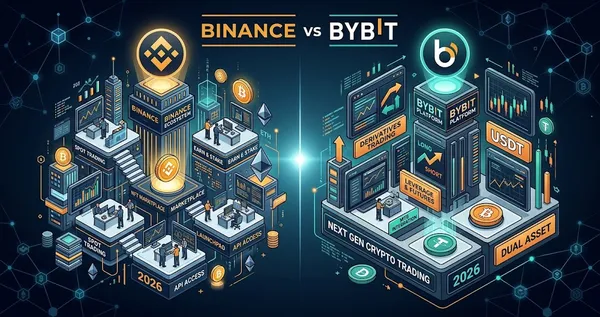
Crypto Narratives June 2026: Quantum Resistance, ETF Outflows, and DePIN Revenue
Quantum-resistant tokens hit $9B market cap, Bitcoin ETFs shed $3.4B in one week, and DePIN revenue tops $150M monthly. Key narrative shifts for June
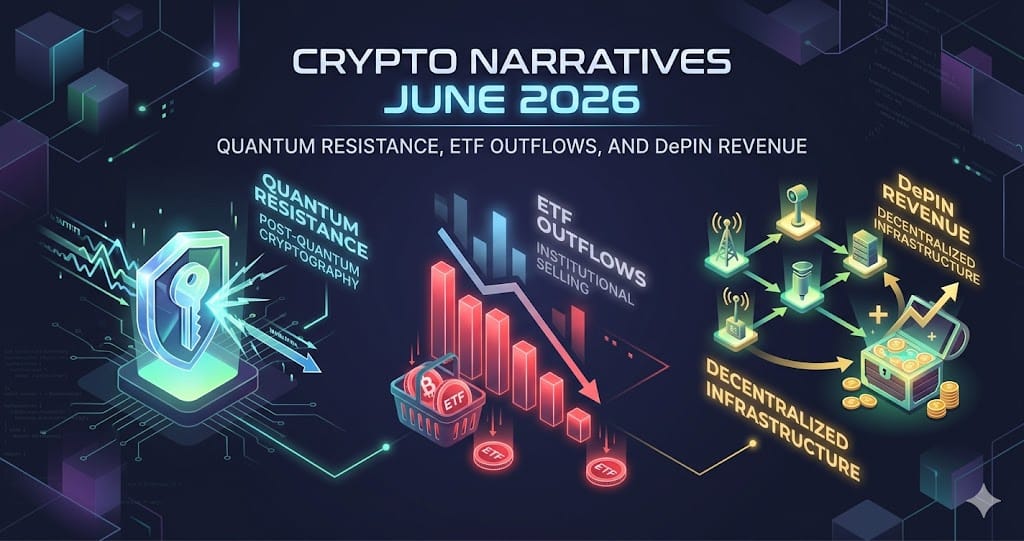
Three narratives dominated crypto markets the week of June 9, 2026: quantum-resistant tokens surged past a $9B collective market cap with QRL posting a 50% weekly gain, Bitcoin spot ETFs recorded their largest-ever single-week net outflow at $3.4B, and DePIN protocols crossed $150M in monthly on-chain revenue. These data points signal a rotation toward security infrastructure and provable utility rather than pure speculative exposure.
Bitcoin dominance held at 58%, well above the 55% threshold traders watch for a confirmed broad altcoin season. The altcoin season index registered between 46 and 49 depending on the data source, confirming a capital-rotation rather than broad-based rally environment. Sector leaders including RWA tokens, perp DEX platforms, and Proof-of-Humanity projects absorbed most of the rotated liquidity alongside the new quantum-resistance entrants.
Quantum Resistance Crosses $9 Billion as Google Research Sets a 2029 Deadline
Google quantum computing research updated its estimate for breaking Bitcoin's elliptic curve cryptography to roughly 500,000 qubits, a threshold significantly lower than prior models assumed. Analysts following the revision publicly set 2029 as a practical deadline for the crypto ecosystem to migrate to post-quantum cryptographic standards, turning what was a tail risk into a sector-level investment thesis.
The repricing was measurable and rapid. QRL, the longest-running quantum-resistant blockchain, gained 50% in the week and is up 980% year-to-date, moving from $0.23 to a seven-year high of $2.49. Cellframe added 40%, Abelian 25%, and both Qubic and QANX gained 10%. Total sector market cap broke $9B with daily trading volume exceeding $1.5B.
Other named beneficiaries cited by analysts include XDC, QTC, MCM, and CKB. On a one-month rolling basis the quantum-resistance sector outperformed Bitcoin by approximately 59.3 percentage points, the strongest single-sector relative performance tracked this week. This is the market pricing a credible engineering timeline, not a speculative narrative without a hard catalyst.
Bitcoin ETF Outflows Hit a Record $3.4 Billion in One Week and What the Data Actually Shows
U.S. spot Bitcoin ETFs recorded a net outflow of $3.4B in the week ending June 6, 2026, the largest single-week withdrawal since the products launched in January 2024. The streak began May 15 and ran 13 consecutive trading days, accumulating $4.33B in cumulative net outflows equivalent to approximately 59,400 BTC leaving the products.
On a 20-day rolling basis, Galaxy Digital calculated outflows of $5.42B or 73,080 BTC, the heaviest sustained withdrawal on record. The macro drivers included rising U.S. Treasury yields, stronger-than-expected nonfarm payrolls reducing Federal Reserve rate-cut expectations, and post-rally profit taking. Despite the withdrawals, total assets under management across U.S. spot Bitcoin ETFs remained above $120B.
Investing.com characterized the episode as cyclical rather than structural, noting that AUM resilience above $120B does not indicate a loss of institutional conviction. Traders watching for a recovery signal typically focus on two metrics: a return to positive weekly ETF net flow and Bitcoin dominance declining below 55% as rotational capital moves into alts.
Bittensor Subnet Tokens and Tempo Stablecoin Infrastructure Open New Investment Surfaces
Bittensor's dTAO upgrade restructured the network so that each AI subnet now has its own tradeable Alpha token and liquidity pool, with TAO emissions allocated by market pricing rather than validator governance. Combined subnet market cap crossed $1.5B, and the network reported over $43M in real AI usage revenue for Q1 2026, with documented interest from NVIDIA and Grayscale.
Individual subnet tokens showed extreme return dispersion. Chutes (SN64), which processed over 9 trillion tokens across 400,000 users, carried a $132M market cap with a 30-day gain of 54%. Targon (SN4) from Manifold Labs, an enterprise GPU inference hub, returned 166% over the same window. Lium (SN51) operates over 500 H100 cards and describes itself as one of the largest sovereign GPU clusters outside centralized cloud providers. TAO itself gained approximately 87 to 90% on the month.
On the stablecoin infrastructure side, Tempo, a Layer 1 backed by Stripe and Paradigm that launched its mainnet on March 18, 2026, reached several new integration milestones. Visa, Fifth Third Bank, Coastal Community Bank, Howard Hughes, and ARQ are live on the network. World Liberty Financial's USD1 stablecoin went native on Tempo on May 8, and on May 18 the chain integrated with Morpho, a DeFi lending protocol with $7.5B in assets.
DePIN Monthly Revenue Tops $150 Million as AI Agent Tokens Split Into Utility and Speculation
Decentralized physical infrastructure networks collectively crossed $150M in monthly on-chain revenue as of January 2026, with some protocols reporting year-over-year growth above 800%. Akash Network became the highest-revenue project in the category with an annualized run rate of $4.2M, Q1 compute consumption breaking $5M, usage growth of 428% year-over-year, utilization above 80%, and AKT up 72% year-to-date.
io.net reported over $20M in cumulative verifiable on-chain revenue, operates across more than 130 countries, and claims compute costs up to 70% below AWS and Google Cloud pricing. The platform denominates miner compensation in fiat terms, decoupling returns from token price movements. Both Akash and io.net derive most revenue from AI teams using decentralized GPU capacity as overflow compute.
Within AI agent tokens, Venice (VVV) on Base represents the utility track: a 30-day return of 152% and 7-day gain of 69% with a $322M market cap as of late March 2026, catalyzed by a permanent 25% annual emission reduction on February 10 and selection as a preferred model provider by OpenClaw on March 2. Siren (SIREN) on BNB Chain represents the speculative track: a single-day gain of 183% on March 22 briefly pushed its market cap to $1.88B, but the token has since retraced 67 to 88% from peak, with 88.5% of supply held by one wallet at a $0.045 cost basis.
What to Watch
- QRL and the quantum-resistance sector: total market cap above $9B, daily volume above $1.5B, one-month outperformance of approximately 59.3 percentage points versus Bitcoin, with XDC, QANX, QTC, MCM, and CKB as additional named beneficiaries
- Bitcoin spot ETF net flow data: the 13-day, $4.33B outflow streak through June 6 is the longest on record; watch for a return to positive weekly net flow and Bitcoin dominance declining below 55% as the two primary recovery confirmation signals
- Bittensor subnet tokens, specifically Chutes (SN64), Targon (SN4), and Lium (SN51): beneficiaries of the dTAO mechanism with over $43M in Q1 real AI revenue and documented NVIDIA and Grayscale interest, offering sub-TAO exposure to specific AI workload categories
- DePIN revenue protocols Akash Network and io.net: Akash at $4.2M ARR with 428% year-over-year usage growth and io.net past $20M in cumulative on-chain revenue, both tied to real AI compute demand rather than token emission subsidies
Ready to start trading?
Trade on Bitget Try CoinTech2uAffiliate links — we may earn a commission at no extra cost to you.
Frequently Asked Questions
Why did quantum-resistant tokens surge in June 2026?
Google updated its quantum computing research to estimate that breaking Bitcoin's elliptic curve cryptography might require approximately 500,000 qubits, a threshold lower than earlier projections. Analysts responded by setting 2029 as a practical deadline for crypto infrastructure to adopt post-quantum cryptographic standards. The repricing moved QRL up 50% in a single week and pushed the broader quantum-resistance sector above a $9B combined market cap with over $1.5B in daily trading volume.
Are Bitcoin ETF outflows a sign the bull market is ending?
The $3.4B single-week outflow and the 13-day, $4.33B streak through early June 2026 are records since U.S. spot Bitcoin ETFs launched in January 2024. However, total ETF assets under management remained above $120B, and Investing.com characterized the episode as cyclical rather than structural, driven by rising Treasury yields and post-rally profit-taking. Most analysts watching recovery signals focus on whether weekly ETF net flow turns positive and whether Bitcoin dominance drops below 55% to confirm rotational conditions.
What is the difference between Bittensor TAO and Bittensor subnet Alpha tokens?
TAO is Bittensor's base-layer token and gained roughly 87 to 90% in the month. The dTAO upgrade added a second investment surface: each AI subnet now has its own Alpha token with a dedicated liquidity pool, and market pricing determines how TAO emissions flow to each subnet rather than validator governance. Combined subnet market cap has reached $1.5B, and subnets like Chutes (SN64) and Targon (SN4) are separately tradeable, allowing investors to express a view on specific AI workloads instead of the network as a whole.