
Crypto Narratives in May 2026: AI Tokens Lead, ETF Flows Reverse
AI tokens like NEAR and Render surged 15% in May 2026 as BTC ETF flows turned negative again. Full breakdown of narratives, RWA, DePIN, and
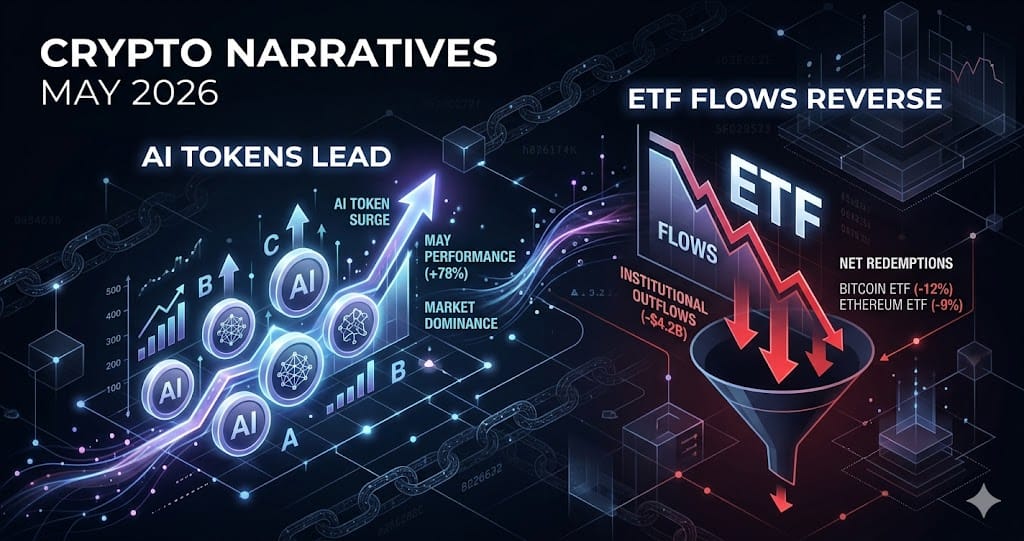
The clearest signal in crypto markets as of May 26, 2026 is a divergence: AI-linked tokens recorded single-day gains between 10% and 17% while Bitcoin ETFs posted a seven-day net outflow of USD 1.42 billion, pushing BTC spot to USD 76,901.95. The data points in opposite directions depending on which segment you watch.
This week's rotation into AI names — NEAR at plus 15.03%, Worldcoin at plus 17.14%, Render at plus 14.77%, and Fetch.ai/ASI at plus 10.74% — came with verifiable volume figures rather than narrative alone. Pump.fun set a single-day DEX volume record of USD 2 billion on Solana the same week, and tokenized gold quietly crossed USD 5 billion in combined market cap. Understanding which of these moves has capital behind it matters more than tracking price alone.
AI Tokens: The Only Sector With Three-Way Confirmation This Week
NEAR, Render, Worldcoin, and Fetch.ai posted coordinated gains on May 26, 2026, with combined spot volume across the four names exceeding USD 3.8 billion in a single session. This is not a one-token story: the breadth across inference infrastructure (Render, Fetch.ai), identity (Worldcoin), and smart-contract execution (NEAR) suggests a sector rotation rather than a single catalyst. Render migrated to Solana earlier in 2026 and now hosts over 600 open-source AI models through its Compute Subnet.
A smaller but notable sub-narrative emerged alongside the large-caps: AI memecoin tokens such as ZEREBRO gained renewed attention, sitting at the intersection of AI infrastructure hype and the Solana memecoin mania that pushed Pump.fun to its all-time high daily volume. This sub-category was not tracked in most prior market frameworks and may represent a retail entry point into the AI narrative rather than a fundamental play.
BTC ETF Outflows: Three Reversals and What They Mean
Since early May 2026, Bitcoin spot ETFs have reversed direction three times. The nine-day inflow streak in early May accumulated USD 2.7 billion. That was followed by a USD 1 billion outflow week around May 11-15, a brief stabilization, and then a fresh seven-day net outflow of USD 1.42 billion through May 26. On the final day of that window, iShares Bitcoin Trust (IBIT) alone shed USD 68.9 million and Fidelity's FBTC shed USD 36.3 million.
BTC spot at USD 76,901.95 and ETH at USD 2,101.10 reflect a market where institutional demand is oscillating rather than trending. The more useful analytical frame is not whether ETFs are net positive or negative in a given week, but whether the inflow and outflow cycles are shortening — which they appear to be. A memecoin ETF angle is also emerging for the first time, with Dogecoin ETF filings acting as a price catalyst alongside whale accumulation in DOGE, suggesting the ETF structure may extend beyond Bitcoin and Ethereum.
Tokenized Gold, DePIN, and the RWA Broadening
Real-world asset tokenization was previously dominated by US Treasuries, which held a 67.2% share of the RWA category. In Q1 2026, tokenized gold and silver have shifted that balance: spot trading volume for tokenized precious metals reached USD 90.7 billion in the quarter alone, already exceeding the USD 84.6 billion recorded across all of 2025. PAXG grew its market share from 36.8% to 41.8% and holds a market cap of USD 2.32 billion, while Tether Gold (XAUT) leads at USD 2.52 billion. Commodities now account for 28.7% of the RWA category. Wintermute's CEO has projected tokenized gold could reach USD 15 billion by end of 2026.
DePIN (Decentralized Physical Infrastructure Networks) is tracking a separate momentum cycle, with the sector's aggregate market cap at USD 9.423 billion and a recent gain of 24.95%. io.net aggregates over 100,000 idle GPUs at pricing reportedly 50-70% below AWS rates. Akash Network launched Starcluster to integrate centralized and decentralized compute, and its tokenomics now burn USD 0.85 of AKT for every USD 1 of compute spend. The GPU-sharing token category rose roughly 20% in early 2026 as demand for AI inference infrastructure increased.
Stablecoins, Telegram DeFi, and BTCfi Concentration
The total stablecoin market reached USD 323 billion in May 2026 according to DefiLlama, with USDC circulation growing 28% year-over-year to USD 77 billion. Ethena's USDe now holds approximately 5% of the stablecoin market, offering 10-15% APY under normal conditions and exceeding 20% during high-funding-rate periods. The Plasma mainnet launched in beta in late September 2025 with Tether announcing native (non-bridged) USDT issuance on the chain; it uses USDT itself as the gas token with no separate L1 token required.
Telegram's built-in wallet has introduced third-party DeFi yield strategies offering up to 18% blended APY on USDT, powered by Re7 DeFi. This positions Telegram Wallet as a DeFi gateway for its 900 million-plus user base — a different adoption path from exchange-native or standalone wallet models. Meanwhile, BTCfi has contracted sharply: the total BTC locked across Bitcoin L2s and native DeFi protocols stands at 91,332 BTC (0.46% of supply), down 74% from the early-2026 peak. Babylon holds USD 4.95 billion in TVL after a USD 15 million injection from a16z in January 2026, while Lombard sits near USD 1 billion, making them the two dominant platforms in the segment.
What to Watch
- NEAR, Render, Worldcoin, and Fetch.ai (ASI): AI-linked large-caps with verified single-day volume above USD 3.8 billion combined on May 26, 2026, and confirmed sector rotation backing
- Pump.fun PUMP token and Solana memecoin ecosystem: Pump.fun set a single-day DEX record of USD 2 billion and has generated over USD 800 million in cumulative revenue across 11.9 million launched tokens
- Tokenized gold via PAXG and XAUT: combined market cap approaching USD 5 billion with a projected USD 15 billion target by year-end 2026, and Hyperliquid's silver perpetual ranking third by daily volume behind only BTC and ETH
- Hyperliquid HIP-3 equity perpetuals: open interest crossed USD 1.43 billion after launch, with 23 of the top 30 trading pairs being tokenized stocks or commodities — a live stress test for on-chain synthetic equity infrastructure
Ready to start trading?
Trade on Bitget Try CoinTech2uAffiliate links — we may earn a commission at no extra cost to you.
Frequently Asked Questions
Why did BTC ETF flows turn negative again in late May 2026?
BTC spot ETFs recorded a seven-day net outflow of USD 1.42 billion through May 26, 2026, following a nine-day inflow streak earlier in the month that had accumulated USD 2.7 billion. The reversal appears tied to BTC spot price weakness near USD 76,901.95 and broader macro factors including dollar strength and rising oil prices, which also pressured privacy coins like Zcash (down 5.63%) and Monero (down 1.57%) in the same week. This is the third directional reversal in a six-week window, suggesting institutional positioning is volatile rather than trending.
What is driving the AI token rally in May 2026?
NEAR, Worldcoin, Render, and Fetch.ai posted gains of 10-17% on May 26, 2026, with total single-session spot volume above USD 3.8 billion across the group. The move reflects a rotation into AI infrastructure plays — Render hosts 600-plus open-source models after migrating to Solana, io.net aggregates 100,000-plus GPUs at below-cloud pricing, and Fetch.ai is expanding its autonomous agent execution layer. Unlike some prior altcoin runs, this one comes with cross-protocol volume data rather than only narrative momentum.
What is a Stablechain and why does Plasma matter?
A Stablechain is a Layer 1 blockchain designed specifically to run stablecoin transactions, using the stablecoin itself (rather than a native governance token) as the gas currency. Plasma launched its mainnet beta in late September 2025 with Tether committing to issue USDT natively on the chain — meaning tokens are minted there rather than bridged from Ethereum. The chain uses Bitcoin as its settlement checkpoint. This architecture removes the friction of holding a separate gas token and is designed for high-volume stablecoin payments rather than general smart contract use.