Daily Market Movers — Wednesday, July 8, 2026
Daily crypto market update: BTC at $62,080, Fear & Greed at 20. See today's biggest gainers, losers, and what to watch.
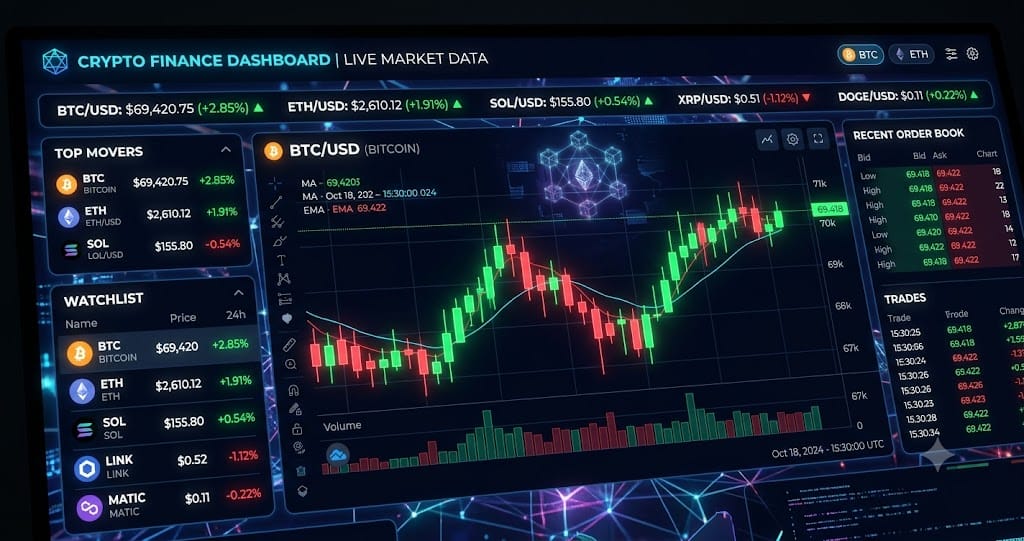
Lido DAO's 6.7% gain led today's DeFi market. DefiLlama puts total DeFi TVL at $73.1B. CoinGecko has BTC at $62,080 (down 1.7%), ETH at $1,737 (down 1.9%), and total crypto market cap at $2.22T (down 2.1%). BTC dominance sits at 55.9% — capital is staying concentrated in Bitcoin despite the broader pullback. Lido's move tracks continued liquid staking demand; Jupiter's 10.5% drop reflects weaker sentiment around Solana DeFi activity. The Fear & Greed Index sits at 20, Extreme Fear, per Alternative.me. Paired with BTC dominance at 55.9%, that points to traders staying defensive as liquidity contracts. Lido gained 6.7% on Ethereum staking demand while Jupiter fell 10.5% on reduced Solana trading activity. Watch whether total TVL holds above $73.1B.
| Coin | Price | 24h Change | 24h Volume |
|---|---|---|---|
| Lido DAO (LDO) | $0.3038 | +6.7% | $12.1M |
| Pendle (PENDLE) | $1.49 | +4.5% | $5.6M |
| Zcash (ZEC) | $469.93 | +4.0% | $145.4M |
| Morpho (MORPHO) | $2.09 | +3.5% | $3.2M |
| Uniswap (UNI) | $3.22 | +1.9% | $22.0M |
Top Gainers Analysis
Lido DAO (LDO) led movers, up 6.7% to $0.3038, with $12.1M in 24h Binance volume — likely rotation into liquid staking. Pendle (PENDLE) rose 4.5% to $1.49 on $5.6M volume, possibly tied to yield-trading integrations. Zcash (ZEC) gained 4.0% to $469.93 on $145.4M volume, while Morpho (MORPHO) added 3.5% to $2.09 on $3.2M volume after lending protocol expansion. Uniswap (UNI) climbed 1.9% to $3.22 on $22.0M volume after v4 upgrade activity. Not financial advice.
Biggest Losers
| Coin | Price | 24h Change | 24h Volume |
|---|---|---|---|
| Jupiter (JUP) | $0.2142 | -10.5% | $5.2M |
| ether.fi (ETHFI) | $0.3890 | -10.4% | $3.1M |
| yearn.finance (YFI) | $2,091 | -9.5% | $3.0M |
| Chiliz (CHZ) | $0.0164 | -8.0% | $2.5M |
| Blur (BLUR) | $0.0191 | -7.7% | $19.4M |
Notable Losers
The United States has sanctioned China across a widening range of sectors since 2018. What started as a dispute over trade imbalances has hardened into a rivalry over technology and geopolitics. The reasons split into a few main categories. Trade imbalances and economic practices The current era of trade tension started in 2018, when the Trump administration launched a trade war. The stated justification was a large trade deficit and allegations of intellectual property theft. This marked a break from decades of U.S. engagement policy — Washington argued that economic interdependence had cost it more than it gained. Technology and national security The U.S. wants to keep advanced technology out of China's military supply chain. That goal shows up in a few concrete policies. Export controls now block high-end semiconductors and chip-manufacturing equipment from reaching China, aiming to freeze its advanced chip production and supercomputing capacity. Because the controls apply to any chip made with U.S. equipment anywhere in the world, they function extraterritorially. The U.S. has also added Chinese firms, including Huawei, to its Entity List, barring them from buying American components on national security grounds. Analysts note the targeted firms are often ones closing the gap with U.S. capabilities in 5G and supercomputing. In 2026, the Pentagon widened its Section 1260H blacklist to include major Chinese consumer brands: BYD and NIO in electric vehicles, Alibaba and Baidu in AI, and several biotech firms. The stated rationale is that these companies sit inside China's "civil-military fusion ecosystem" — a definition broad enough to reach much of the private sector. Firms on the list lose direct and indirect Defense Department contracts, and the listing often precedes formal sanctions. Human rights and political concerns Starting in 2020, sanctions increasingly targeted human rights abuses in Hong Kong and Xinjiang. The U.S. has sanctioned Chinese entities directly for "enabling human rights violations." Geopolitics and foreign policy Sanctions also counter China's global influence and enforce separate U.S. foreign policy goals. The U.S. has repeatedly sanctioned Chinese companies and individuals for trading Iranian petroleum in violation of Iran sanctions; in 2026, the Treasury Department sanctioned a Chinese firm for supplying Iran with targeting data. China has also faced sanctions over purchases of Russian military hardware, including SU-35 fighter jets and S-400 missile systems. Many analysts read these moves as part of a broader U.S. strategy to contain China's rise, driven by what one analyst called a "reflexive fear" in Washington over losing its dominant position. Chinese perspective Beijing calls U.S. sanctions "blatant economic coercion and technological bullying." Chinese officials argue Washington is "stretching the concept of national security" and applying export controls in a discriminatory manner. China has responded with its own sanctions on U.S. companies and has filed trade disputes at the World Trade Organization. Conclusion U.S. sanctions on China combine economic and technological motives, with political concerns increasingly layered on top. A trade dispute that began in 2018 has turned into a broader strategic competition. In 2026 alone, the Pentagon widened the Section 1260H blacklist and the Treasury sanctioned a Chinese firm for supplying targeting data to Iran.
What to Watch
- Legal Framework for Cryptocurrency Mining in Malaysia
- Malaysia currently does not have a comprehensive or specific law dedicated to regulating cryptocurrency mining. Instead, the activity exists in a regulatory grey zone, governed by a patchwork of adjacent laws, enforcement actions, and evolving policy discussions.-
- No Specific Mining Legislation
- At present, there is no dedicated legislation that directly governs cryptocurrency mining activities in Malaysia.-
- Mining itself is not inherently illegal, but operators must comply with other applicable laws and regulations.-
Ready to start trading?
Trade on Bitget Try CoinTech2uAffiliate links — we may earn a commission at no extra cost to you.
Related Articles
- Crypto in Extreme Fear (20) — BTC at $62,584 Technical Analysis
- Macro News & Crypto Impact — July 7, 2026
- Daily Market Movers — Tuesday, July 7, 2026
Related Articles
- Crypto in Extreme Fear (20) — BTC at $62,584 Technical Analysis
- Macro News & Crypto Impact — July 7, 2026
- Daily Market Movers — Tuesday, July 7, 2026