Pump.fun (PUMP) Spotlight — August 4, 2026
In-depth Pump.fun spotlight: $0.002267 price, +7.2% 24h change, technical analysis, pros/cons, and market outlook.
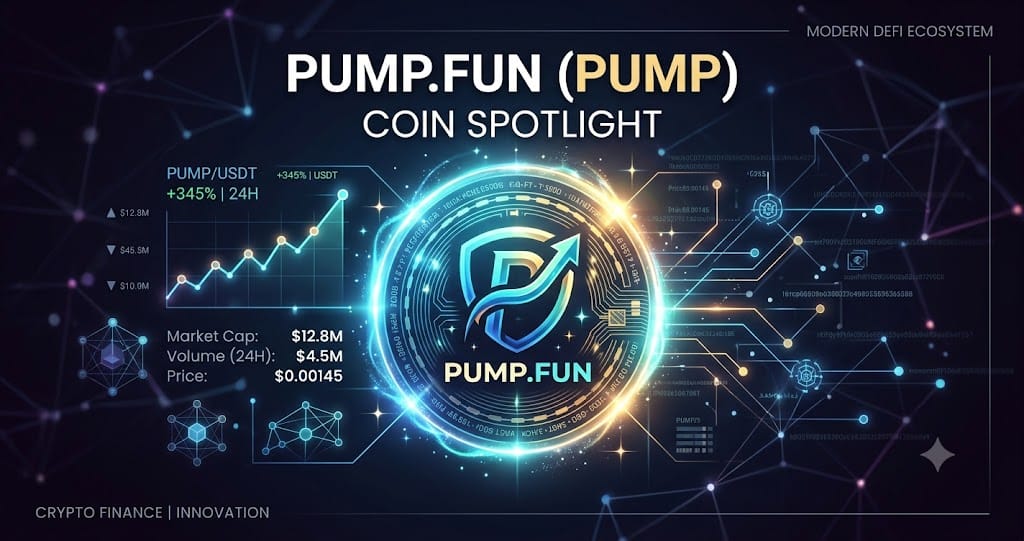
Pump.fun (PUMP) trades at $0.002267 with a $896.2M market cap, according to CoinMarketCap data as of August 4, 2026. The token ranks #70 and has gained 42.2% over the past 30 days, while remaining 74.3% below its $0.008819 all-time high, which indicates a recovery phase rather than a full return to previous valuation levels. The next key metric is whether PUMP can sustain a market cap above $896.2M while maintaining positive 7-day momentum.
PUMP is linked to Pump.fun’s meme token creation platform and fits categories including Decentralized Exchange (DEX), Exchange-based Tokens, SocialFi, DeFi, and Automated Market Maker systems. Market data as of August 4, 2026 shows PUMP is up 7.2% in 24 hours and 12.1% over 7 days, suggesting renewed trading interest, but the token remains below its peak price by 74.3%. A move above the previous $0.008819 ATH would require a 289% increase from the current $0.002267 price, making the $0.008819 level the specific resistance metric to monitor.
What Is Pump.fun?
Pump.fun solves the problem of making token creation accessible without requiring coding skills or large amounts of startup capital. According to CoinMarketCap data as of August 2026, Pump.fun’s PUMP token is tracked as the platform’s native asset, while the platform itself runs on Solana and lets users create and trade meme coins through a simplified launch process. A user can choose a name, ticker, and image, then deploy a token through Pump.fun’s automated system instead of building smart contracts manually. The key metric to monitor is Pump.fun’s daily token creation count and trading volume, which shows whether user activity remains active.
Pump.fun works by using a bonding curve model, where newly created tokens start with limited liquidity and prices change automatically as more users buy or sell. According to Solana ecosystem data, Pump.fun became one of the highest-volume token launch platforms during 2024, with millions of tokens created since launch, but many tokens failed to gain lasting demand after initial speculation. The bull case is that the platform lowers barriers for creators and traders, while the bear case is that high token creation volume can dilute attention and increase low-quality launches. The specific metric to watch is monthly active creators and the percentage of launched tokens that reach sustained trading volume after 30 days.
Key Features
- Blockchain Technology: Built on a robust blockchain infrastructure designed for security and scalability
- Active Development: Regular updates and improvements from a dedicated development team
- Community: Growing community of users, developers, and supporters worldwide
- Market Presence: Ranked #70 with $896.2M market capitalization
- Trading Volume: $96.6M in 24-hour trading volume indicates healthy market interest
Use Cases
- Decentralized Exchange (DEX) applications and use cases
- Exchange-based Tokens applications and use cases
- SocialFi applications and use cases
- Decentralized Finance (DeFi) applications and use cases
- Automated Market Maker (AMM) applications and use cases
Pros & Cons
✅ Pros
- Strong market position at rank #70 with $896.2M market cap
- Active trading volume of $96.6M suggests healthy liquidity
- Positioned in growing sectors: Decentralized Exchange (DEX), Exchange-based Tokens, SocialFi, Decentralized Finance (DeFi), Automated Market Maker (AMM)
- Listed on major exchanges ensuring accessibility for traders
❌ Cons
- Currently -74.3% from all-time high of $0.008819
- Cryptocurrency markets are highly volatile and unpredictable
- Regulatory uncertainty could impact price and adoption
- Competition from other projects in the same space
Technical Analysis
Our TA engine shows a NEUTRAL signal with a score of 18/100 (CONFLICTED).
- RSI(14) — Approaching overbought (67.9) (bearish)
- MACD(12,26,9) — Bullish momentum (hist: 0.00) (bullish)
- EMA Trend — Strong uptrend (Price > EMA20 > EMA50) | Above 200d EMA (bullish)
- Bollinger Bands — Above upper band (%B: 101%) (bearish)
- Volume — Normal volume (1.4x avg) (neutral)
Price Outlook
Comprehensive Report on US and EU Sanctions Imposed on China (2025–2026)
This report provides a detailed overview of sanctions and restrictive measures imposed by the United States and the European Union on China during 2025 and 2026, based on available public information through August 4, 2026.
I. UNITED STATES SANCTIONS AND RESTRICTIVE MEASURES A. Sanctions Lists and Entity Designations 1. Entity List
The U.S. Department of Commerce's Bureau of Industry and Security (BIS) continued to expand the Entity List throughout 2025–2026. By the end of 2025, the Entity List had expanded to include more than 1,000 Chinese individuals and entities, with the addition of more than 120 new entries- 22 . Chinese companies continued to be designated due to alleged support of sanctions and export-control evasion involving Russia, Iran, and North Korea- 22 .
In September 2025, BIS expanded the scope of the Entity List, extending restrictions to any entity owned 50% or more by one or more listed entities—a rule that was subsequently suspended for one year starting November 2025- 22 - . The suspension is set to end on November 9, 2026- .
On November 13, 2025, BIS added 29 total entries to the Entity List, including 26 entities and three addresses, with 19 entries located in China- . In September 2025, BIS added 32 new entities across multiple countries including China- .
2. Specially Designated Nationals (SDN) List
Throughout 2025, more than 230 Chinese individuals and organizations were designated under OFAC's Russia-, Iran-, and North Korea-related sanctions programs- - 22 . The primary risk for Chinese entities being placed on the SDN List involved alleged violations of U.S. sanctions against Iran- 2 . Notably, U.S. sanctions against Chinese entities related to Russia were concentrated in the final two months of the Biden administration; after Trump began his second term, no further Russian-related SDN designations of Chinese entities occurred- 2 .
3. Chinese Military Companies (CMC / 1260H List)
The U.S. Department of Defense continued to expand the definition of Chinese military companies, with a notable increase in listings- 2 . The list covers ten major areas, including semiconductors and integrated circuits, artificial intelligence and cloud computing, communications and information infrastructure, aerospace and defense equipment, new energy and power equipment, smart manufacturing, biomedicine, security and surveillance, emerging strategic technologies, and transportation logistics- 2 .
4. Uyghur Forced Labor Prevention Act (UFLPA) Entity List
On July 31, 2026, the U.S. Department of Homeland Security announced the addition of 43 Chinese companies to the Entity List under the Uyghur Forced Labor Prevention Act- - 5 - . This marked the single largest expansion in the law's history, bringing the total number of listed entities from 144 to 187, a 30% increase- 5 . The newly listed companies span industries including metals, electronics, apparel, cotton, food processing, aluminum, copper, and tomatoes- 5 - . Specific companies identified include capacitor manufacturer Hunan Aihua Group, snack food producer ChaCha Food, and cotton supplier Henan Tongzhou Cotton Industry Co.- 5 . The additions took effect on August 4, 2026- 5 .
B. Tariff Measures 1. IEEPA Tariffs (February 2025)
In February 2025, the U.S. imposed a 20% "fentanyl tariff" on all imports from China under the International Emergency Economic Powers Act (IEEPA)- . Under a de-escalation agreement, this tariff was reduced to 10%, effective November 10, 2025- - 1 .
2. IEEPA Reciprocal Tariffs (April 2025)
A 34% IEEPA reciprocal tariff on imports from China was initially announced alongside other global reciprocal tariffs in Executive Order 14257 of April 2, 2025- 1 . This was suspended in May 2025, with only the 10% IEEPA baseline tariff remaining. The suspension was extended until November 10, 2026, maintaining the 10% baseline tariff- 1 .
3. Section 301 Tariffs
The U.S. maintained existing Section 301 tariffs, with 178 active product exclusions extended until November 10, 2026- 1 . Section 301 vessel fees and cargo handling equipment tariffs were suspended for one year, effective November 10, 2025 through November 9, 2026- 1 .
4. Proposed Additional Tariffs
A proposed additional 100% U.S. tariff on mainland Chinese goods was rescinded- .
C. Export Controls 1. Information and Communications Technology and Services (ICTS) Rule
The ICTS rule under Executive Order 13873 took effect in February 2025, establishing a framework to review ICTS transactions involving critical infrastructure, sensitive personal data, and critical or emerging technologies- 22 .
2. Vehicle Connectivity Restrictions
In January 2025, BIS issued a final rule restricting the sale or import of certain Vehicle Connectivity System (VCS) and Automated Driving System (ADS) software supplied by persons with a sufficient nexus to China- 22 .
3. Semiconductor Controls
In October 2022 (with ongoing effects through 2025–2026), the U.S. published sweeping export controls including a measure to cut China off from certain semiconductor chips made anywhere in the world with U.S. equipment- . Export controls and sanctions policy in 2025 focused on AI, advanced computing, semiconductor technologies, and heightened restrictions on China- .
4. Affiliates Rule
BIS announced an "Affiliates Rule" in September 2025 expanding controls to 50%-owned affiliates of certain listed entities- 22 . This was subsequently suspended for one year starting November 2025- 22 . The license requirements and related provisions of the Affiliates Rule are scheduled to resume on November 10, 2026- 1 .
D. Outbound Investment Restrictions
In January 2025, the U.S. Treasury's Outbound Investment Security Program (OISP) took effect, establishing a standing screening regime for U.S. investments in Chinese-owned companies in three sectors: semiconductors and microelectronics, quantum information technologies, and artificial intelligence- 22 . In December 2025, the Comprehensive Outbound Investment National Security (COINS) Act of 2025 was signed into law, further expanding the scope of OISP- 22 .
E. Import Bans
On July 28, 2026, the U.S. government announced a ban on imports of new Chinese humanoid robots, quadruped robots, and grid-connected power inverters, citing national security risks- .
On August 3, 2026, the U.S. sanctioned a group of mainland Chinese and Hong Kong shipping companies accused of operating vessels that transported Iranian oil to China- .
II. EUROPEAN UNION SANCTIONS AND RESTRICTIVE MEASURES A. Russia-Related Sanctions Packages
The EU has repeatedly included Chinese entities in its sanctions packages against Russia throughout 2025–2026.
1. 18th Sanctions Package (2025)
The 18th EU sanctions package affected Chinese entities- .
2. 19th Sanctions Package (October 2025)
On October 23, 2025, the European Commission adopted the 19th sanctions package against Russia and Belarus- . This package included Chinese enterprises on the sanctions list, prompting China's Ministry of Commerce to urge the EU to immediately cease listing Chinese companies- .
3. 20th Sanctions Package (February 2026)
The EU adopted the 20th package of sanctions against Russia on February 6, 2026- . This package included measures affecting Chinese entities- .
4. 21st Sanctions Package (July 2026)
On July 23, 2026, the EU adopted its 21st package of sanctions against Russia- . The package blacklisted 15 companies from China and 11 companies from five other countries, including Turkey, Kyrgyzstan, Kazakhstan, the United Arab Emirates, and India- 17 . The EU accused them of supporting the Russian economy and defense industry, or assisting Moscow to bypass European sanctions- 17 . The package also barred the export of dual-use goods and technologies to 51 entities- . A total of 3,100 entities were then under EU anti-Russian sanctions- 17 . Additionally, the EU listed two Chinese banks in its July 2026 package- .
B. Anti-Dumping and Trade Defense Measures 1. Tire Anti-Dumping Duties (July 2026)
On July 7, 2026, the European Commission imposed definitive anti-dumping duties of up to 45% on imports of passenger-car and light-lorry tires originating from China- - 11 .
2. Steel Safeguard System (July 2026)
On July 1, 2026, the new European "safeguard" system for steel imports came into effect, introducing lower import quotas for duty-free imports and a 50% tariff on imports exceeding these quotas, significantly impacting Chinese steel mills and products- 11 .
C. Digital Services Penalties
On July 20, 2026, the European Commission fined Chinese online retailer AliExpress €550 million for allegedly failing to curb the sale of counterfeit goods—the heftiest penalty issued to date under the Digital Services Act- 11 .
D. Accusations of Sanctions Evasion
In May 2025, a German report cited by the EU claimed that China, including Hong Kong, was responsible for approximately 80% of the circumventions of sanctions against Russia- .
III. CHINESE COUNTERMEASURES
In response to U.S. and EU sanctions, China has taken a series of countermeasures:
A. Rare Earth Export Controls (April–October 2025)
On April 4, 2025, China introduced export controls on seven heavy rare earth elements (REEs) with licensing requirements in response to U.S. tariffs- . A second wave of export controls was introduced in October 2025- . Both waves were suspended on November 7, 2025, until November 10, 2026, following U.S.-China negotiations- .
B. Export Controls on EU Entities (2025–2026)
In April 2025, after the EU sanctioned 27 Chinese companies, China retaliated within 24 hours by blacklisting seven EU defense contractors- .
On July 24, 2026, in response to the EU's 21st sanctions package, China added 14 EU entities to its export control list, banning the export of dual-use items to these organizations- - . Chinese companies are prohibited from exporting dual-use items to these 14 European organizations- .
C. Sanctions on U.S. Military-Related Entities (December 2025)
On December 26, 2025, China announced countermeasures against U.S. military-related companies and senior executives in response to U.S. arms sales to Taiwan- .
D. Blocking Regulations (May 2026)
In May 2026, Chinese authorities took two landmark measures signaling a shift in China's anti-foreign sanctions regime from a framework focused on legislative development to active enforcement and implementation- . China's Ministry of Commerce issued its first formal prohibition order under the 2021 blocking rules, barring recognition, enforcement, or compliance with certain U.S. measures- .
E. New Countermeasures Regulations (April 2026)
On April 13, 2026, China's State Council promulgated the Regulations on Countering Improper Extraterritorial Application of Foreign Legislation- , expanding China's retaliatory toolkit against foreign sanctions, export controls, forced-labor rules, and other extraterritorial measures- .
F. Suspension of Retaliatory Tariffs (November 2025)
As part of the U.S.-China de-escalation agreement, China suspended all retaliatory tariffs announced since March 4, 2025, including tariffs on U.S. agricultural products- .
IV. SUMMARY STATISTICS Category United States European Union Entities/Individuals Sanctioned 1,000+ on Entity List; 230+ on SDN List (2025)- 22 - 15+ Chinese firms in 21st sanctions package alone- 17
Major List Expansions 43 companies added to UFLPA List (July 2026)- 5 Multiple packages (18th–21st)-
Tariffs 10% IEEPA baseline; Section 301 tariffs- 1 Up to 45% anti-dumping on tires- 11
Export Controls Semiconductor, AI, quantum, ICTS, vehicle connectivity- 22 Dual-use goods restrictions-
Investment Restrictions OISP + COINS Act- 22 — V. KEY TRENDS AND OBSERVATIONS
Russia-related sanctions have been the primary driver for both U.S. and EU designations of Chinese entities, with the EU's 21st package (July 2026) representing the most recent major escalation- 17 .
The UFLPA emerged as a significant tool for U.S. sanctions in 2026, with the July 2026 expansion being the largest single addition since the law's enactment- .
Tariff de-escalation occurred through U.S.-China negotiations in late 2025, with multiple tariffs suspended until November 2026- 1 .
China has actively retaliated through rare earth export controls, blocking regulations, and targeted export controls on EU and U.S. entities- .
Sectoral focus has shifted toward semiconductors, AI, quantum technologies, advanced computing, and critical minerals- - 2 .
The EU has pursued a dual strategy of dialogue and pressure, establishing a China-EU trade and investment consultation mechanism while simultaneously imposing restrictive measures- 11 .
Pump.fun (PUMP) Resources
Frequently Asked Questions
What is Pump.fun (PUMP)?
Pump.fun is a cryptocurrency project ranked #70 by market cap. It operates within the broader blockchain ecosystem.
Is PUMP a good investment?
Like all cryptocurrencies, PUMP carries significant risk. It has a market cap of $896.2M and is -74.3% from its ATH. Always do thorough research before investing.
What is the current price of PUMP?
As of this writing, PUMP is trading at $0.002267 with a 24-hour change of +7.2%.
Where can I buy PUMP?
PUMP is available on major exchanges including Binance, Coinbase, and Kraken. Always use reputable exchanges and enable 2FA for security.
Ready to start trading?
Trade on Bitget Try CoinTech2uAffiliate links — we may earn a commission at no extra cost to you.
Our Verdict
Executive Summary The U.S. AI chip export ban presents an existential threat to DeepSeek's inference infrastructure—but paradoxically, it has also forged one of the world's most resourceful optimization cultures. DeepSeek has developed a remarkable portfolio of algorithmic and system-level innovations that extract maximum performance from constrained hardware. However, the ban's escalation—particularly restrictions on high-bandwidth memory (HBM), advanced foundry access, and the potential addition of DeepSeek to the U.S. Entity List—threatens to sever the hardware lifeline on which even the best optimizations depend. 1. DeepSeek's Core Inference Optimization Portfolio DeepSeek's optimization strategy operates across four layers: algorithmic efficiency, speculative decoding, memory management, and parallelization. 1.1 Multi-Head Latent Attention (MLA) DeepSeek-V3 introduced MLA, which compresses the key-value (KV) cache into a low-rank latent space, dramatically reducing memory bandwidth requirements during inference- . This is particularly valuable on bandwidth-limited hardware, as MLA provides more stable and efficient performance than standard multi-head attention (MHA) on constrained platforms- . By reducing the memory footprint of the KV cache, MLA enables larger batch sizes and longer context windows without proportional increases in hardware requirements. 1.2 DeepSeek Sparse Attention (DSA) DeepSeek-V3.2 introduced DSA, a fine-grained sparse attention mechanism that selects only the most important key-value entries for attention computation- 36 . A lightweight "indexer" first determines the importance of all KV entries for each query token, then a Top-K selector retains only the most relevant entries- 36 . This reduces computational overhead while maintaining model quality, particularly in long-sequence scenarios. Crucially, DSA operates in MQA (multi-query attention) mode for both prefill and decoding phases to maximize kernel efficiency- 36 . 1.3 Multi-Token Prediction (MTP) and Speculative Decoding MTP is a speculative decoding method that verifies and accepts multiple draft tokens in a single iteration, significantly improving inference performance in both low-latency and high-throughput scenarios- . On AMD Instinct GPUs, enabling MTP achieves 1.25× to 2.11× speedups on random datasets- . This technique uses a smaller "draft" model to propose token candidates that a larger model verifies in batches- . 1.4 DSpark Inference Framework DeepSeek's open-source DSpark framework accelerates LLM inference by 60% to 85% without requiring new hardware or larger clusters- 13 - 42 . DSpark uses a "scout" model that runs ahead to guess likely token paths, allowing the larger model to verify multiple steps at once- 42 . The framework is MIT-licensed and applicable beyond DeepSeek's own models, covering Alibaba's Qwen and Google's Gemma families- 42 . 1.5 Precision Quantization (FP8, NVFP4) DeepSeek inference stacks leverage FP8 attention and NVFP4 MoE (Mixture of Experts) to reduce memory bandwidth pressure and communication traffic- 28 . On NVIDIA GB200 NVL72 systems, these optimizations achieve 3.8× prefill and 4.8× decode throughput compared to H100 settings- 28 . FP8 attention roughly halves memory access pressure in decode, while NVFP4 GEMM halves communication traffic for token dispatching- 28 . 1.6 Prefill-Decode Disaggregation and Expert Parallelism Large-scale expert parallelism and prefill-decode disaggregation separate the compute-heavy prefill phase from the memory-bandwidth-bound decode phase- 28 . This allows each phase to be optimized independently and scaled separately. The SGLang team demonstrated that these techniques, combined with FP8/NVFP4 quantization, deliver substantial throughput gains on NVIDIA Blackwell systems- 28 . 1.7 Latent-Cache Offloading (ESS) The ESS architecture transfers latent-cache storage to the CPU side, alleviating memory-capacity constraints that typically limit decode performance- . It works seamlessly with MTP and two-batch overlap, making it a practical enhancement for large-scale industrial serving systems- . 2. How the U.S. Export Ban Threatens Each Optimization 2.1 The Ban's Current Scope The U.S. has banned shipments of NVIDIA A100, A800, H100, and H800-class parts to China- . H20—designed to fit under October 2023 thresholds—remains shippable subject to license- . More recently, the Commerce Department has escalated controls on high-bandwidth memory (HBM) and AI chips, directly impacting DeepSeek's hardware supply chain- . The U.S. has also weighed adding DeepSeek to the Entity List- and is considering sanctions over alleged model distillation and chip export violations- . 2.2 Vulnerability: HBM Dependency Most Critical Vulnerability. HBM is the fast memory that AI accelerators need to perform well- . DeepSeek's MLA, DSA, and KV cache optimizations are all designed to reduce memory bandwidth pressure—but they cannot eliminate the fundamental need for high-bandwidth memory. The HBM ban directly undermines the performance of every memory-sensitive optimization: MLA compresses KV caches but still requires fast memory to retrieve latent representations. DSA's Top-K selection depends on rapid access to KV entries. FP8 attention halves memory access pressure, but if HBM bandwidth itself is constrained, even half may be insufficient for competitive performance. NVFP4 MoE reduces memory traffic for GEMM operations, but expert routing and token dispatching still rely on HBM throughput. 2.3 Vulnerability: Foundry Access DeepSeek's reported chip design would be fabricated by SMIC (Semiconductor Manufacturing International Corporation) , China's largest foundry- 5 . However, SMIC has been cut off from the most advanced chipmaking tools by U.S. and Dutch export controls and is stuck on a 7-nanometer process several generations behind the leading edge- 5 . SMIC's AI-chip yields remain low, limiting how many usable parts any design could realistically produce- 5 . This means even if DeepSeek successfully designs a competitive inference chip, manufacturing constraints will limit volume, performance, and cost competitiveness. The gap between SMIC's 7nm and TSMC's 3nm/2nm nodes represents a fundamental performance ceiling that no amount of algorithmic optimization can fully overcome. 2.4 Vulnerability: NVIDIA Hardware Dependency DeepSeek trained its R1 reasoning model on NVIDIA's H800 chips—a China-market chip later banned in late 2023- - 1 . Since then, DeepSeek has been forced to rely on a mix of older NVIDIA hardware and Huawei's Ascend processors, which still lag NVIDIA's best by a wide margin- . The situation has become more acute with reports that DeepSeek may have acquired NVIDIA Blackwell chips despite the ban- . The U.S. believes DeepSeek removed technical indicators that might reveal its use of American AI chips, with Blackwells likely clustered at a data center in Inner Mongolia- . This suggests DeepSeek is already operating in a gray market—a precarious position that could trigger Entity List designation and further supply disruptions. 2.5 Vulnerability: Ecosystem Lock-in DeepSeek's optimizations are deeply intertwined with specific hardware ecosystems: FP8 and NVFP4 optimizations are NVIDIA-specific (though AMD has也开始 supporting similar techniques)- 28 . TensorRT LLM optimization guides are written for NVIDIA Blackwell- 36 . SGLang deployments target NVIDIA GB200/GB300 and AMD MI355X- . Porting these optimizations to domestic Chinese hardware (Huawei Ascend) is non-trivial. DeepSeek's R2 model was repeatedly delayed after training runs failed on Huawei hardware, forcing the lab back to NVIDIA- 5 . This highlights the fragility of software-hardware co-optimization when the hardware itself is uncertain. 3. Strategic Responses and Their Limitations 3.1 In-House Chip Development DeepSeek is reportedly developing its own AI inference chip to reduce dependence on NVIDIA and Huawei- - 1 . The chip is designed for inference—the stage where trained models generate responses—rather than training- 1 . This mirrors a broader trend: OpenAI and Broadcom recently announced "Jalapeño," a custom inference chip- 2 . Limitations: Chip design is a multi-year undertaking- 5 . SMIC's manufacturing constraints limit performance and yields- 5 . U.S. export controls on chipmaking equipment mean even a good design cannot be manufactured at world-class scale. DeepSeek's chip project is still in early stages; the company has been holding discussions with chip-design companies, foundries, and memory suppliers, but no working silicon exists- 1 . 3.2 Algorithmic Adaptation DeepSeek's optimization culture—forged by scarcity—is arguably its greatest asset. As one analyst noted: "When you cannot buy more compute, you have to go deeper into the system: inference scheduling, batching strategies, the arithmetic of how a model actually runs on hardware"- 13 . DSpark, MLA, and DSA are all products of this constraint-driven engineering- 13 . Limitations: Algorithmic gains are subject to diminishing returns. Each new optimization requires validation on available hardware—hardware that is itself becoming scarcer. The gap between optimized Chinese hardware and unoptimized Western hardware may still favor the West. 3.3 Domestic Hardware Adoption (Huawei Ascend) DeepSeek has increasingly adopted Huawei's Ascend processors, releasing its V4 model adapted for the platform- 1 . Huawei commands about half of China's estimated $50 billion AI chip market- - 1 . Limitations: Ascend still lags NVIDIA's best by a wide margin- . Training runs on Huawei hardware have failed, causing delays- 5 . Huawei itself is subject to U.S. sanctions, limiting its access to advanced tools and HBM. 3.4 Gray Market and Smuggling Reports suggest DeepSeek may have acquired Blackwell chips through unofficial channels- . Smugglers have attempted to circumvent U.S. export controls- . Limitations: This is legally precarious; Entity List designation would cut off all U.S.-origin technology. Gray market supply is unreliable and expensive. The U.S. is actively monitoring and closing third-country transit routes- . 4. Comprehensive Vulnerability Assessment Optimization Ban Impact Severity MLA (KV cache compression) HBM ban reduces benefit; still requires fast memory Critical DSA (sparse attention) Top-K selection depends on memory bandwidth Critical MTP / Speculative Decoding Compute-bound; less HBM-sensitive but requires reliable hardware High DSpark Framework Software-only; works on any hardware but performance scales with hardware Medium FP8 / NVFP4 Quantization NVIDIA-specific; porting to domestic hardware is difficult High Prefill-Decode Disaggregation Requires sufficient total compute; hardware scarcity limits scaling High ESS Offloading CPU-GPU bandwidth dependent; domestic interconnects may lag Medium Overall Assessment: DeepSeek's optimizations are remarkably effective at stretching available hardware, but they cannot replace it. The HBM ban and foundry restrictions create a hardware ceiling that no amount of software ingenuity can fully transcend. 5. The Broader Strategic Picture 5.1 Inference Demand Is Growing Faster Than Training Roughly 70% of AI compute demand is now expected to come from inference rather than training- 5 . This is where DeepSeek's purpose-built chip would earn its keep—and where Chinese silicon is already closest to competitive- 5 . However, the gap in manufacturing capability means DeepSeek's chip may be competitive in cost but not in peak performance. 5.2 U.S. Escalation Risks The U.S. has held off adding DeepSeek to the Entity List as the Trump administration tries to avoid escalating tensions- . However, sanctions and restrictions are under consideration- . If DeepSeek is blacklisted: All U.S.-origin technology (software, hardware, IP) would be cut off. NVIDIA, AMD, and other U.S. companies could no longer supply even older chips. DeepSeek's entire inference stack—much of which is optimized for NVIDIA—would need a complete reboot. 5.3 The Scarcity-Driven Engineering Advantage There is a counter-narrative: scarcity produces better engineering. Labs with abundant GPU access solve performance by scaling—more parameters, more chips, more data- 13 . DeepSeek, constrained from the start, has developed a different kind of engineering- 13 . DSpark may not be the best approach long-term, but "the fact that it came from the side with fewer resources is not a coincidence, and it is probably not the last time that will be true"- 13 . 6. Conclusion DeepSeek's inference infrastructure optimizations—MLA, DSA, MTP, DSpark, FP8/NVFP4 quantization, and disaggregated serving—represent a world-class engineering effort that extracts exceptional performance from constrained hardware. However, the U.S. export ban presents four irreducible vulnerabilities: HBM dependency — DeepSeek's memory-sensitive optimizations cannot function without fast memory. Foundry access — SMIC's 7nm process cannot match TSMC's leading-edge nodes. Ecosystem lock-in — DeepSeek's optimizations are deeply intertwined with NVIDIA hardware and software. Entity List risk — Blacklisting would sever all U.S.-origin technology access. DeepSeek's in-house chip development is a necessary long-term response, but it faces multi-year timelines and manufacturing constraints that may prove insurmountable within the current U.S. export control regime. The most likely outcome is a widening performance gap between DeepSeek's inference capabilities and those of Western AI labs—a gap that algorithmic brilliance can narrow but not close.
Related Articles
- Crypto Week June 2026: Proof-of-Humanity Leads as Tokenized Stocks Arrive
- BTC Crashes to USD 78,600: The May 2026 Liquidation Cascade Explained
- Crypto Market Sentiment Breakdown 2026: Fear, Funding Rates, and Macro Risk Signals Explained