Crypto Market Sentiment Breakdown 2026: Fear, Funding Rates, and Macro Risk Signals Explained
Crypto sentiment stays in extreme fear while BTC funding remains negative for 47+ days. Learn key signals, risks, and trading structure shifts in
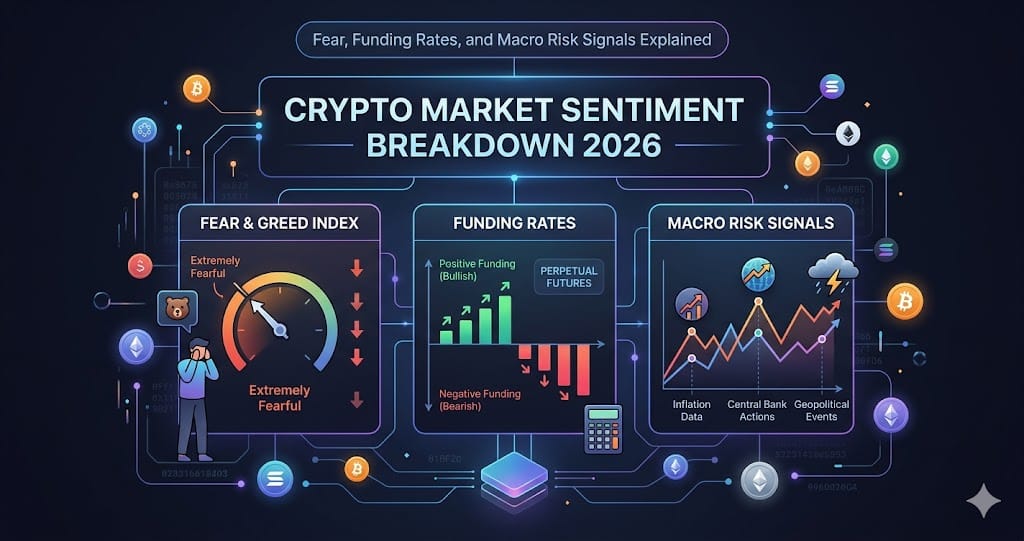
Crypto markets in 2026 are showing a rare split between sentiment, derivatives, and macro conditions. The Fear & Greed Index dropped to 26 after the April 29 FOMC event, while BTC funding rates stayed negative for over 47 days despite a +14% monthly price move. This divergence reflects a market driven more by institutional hedging than retail speculation. At the same time, $534.86M in liquidations and ETF outflows of $137.77M confirmed that leverage was reset but not fully cleared. The result is a market stuck between structural accumulation and macro-driven fear, where traditional indicators behave less predictably than in past cycles.
In This Guide
Step-by-Step Guide
Identify Sentiment Regime Before Trading
Crypto sentiment in 2026 is not cyclical in the same way as earlier markets. The Fear & Greed Index stayed between 26–29 for over 47 days, marking one of the longest extreme fear regimes since 2022. This type of prolonged fear does not always signal a bottom. Instead, it often reflects “fear adaptation,” where market participants stop reacting to negative news. Traders must distinguish between shock-driven fear and persistent structural fear before positioning.
Analyze Funding Rate Direction vs Price Action
BTC funding rates remained negative at around -0.005% to -0.011% while price increased from ~$60,000 to $77,000. This divergence shows that funding is no longer a clean sentiment indicator. In 2026, negative funding often reflects hedging flows such as cash-and-carry trades and ETF arbitrage. Traders should avoid assuming bearish bias solely from negative funding and instead evaluate open interest and flow composition.
Track Liquidation Events as Macro Triggers
The April 29 liquidation event totaled $534.86M, triggered by BTC dropping from $77,000 to $74,914 after the Fed maintained rates at 3.50%–3.75%. Unlike previous cycles, this liquidation was not caused by excessive retail leverage. It was a macro-driven reset tied to FOMC expectations and ETF flow adjustments. Traders should map liquidations to macro events rather than isolated leverage spikes.
Monitor Institutional Flow Divergence
Institutional accumulation, including multi-billion-dollar BTC purchases over recent weeks, continued even during periods of extreme fear. This creates a structural split between retail sentiment and institutional positioning. ETF flows and large balance sheet accumulation often lead price direction in this environment. When retail fear remains high but institutional inflows persist, the market tends to remain structurally bid despite short-term volatility.
Evaluate Macro Risk Layers (Iran, Inflation, Fed Policy)
Crypto sentiment in 2026 is heavily influenced by macro risk clusters, including geopolitical tension, persistent inflation, and delayed Fed policy shifts. Any deterioration in one of these factors can rapidly destabilize fragile sentiment. These macro layers matter more than internal crypto dynamics. Traders should treat them as volatility triggers that can override technical and derivatives signals within hours.
Tips and Best Practices
- Always test with small amounts before committing significant funds.
- Bookmark the official websites of tools mentioned in this guide to avoid phishing.
- Keep detailed records of your transactions for tax reporting purposes.
Ready to start trading?
Trade on Bitget Try CoinTech2uAffiliate links — we may earn a commission at no extra cost to you.
Frequently Asked Questions
Why is BTC funding negative while price is rising in 2026?
Because funding reflects hedging and arbitrage flows, not just directional trading. Institutional strategies like cash-and-carry and ETF hedging keep funding negative even in uptrends.
Does extreme fear always mean a market bottom?
No. In 2026, fear can persist for 40+ days without reversal. It often reflects adaptation rather than capitulation, especially when institutional buying continues.
What is the most important signal after FOMC events?
Funding rate normalization combined with ETF flow stability. These two together indicate whether the market is transitioning from hedge-driven to directional structure.
Related Articles
- 2026 Crypto Narratives Explained: BTCFi, DeFAI, AI Restaking, and Capital Rotation Trends
- Bear Case — April 29, 2026
- How Regulatory Changes Impact Crypto Trading Bots in 2026 (Compliance Guide)