Solana vs Avalanche — Detailed Comparison 2026
Solana vs Avalanche: detailed comparison of features, fees, and user experience. Find out which is right for you.
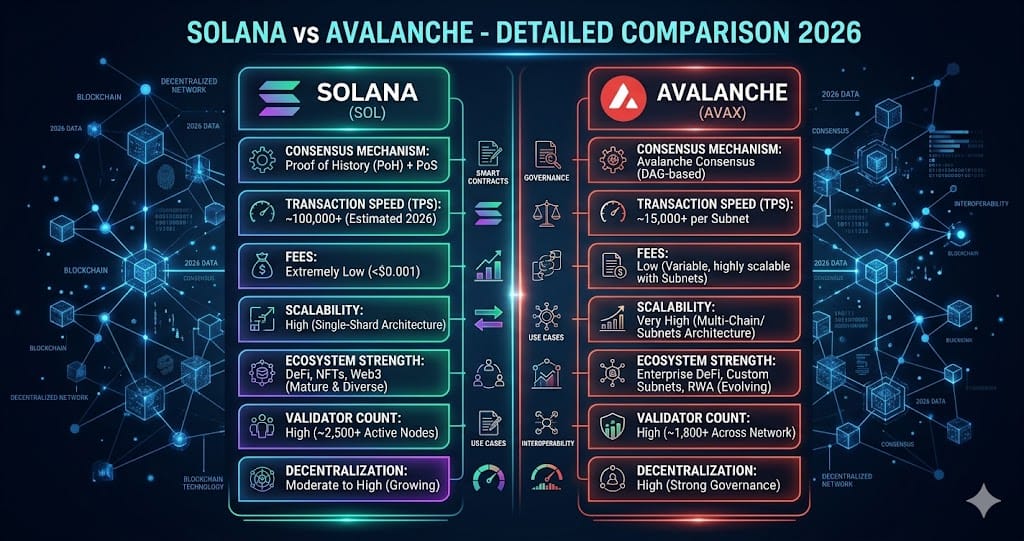
Solana is built for high-throughput consumer applications and handles far greater transaction demand at scale. Avalanche focuses on customizable subnet architectures for modular blockchain deployments. Solana trades at $86.65, down -1.1% in the last 24h with $155.1M in volume. Avalanche sits at $9.40 with the same -1.1% daily change but only $17.6M in volume, per CoinGecko.
Both assets are in a low-momentum market phase where volume divergence is widening liquidity gaps — visible across the past 7 days of trading activity per CoinMarketCap snapshot data. Solana's higher liquidity favors active traders seeking short-term positioning. Avalanche's thinner participation makes its price more sensitive to swings under current 2026 market conditions.
Quick Comparison
| Feature | Solana | Avalanche |
|---|---|---|
| Price | $86.65 | $9.40 |
| Market Cap | — | — |
| 24h Change | -1.1% | -1.1% |
| 24h Volume | $155.1M | $17.6M |
| Rank | #undefined | #undefined |
Technology & Features
Solana and Avalanche use different technical foundations. Solana's architecture prioritizes speed through Proof of History sequencing, while Avalanche uses a three-chain structure — X-Chain, C-Chain, and P-Chain — to separate transaction types. That separation shapes what each network handles well.
Both platforms support smart contracts and DeFi applications, but their implementations differ. Solana uses Rust-based programs with low per-instruction fees, while Avalanche's C-Chain is EVM-compatible, letting Ethereum developers deploy without rewriting code.
✅ Pros
- Solana offers strong core functionality
- Solana has a well-established ecosystem
❌ Cons
- Solana may have higher entry barriers
- Solana can be complex for beginners
Fees & Value
Solana fees average fractions of a cent per transaction — often under $0.001. Avalanche's C-Chain fees are higher and more variable, typically ranging from $0.01 to $0.10 depending on network congestion. For high-frequency trading or microtransactions, Solana is cheaper at current usage levels.
Solana fits use cases requiring high transaction throughput at minimal cost — payments and NFT minting especially. Avalanche suits developers who need EVM compatibility or want to launch application-specific subnets. The choice comes down to whether you need raw speed or Ethereum ecosystem compatibility.
✅ Pros
- Avalanche provides competitive pricing
- Avalanche offers good value for active users
❌ Cons
- Avalanche fees can add up for low-volume users
- Avalanche may have hidden costs
User Experience
Solana's ecosystem centers on wallets like Phantom and Backpack, which have iterated rapidly on UX. Avalanche's Core wallet supports subnet assets natively. Solana's developer tooling — including the Solana Playground browser IDE — has a broader base of tutorials and community documentation as of 2026.
Solana has shipped several performance upgrades since 2023, with the Firedancer validator client developed by Jump Crypto as its most consequential work in progress. Avalanche's recent Avalanche9000 upgrade significantly cut the cost of launching subnets. Both chains are in active development, but Firedancer's mainnet rollout is the higher-stakes near-term milestone.
✅ Pros
- Strong community and support resources
- Intuitive interface for common operations
❌ Cons
- Learning curve for advanced features
- Customer support response times vary
Solana (SOL) Resources
Avalanche (AVAX) Resources
Ready to start trading?
Trade on Bitget Try CoinTech2uAffiliate links — we may earn a commission at no extra cost to you.
Final Verdict
Solana leads on liquidity and trading activity with $155.1M in 24h volume versus Avalanche's $17.6M, per CoinMarketCap data as of May 23, 2026. Both are down -1.1% in 24h, but Solana's volume signals stronger speculative interest. Avalanche is cheaper at $9.40 versus Solana's $86.65 per CoinGecko as of May 23, 2026, but the lower price isn't backed by usage — its volume is nearly 9x lower. Solana holds a stronger liquidity profile while Avalanche shows thin participation despite the lower entry point. Solana is the stronger momentum asset. Avalanche carries higher price-swing risk from lower participation. With volume divergence intact, Solana is better positioned to hold relative strength.
Frequently Asked Questions
Which is better, Solana or Avalanche?
It depends on your needs. Solana excels in certain areas while Avalanche has its own strengths. Consider what features matter most to you.
Can I use both Solana and Avalanche?
Yes, many crypto users diversify across multiple platforms. Using both lets you take advantage of each one's strengths.
Is Solana safe?
Solana is a well-established option in the crypto space. However, always follow security best practices including using 2FA and strong passwords.
Which has lower fees?
Fee structures vary depending on usage. Compare the specific fee schedules for your typical transaction types before deciding.
Related Articles
- Bitcoin vs Ethereum — Detailed Comparison 2026
- Kraken vs KuCoin — Detailed Comparison 2026
- Solana vs Avalanche — Detailed Comparison 2026